India’s 2020-21 Border-Gavaskar Trophy campaign became one of the most memorable comebacks in Test cricket, but the story could easily have ended in disappointment after the opening match in Adelaide. India were dismissed for just 36 runs in their second innings, suffered a crushing defeat and faced widespread doubts about their chances of competing in Australia.
Ajinkya Rahane, who took over the captaincy after Virat Kohli returned to India, has since revealed the emotional challenge behind the team’s recovery. Speaking at an event in Mumbai, Rahane admitted that he was nervous after the Adelaide defeat. However, he believed he needed to project confidence in front of his teammates, Australian opponents and the media.
His approach was not simply about hiding personal anxiety. Rahane encouraged his players to view representing India as a privilege and to fight for those who had not received an opportunity to play international cricket. That message became part of the team’s response as India recovered from their opening defeat, won the Melbourne Test, survived injuries and eventually secured a historic victory at the Gabba in Brisbane.
The series remains a powerful example of how leadership, adaptability and contributions from players outside the established first-choice lineup can change the course of a sporting contest.
India’s Adelaide collapse changed the entire series
The opening Test of the 2020-21 Border-Gavaskar Trophy took place in Adelaide under lights, with the pink ball introducing its own challenges for both batting lineups. India had competed well during the first innings and were still in contention after the two teams completed their initial turns at the crease.
However, India’s second innings unravelled dramatically. Australia’s bowlers exploited the conditions, and the Indian batting lineup failed to cope with the pressure. The visitors were dismissed for 36, their lowest total in Test cricket history at the time.
The collapse transformed a competitive match into a damaging defeat. Australia won the first Test by eight wickets, taking a 1-0 lead in the four-match series.
The scoreline was especially alarming because India had entered the contest with expectations of challenging Australia. Instead, the batting collapse raised questions about the team’s technique, confidence and ability to recover against a strong home side.
Rahane recalled the atmosphere that followed the defeat, explaining that public discussion quickly shifted towards the possibility of a complete Australian sweep.
“We lost the game in Adelaide and then everyone started talking about that ‘India will probably lose 4-0’ and ‘there is no chance for the Indian team,” Rahane recalled.
The prediction reflected the mood surrounding the team after such a heavy loss. Yet a four-Test series offered India opportunities to respond, provided the players could move beyond the psychological damage of Adelaide.
Why Rahane had to hide his nervousness from the team
Taking over as captain after a defeat of that magnitude was a difficult assignment. Rahane was not only responsible for his own performance but also had to help his teammates regain their confidence before the second Test.
Virat Kohli had announced before the tour that he would return to India after the opening Test for the birth of his first child. His departure meant Rahane, who had been Kohli’s deputy, would lead India for the remaining three matches.
The timing made the leadership transition particularly challenging. India had just suffered a devastating defeat, public expectations had shifted sharply, and the team needed to find a way to compete against Australia without allowing one disastrous innings to define the entire series.
Rahane has now acknowledged that he was genuinely nervous about the situation. Rather than allowing that anxiety to become visible in the dressing room, however, he decided to project confidence.
“I was nervous, frankly. I will be really honest. But as a sportsperson, you get to learn so many things and the most important learning and the most important thing for me was to bluff in front of my teammates, bluff in front of the Aussies, and bluff in front of the media,” Rahane said.
His use of the word “bluff” describes the difference between what he felt internally and what he wanted others to see. He was not claiming that the team had no problems. Instead, he understood that visibly surrendering to doubt could make an already difficult situation worse.
In cricket, confidence can influence how players approach a difficult spell, respond to pressure and recover after making mistakes. A captain cannot eliminate uncertainty, but the way he responds to it can affect the atmosphere around the team.
Rahane’s approach was particularly relevant after Adelaide because India needed to prepare for another Test rather than spend the remaining series reliving the previous defeat.
Rahane’s message: Play for the opportunity to represent India
Rahane’s response went beyond telling his teammates to remain positive. He reminded them that representing India was an opportunity many talented cricketers hoped to receive but never experienced.
During his conversation with the players, he asked them to appreciate their position and remember those who had not been selected to play for the national team, along with aspiring cricketers who hoped to represent India in the future.
“We are the lucky ones to be here representing our country. There are so many guys wanting to play for India, but at times, luck plays a massive part in our careers,” Rahane recalled telling his teammates.
He also encouraged the squad to play for those players who had never received an opportunity at international level and those who were still working towards that goal.
The message shifted the emphasis away from the fear of losing. Instead of treating the remaining matches as a test of whether India could avoid a humiliating series defeat, Rahane wanted his players to concentrate on the privilege and responsibility of wearing the national jersey.
This was a practical leadership choice. Players cannot control every match situation, an opponent’s performance or the consequences of an unexpected injury. They can, however, control their preparation, effort, communication and response to setbacks.
By focusing on those responsibilities, Rahane gave the team a way to approach the remaining matches without becoming overwhelmed by the possibility of losing the series.
Melbourne Test: Rahane’s century begins India’s recovery
India’s response arrived in the second Test at the Melbourne Cricket Ground, where Rahane delivered one of the defining performances of his captaincy.
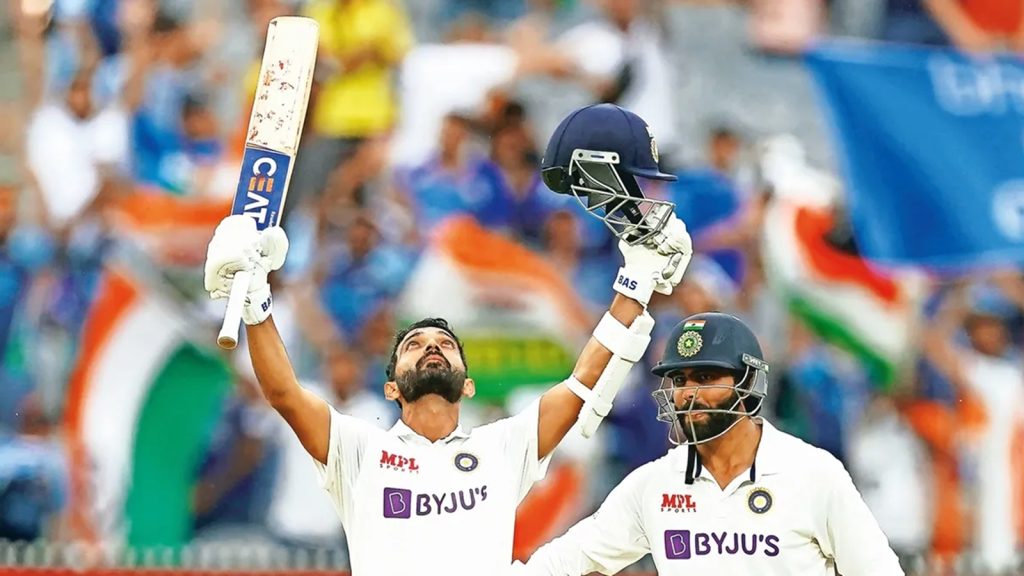
After Australia won the toss and elected to bat, India bowled the hosts out for 195 in the first innings. Rahane then scored 112 runs, providing stability and taking control of the contest when India needed a substantial response.
His century was especially significant because it came immediately after the Adelaide collapse. Rather than allowing the previous defeat to dictate his approach, Rahane produced a composed innings that helped India establish a first-innings lead of 131 runs.
Australia were dismissed for 200 in their second innings, leaving India a target of 70. The visitors reached it with eight wickets remaining, securing an eight-wicket victory and levelling the four-Test series at 1-1.
The result did not erase the Adelaide defeat, but it changed the direction of the series. India had demonstrated that they could respond to pressure, compete with Australia and win a Test despite the difficult circumstances surrounding the team.
Rahane’s innings also showed why his captaincy and batting performance mattered together. His century provided runs on the scoreboard while reinforcing the message that the team could recover through disciplined cricket.
Sydney Test: India show resilience under pressure
The third Test at the Sydney Cricket Ground presented a different challenge. Australia took control of significant portions of the match, and India faced another demanding test of their batting depth and ability to withstand pressure.
Australia scored 338 in their first innings before India replied with 244. The hosts then declared their second innings at 312 for six, setting India a target of 407 runs.
India’s pursuit became increasingly difficult as wickets fell, but the visitors refused to give up. Rishabh Pant scored 97, while Cheteshwar Pujara made 77. In the final stages, Ravichandran Ashwin and Hanuma Vihari resisted Australia’s bowling attack, with Vihari batting through injury, to help India secure a draw.
The match ended with India at 334 for five in their second innings. Although the visitors did not win, surviving the contest kept the series alive and prevented Australia from taking an unassailable lead.
The Sydney result also reinforced an important feature of India’s recovery: the comeback was not built exclusively on one captain’s century or a single outstanding performance. Different players contributed at different stages, depending on what the match required.
India entered the final Test with the series level at 1-1. The team now had an opportunity to win the Border-Gavaskar Trophy, but it would have to do so at one of Australia’s most challenging venues.
Gabba victory: India complete a historic comeback
The fourth Test in Brisbane became the defining chapter of the series. Australia had not lost a Test at the Gabba since 1988, giving the venue a formidable reputation in Australian cricket.
India arrived with a squad severely affected by injuries. Several first-choice players had been ruled out or were unavailable, leaving the team with fewer established options as the series reached its decisive match.
Despite those setbacks, India competed throughout the Test. Australia scored 369 in their first innings, while India responded with 336, keeping the contest competitive.
Australia then made 294 in their second innings, setting India a challenging target of 328 runs to win. The task required sustained batting against an Australian attack on its home ground, with a series victory at stake.
India eventually reached 329 for seven to win by three wickets on the final day. Shubman Gill scored 91, Cheteshwar Pujara made 56, and Rishabh Pant finished unbeaten on 89, guiding India to a victory that secured the series 2-1.
The result ended Australia’s 32-year unbeaten run in Test cricket at the Gabba. More importantly for India, it completed a comeback that had appeared unlikely after the 36-run collapse in Adelaide.
The victory also demonstrated the value of squad depth. Players who were not necessarily expected to carry the team’s hopes at the beginning of the tour stepped into important roles as injuries changed the lineup.
How injuries tested India’s leadership and team spirit
Rahane’s recent recollection highlights another difficulty that made the Australian tour remarkable: India had to keep adapting as players became unavailable.
He recalled that two or three players were getting injured after successive matches and described the situation at Brisbane as particularly demanding. According to Rahane, the team eventually reached a point where it had only 11 players available for the final Test.
That recollection illustrates the pressure on the leadership group. When injuries disrupt a team, the challenge is not limited to finding replacements. Players must adjust to unfamiliar combinations, new responsibilities and changes in the balance between batting and bowling.
Those circumstances also make it difficult to maintain continuity across a series. A player who performs one role in the opening match may have to take on a different responsibility later, while less experienced teammates may suddenly find themselves facing high-pressure situations.
India’s victory at Brisbane was therefore not simply a story of recovering from a low score. It was also a demonstration of how a team can adapt when its original plans become impossible to maintain.
Rahane’s emphasis on playing for one another reflected this reality. When the available resources are limited, individual performances become more valuable, but cooperation becomes even more important.
Why Rahane’s ‘bluff’ matters beyond cricket
Rahane’s account offers an interesting distinction between confidence and the absence of fear. He did not claim that he felt completely comfortable after Adelaide. Instead, he acknowledged his nervousness while explaining why he chose not to let it define his leadership.
That distinction matters because leadership is often judged by how someone responds when circumstances are uncertain. A captain may have doubts about the outcome, but the team still needs clear communication, a practical plan and someone willing to accept responsibility.
Rahane also made a point of telling his teammates that he would take responsibility for the outcome. That message could help reduce the pressure individuals feel when they make mistakes or find themselves in difficult situations.
However, his experience should not be interpreted as evidence that leaders must always conceal their emotions. The more useful lesson is that personal anxiety does not have to determine collective behaviour. A leader can acknowledge uncertainty privately while helping the group focus on decisions within its control.
There is also a difference between projecting confidence and ignoring problems. India’s recovery required changes in performance, contributions from multiple players and the ability to respond to changing match situations. A positive message alone could not have produced the Melbourne and Brisbane victories.
Rahane’s approach worked alongside the team’s cricketing execution. His leadership helped frame the challenge, while the players still had to perform under pressure to achieve the result.
2020-21 Border-Gavaskar Trophy: The key results
The four-Test series produced a dramatic shift in momentum, from Australia’s opening victory to India’s eventual triumph. The following results explain how the visitors recovered after Adelaide.
| Test | Venue | Result | Significance |
|---|---|---|---|
| First Test | Adelaide | Australia won by eight wickets | India were dismissed for 36 in their second innings. |
| Second Test | Melbourne | India won by eight wickets | Rahane scored 112 as India levelled the series. |
| Third Test | Sydney | Match drawn | India resisted Australia’s attempts to force a result. |
| Fourth Test | Brisbane | India won by three wickets | India chased 328 to secure a 2-1 series victory. |
The results show why the Melbourne victory was so important. It restored balance after Adelaide, while the Sydney draw ensured that India remained in contention before the decisive match at Brisbane.
What happened after Adelaide? The lasting lesson from India’s comeback
Rahane’s latest comments bring attention back to the emotional side of India’s 2020-21 Australian tour. The 36 all-out defeat remains a striking moment in the team’s history, but it was not the final word on the series.
Rahane admitted that he was nervous when responsibility fell on him. He also explained how he tried to maintain confidence among his teammates by reminding them of the privilege of representing their country and encouraging them to play for those who dreamed of earning the same opportunity.
India subsequently won in Melbourne, held on for a draw in Sydney and completed a remarkable victory at Brisbane. The 2-1 series triumph was achieved despite injuries and the absence of several key players.
The wider lesson is that a setback does not automatically determine what happens next. Recovery depends on how a team responds, how effectively its leaders communicate and whether its players can translate belief into performance.
Rahane’s “bluff” was his way of keeping doubt from becoming the defining emotion in the dressing room. The team’s eventual success gave that approach a memorable outcome, although the victories themselves came through collective effort, individual skill and resilience under pressure.
For Indian Cricket, the series remains a reminder that even after a historic collapse, a team can still find a path back. For Rahane, it stands as a defining chapter of his captaincy, built on an honest admission: he was nervous, but he chose to lead anyway.
For breaking news and live news updates, like us on Facebook or follow us on Twitter and Instagram. Read more on Latest Cricket on thefoxdaily.com.






COMMENTS 0