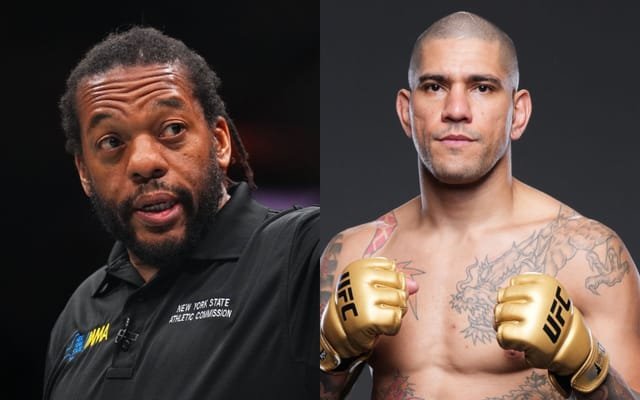
Alex Pereira has clarified why his frustration after UFC Freedom 250 was aimed at referee Herb Dean rather than Ciryl Gane. Pereira believes fighters can lose track of what is happening during an intense exchange because adrenaline and momentum take over, but he argues that the referee has a different responsibility inside the Octagon.
Pereira and Gane met in an interim heavyweight title fight at the UFC’s White House event in June. The bout marked Pereira’s heavyweight debut, but his move up in weight ended in disappointment when Gane stopped him with a second-round knockout.
The result itself was not the only reason the fight continued to generate discussion. Pereira later criticized Dean’s officiating, arguing that he had been hit by strikes to the back of the head that should have been identified as fouls.
That criticism raised an obvious question: if the shots were illegal, why was Pereira angry with the referee rather than Gane?
Pereira’s latest explanation provides a clearer answer. The former light heavyweight champion believes responsibility for enforcing the rules belongs primarily to the official, particularly when fighters are operating under extreme physical and emotional pressure.
Why Alex Pereira blamed Herb Dean after the Ciryl Gane fight
Pereira explained that he understands why fighters can commit mistakes during a fight. Both competitors are dealing with adrenaline, fatigue, movement, reactions and the immediate pressure of surviving and attacking.
In his view, that makes it unreasonable to expect a fighter to stop in the middle of an exchange and accurately determine whether an opponent’s strike has crossed the legal boundary.
That responsibility falls on the referee.
Speaking to The Mac Life, Pereira explained that he felt a legal strike and then experienced what he believed were illegal blows. His argument was not necessarily that Gane deliberately attempted to cheat him. Instead, Pereira emphasized the distinction between what a fighter experiences during an exchange and what an official is expected to observe.
His comments essentially separate intent from responsibility. A fighter may be acting instinctively during a scramble, while the referee is specifically tasked with monitoring the action and enforcing the unified rules.
Pereira says fighters are too emotional to police every foul
The former UFC champion’s explanation revolves around one of the fundamental challenges of combat sports: fighters do not experience a bout the same way an official does.
A fighter is trying to win. That means attacking openings, defending takedowns, escaping dangerous positions and reacting to an opponent’s movements in fractions of a second.
During those moments, a fighter may not even know exactly where every strike lands.
Pereira acknowledged this reality by pointing out that mistakes happen during fights. His argument is that the referee has a different role because the official is not supposed to be making decisions based on the same emotional involvement as the competitors.
That distinction becomes particularly important during chaotic grappling sequences, where the fighters’ heads can move rapidly and legal and illegal target areas may briefly overlap.
What Pereira said about the strikes
Pereira described feeling the impact of the punches and suggested that he could perhaps have recovered better from some of the exchanges. However, he also maintained that the fight included both legal and illegal blows.
That admission makes his argument more nuanced than simply claiming that every significant strike he received was illegal.
He recognized that Gane landed legitimate offense and that he had opportunities to respond differently. At the same time, Pereira believed some shots crossed the line and that Dean should have intervened when necessary.
This distinction matters because a fighter can accept that an opponent fought well while still questioning whether specific moments were officiated correctly.
Ciryl Gane was too effective for Pereira to overcome
Although the officiating controversy remains part of the discussion, it should not obscure the central sporting result.
Gane defeated Pereira by second-round knockout, ending Pereira’s heavyweight debut with a decisive result.
Gane’s striking presented significant problems for Pereira throughout the contest. Moving up in weight meant Pereira was dealing with a larger opponent while also adjusting to the physical demands of heavyweight competition.
The defeat demonstrated one of the biggest challenges associated with changing weight classes in MMA: success at one division does not automatically translate into another.
Pereira entered heavyweight with a reputation built around elite striking and devastating power. But Gane’s own striking ability and size presented a different tactical puzzle.
The loss therefore offers Pereira more than one lesson. He must evaluate his performance, his defensive reactions and his ability to deal with heavyweight opponents, while separately considering the officiating issues he believes affected the contest.
Dana White supported Pereira’s concern about illegal strikes
Pereira’s criticism of Dean received an important response from UFC CEO Dana White.
White said he also believed that Pereira had been hit by strikes to the back of the head during the fight. At the same time, White acknowledged the difficulty of identifying fouls in the middle of fast-moving exchanges.
That is a significant distinction.
White did not portray the situation as proof that Gane intentionally attempted to break the rules. Instead, he pointed out that fighters can be moving and scrambling rapidly, meaning fouls can occur during the action.
White also defended Pereira’s credibility, emphasizing that the Brazilian is not generally known for making excuses after defeats.
That part of White’s response is important because Pereira’s criticism came immediately after a clear loss. When a fighter challenges officiating after being knocked out, the accusation can easily be interpreted as an attempt to explain away the result.
White’s comments pushed back against that interpretation by suggesting that Pereira’s reputation for accepting difficult outcomes made his complaint worth taking seriously.
Why the referee’s role is different from the fighter’s role
The Pereira-Dean controversy illustrates a fundamental principle in combat sports officiating.
Fighters are responsible for competing within the rules, but referees are responsible for enforcing those rules in real time.
That does not mean every foul is deliberate or that every missed infraction changes the outcome of a fight. It means that the official has the vantage point and authority required to intervene when a clear violation occurs.
In a high-speed MMA exchange, that can be extremely difficult.
Unlike sports where the action happens within a clearly defined area and at a relatively predictable pace, MMA can transition from striking to grappling almost instantly. Fighters can rotate, fall, scramble and change positions while throwing strikes.
The referee therefore has to make decisions under intense time pressure.
Why strikes to the back of the head are such a sensitive issue
Strikes to the back of the head are treated differently from many other legal attacks because of the vulnerable area involved.
That creates a difficult officiating challenge. The target can shift during a scramble, and a strike initially aimed at a legal area can land somewhere illegal when an opponent moves.
There is also a difference between a deliberate foul and an accidental or incidental one.
This is why referees often have to judge not only where a strike landed but also the circumstances surrounding it. Was the fighter moving? Was the opponent turning? Was the strike directed toward a legal target before the position changed?
These questions can become extremely difficult to answer instantaneously.
Pereira’s comments do not necessarily accuse Gane of deliberate cheating
One of the most important takeaways from Pereira’s explanation is that his criticism should not automatically be interpreted as an accusation that Gane intentionally cheated.
Pereira explicitly acknowledged that mistakes happen in fights and recognized the effects of adrenaline and the intensity of competition.
His criticism was directed toward the person he believed should have been responsible for identifying and managing the fouls.
That distinction could help explain why Pereira chose to direct his frustration toward Dean.
From Pereira’s perspective, Gane was fighting under the same chaotic conditions he was. The referee, however, had the specific responsibility of monitoring whether the action remained legal.
The bigger challenge: separating officiating from the result
Another important question is how much the disputed strikes affected the final outcome.
That is much harder to determine.
Pereira was stopped in the second round, meaning the fight did not go to the judges’ scorecards. Even if some illegal strikes occurred, assessing exactly how much they influenced the eventual knockout requires more than simply identifying a foul.
This is where post-fight analysis becomes complicated.
A foul can be real without necessarily being the decisive factor in a fight. Conversely, a single illegal strike can potentially have a major impact if it significantly changes a fighter’s condition or ability to defend.
Without making assumptions about the exact effect of the strikes, the safest conclusion is that Pereira believes the officiating should have been better while accepting that Gane also landed legitimate offense.
Pereira’s heavyweight debut creates another major storyline
The fight also represented a major moment in Pereira’s career because he stepped into the heavyweight division after establishing himself as one of the most dangerous strikers in MMA.
Moving between divisions is not simply a matter of gaining or losing weight. Fighters must adjust to differences in speed, power, durability and physical strength.
Heavyweight can be particularly unforgiving because one clean strike can dramatically alter a fight.
Gane’s victory therefore showed the danger of assuming that a successful fighter’s previous strengths will automatically dominate against larger opponents.
For Pereira, the next stage will involve determining whether heavyweight is a sustainable long-term destination or whether his best path remains elsewhere.
Gane now has a major opportunity ahead
With his victory over Pereira, Gane strengthened his position in the heavyweight division and is expected to face champion Tom Aspinall next.
That potential matchup would present another fascinating stylistic test.
Aspinall’s combination of speed, athleticism and finishing ability would give Gane a completely different challenge from the one Pereira presented.
The Gane-Pereira result also means that the Brazilian’s heavyweight experiment did not immediately produce the title opportunity he may have hoped for.
Instead, Gane has emerged from the fight with momentum and a path toward the championship.
Comparison: Pereira’s reaction versus a typical post-fight excuse
| Aspect | Pereira’s explanation | Why it matters |
|---|---|---|
| Opponent’s performance | Acknowledged legal strikes and the difficulty of the fight | Shows he is not dismissing Gane’s victory entirely |
| Illegal strikes | Argued that some blows landed illegally | Focuses on officiating rather than denying the result |
| Referee criticism | Directed frustration toward Herb Dean | Reflects the referee’s responsibility to enforce the rules |
| Personal responsibility | Admitted he may have recovered better from certain shots | Recognizes that fighters also make mistakes |
| Dana White’s response | White agreed that back-of-the-head strikes occurred | Added credibility to Pereira’s concern while noting the difficulty of officiating |
What Alex Pereira can learn from the defeat
Despite the controversy, Pereira’s most important task is likely to be studying the fight itself.
The heavyweight division demands careful risk management because the power of the opponents can change the consequences of defensive mistakes.
Pereira has elite striking credentials, but his move to heavyweight will require him to determine how his style works against larger fighters with their own high-level technical skills.
His comments about Dean should therefore be viewed as only one part of his post-fight evaluation.
The more important long-term questions concern his defense, positioning, physical adaptation and ability to manage exchanges against heavyweight opponents.
Why the controversy will likely continue
The Pereira-Gane fight has several ingredients that naturally create prolonged debate: a former champion moving up in weight, a knockout finish, disputed strikes and criticism of an experienced referee.
Those elements guarantee that fans will continue to analyze individual moments from the bout.
However, the controversy should not erase the broader reality that Gane won the fight and earned the opportunity to move forward in the heavyweight title picture.
Pereira’s explanation also gives the debate more nuance. Rather than simply blaming Gane, he has explained why he believes the referee should have been the person to address the alleged fouls.
Conclusion: Pereira separates Gane’s victory from his frustration with officiating
Alex Pereira’s latest comments clarify that his anger after UFC Freedom 250 was directed at Herb Dean because he believes referees, rather than fighters caught in the intensity of competition, are responsible for identifying and stopping illegal strikes.
Pereira acknowledged that fighters make mistakes under pressure and even admitted that he might have recovered better from some of the legal offense he absorbed. His complaint centered specifically on the blows he believes landed illegally and the failure to intervene.
Dana White’s response added another important layer, with the UFC CEO agreeing that Pereira appeared to have taken strikes to the back of the head while also recognizing how difficult it can be for officials to identify fouls during chaotic exchanges.
Ultimately, the controversy does not change the result: Ciryl Gane stopped Pereira in the second round and moved closer to a heavyweight title opportunity against Tom Aspinall.
For Pereira, the defeat offers a more complicated lesson. He must evaluate both the officiating and his own performance as he considers his future at heavyweight.
The next chapter will determine whether UFC Freedom 250 was simply a difficult heavyweight debut or the beginning of a new phase in Pereira’s career.
For breaking news and live news updates, like us on Facebook or follow us on Twitter and Instagram. Read more on Latest MMA on thefoxdaily.com.






COMMENTS 0