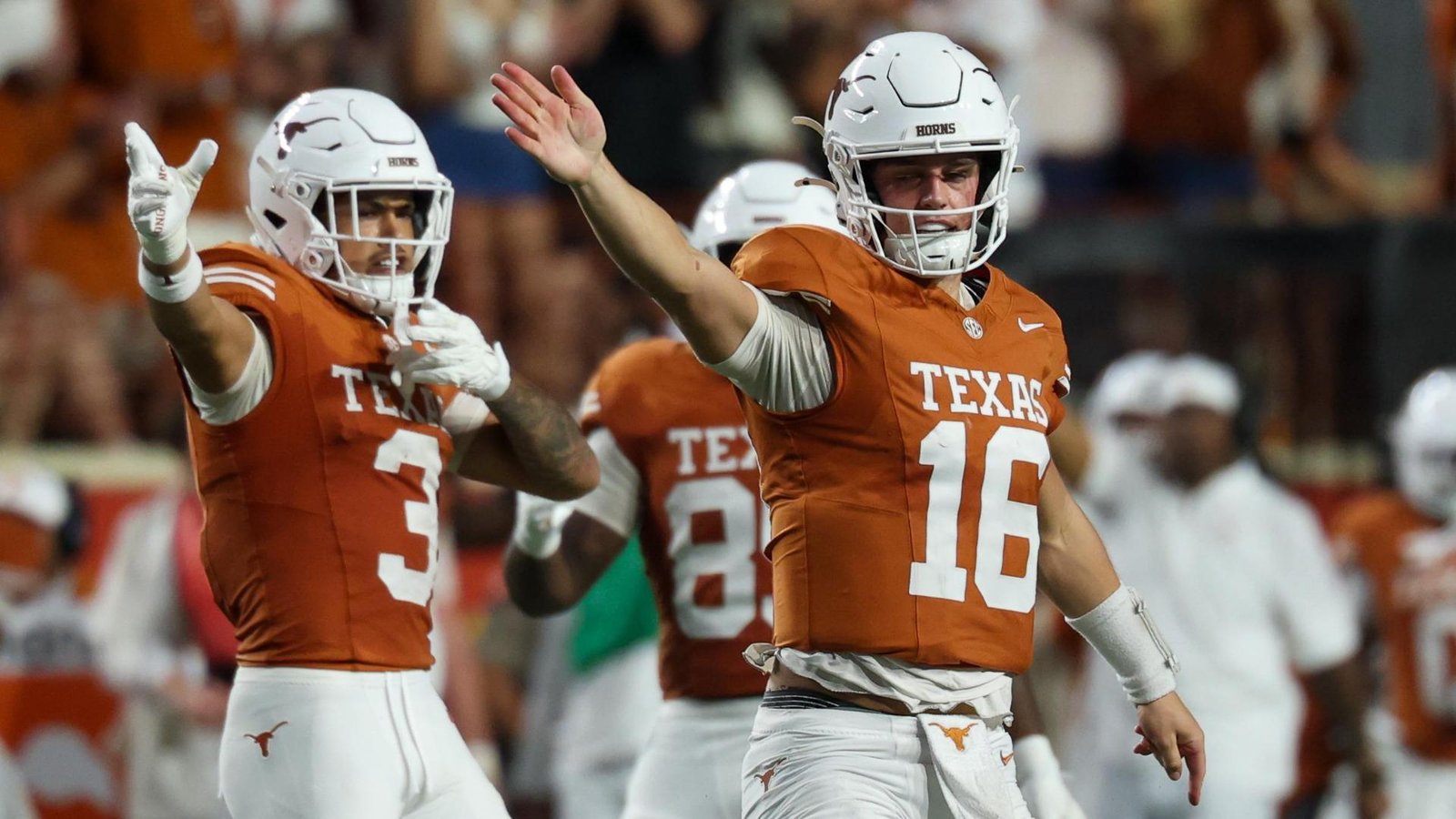
Texas Longhorns coach Steve Sarkisian praised Arch Manning’s combative mentality after the quarterback helped lead his team to a tense 34-27 victory over No. 7 Ole Miss in Week 8. Following consecutive losses to Oklahoma and Florida, Manning responded to mounting criticism with a determined performance that included two rushing touchdowns and a crucial late-game score.
Manning finished with 212 passing yards and a touchdown through the air, completing 18 of 30 attempts. Although three turnovers threatened to undermine his performance, the young quarterback showed resilience as Texas held on for a much-needed win at home in Austin.
Sarkisian had challenged Manning to improve following the defeat to Florida, calling for a better version of his quarterback. The coach said he was encouraged by the response, particularly Manning’s confidence, competitiveness and willingness to use his legs when the offense needed a spark.
The victory was significant for more than just the result. Texas needed to restore confidence after two disappointing defeats, while Manning was under intense scrutiny over his performances and his position as the team’s starting quarterback. Against a highly ranked Ole Miss team, he showed both the promise and the inconsistencies that have defined his season.
Steve Sarkisian Likes Arch Manning’s Newfound Edge
Sarkisian revealed before the Ole Miss game that Manning had spent the week playing with an extra edge after being challenged following Texas’ back-to-back losses. The coach welcomed the change in attitude, believing the quarterback performs best when he embraces his competitive instincts and plays with confidence.
After Texas secured the victory on Saturday night, Sarkisian made clear that he appreciated the mentality Manning brought to the contest.
“One thing I know about Arch Manning, he’s a fighter. I like the edgy, kind of borderline arrogant, full-of-swagger Arch. I just feel like that’s when he’s at his best.”
The comments reflected the coach’s belief that Manning needs to trust his instincts rather than become overly cautious under pressure. For a quarterback whose name attracts significant attention, the challenge is balancing confidence with sound decision-making, particularly when opponents are determined to exploit mistakes.
A response to criticism after consecutive defeats
Texas entered the Ole Miss matchup needing a strong performance after losing to Oklahoma and Florida. Those results intensified questions about the team’s direction and Manning’s ability to deliver consistently at quarterback.
Sarkisian had publicly challenged his quarterback after the Florida loss, raising the stakes ahead of the meeting with Ole Miss. Manning later revealed that the defeat had affected him deeply. He visited his family on Sunday and admitted that he had nearly broken down emotionally while processing the setback.
That reaction offered a glimpse into the pressure surrounding a player who entered College Football with enormous expectations. Manning’s family name has kept him in the national spotlight, making every strong performance a headline and every mistake a subject of widespread discussion.
Rather than retreat from that attention, Manning said he used the possibility of being overlooked as motivation. He was aware of reports that freshman backup KJ Lacey had received additional first-team practice repetitions during the week, adding another layer of uncertainty to his position.
Manning said he was accustomed to being hyped throughout his career and suggested that being doubted could bring out the best in him. His response demonstrated a willingness to embrace the challenge, even as questions about his consistency remained.
Arch Manning Delivers Two Rushing Touchdowns Against Ole Miss
Manning’s performance against Ole Miss featured several impressive moments, particularly when Texas needed him to make plays with his legs. While his passing production declined after halftime, his ability to contribute as a runner helped the Longhorns maintain their advantage during a difficult second half.
He finished the game with 18 completions from 30 attempts for 212 yards and one passing touchdown. He also scored twice on the ground, giving Texas an additional offensive dimension that proved important as Ole Miss mounted its comeback.
A memorable touchdown put Texas back in control
One of Manning’s most notable moments came on a naked bootleg that ended with him high-stepping into the end zone. The play gave Texas a 31-24 lead with 8:04 remaining and drew comparisons to a similar touchdown by his uncle Peyton Manning during his college career.
The score was particularly important because it came immediately after Manning’s second interception. The Longhorns could have struggled to recover from another turnover, but instead they responded with a six-play, 80-yard drive that restored their momentum.
Manning admitted that he had failed to see the cornerback who moved into position to intercept his overthrown pass down the right side. The mistake highlighted the decision-making issues that remain part of his development, but his subsequent response was precisely the kind of resilience Sarkisian wanted to see.
The quarterback’s running ability also gave Texas another way to attack a defense that had begun to disrupt the passing game. Rather than forcing difficult throws, the Longhorns increasingly relied on their ground attack to protect the lead.
Turnovers remain a concern despite the victory
For all the positives, Manning’s three turnovers prevented the performance from being an entirely convincing display. He lost a fumble after taking a blindside hit and threw two interceptions, giving Ole Miss opportunities to recover after falling behind early.
Sarkisian defended his quarterback by pointing to the quality of the Rebels’ defensive plays. However, the turnovers still illustrated the risks Texas faces when its offense becomes too dependent on Manning making difficult decisions under pressure.
Against a strong opponent, such errors can quickly change the course of a game. Texas survived them against Ole Miss, but the team will need to reduce costly mistakes if it hopes to remain competitive against the country’s leading programs.
The encouraging sign for Sarkisian was that Manning did not allow the interceptions to define the rest of his night. He continued competing, scored with his legs and helped Texas execute a more conservative offensive approach late in the game.
Texas Running Game Helps Prevent Another Late Collapse
Texas’ ground attack played a major role in securing the victory. After building a 24-3 halftime lead, the Longhorns watched Ole Miss erase much of that advantage. The response was to rely increasingly on the running game, limiting the number of opportunities for the Rebels to force another turnover through the passing attack.
With Hollywood Smothers unavailable because of an injury, Raleek Brown took on a larger role and delivered one of his most productive performances in a Texas uniform. Brown carried the ball 23 times for 157 yards, providing the physical presence the Longhorns needed to control the closing stages.
Raleek Brown provides a crucial offensive boost
Brown’s performance was particularly notable given his limited workload in Texas’ previous losses to Oklahoma and Florida. He had received just five carries against Oklahoma and eight against Florida, but the opportunity against Ole Miss allowed him to become a central part of the offensive plan.
His production helped Texas finish with 207 rushing yards, averaging 4.9 yards per carry. That represented a substantial improvement over the team’s season averages entering the contest, when the Longhorns had been gaining 136 rushing yards per game at 3.6 yards per attempt.
The improved ground game gave Texas a way to manage the clock and reduce the pressure on Manning. With Brown consistently gaining yards, the Longhorns could avoid asking their quarterback to make repeated high-risk throws as the game approached its conclusion.
Following Manning’s second interception, Texas used 12 rushing plays and attempted just one more pass for the remainder of that stretch. The pass was a short completion to Ryan Wingo behind the line of scrimmage, which resulted in a three-yard gain.
The approach reflected a clear tactical adjustment. Rather than continue relying on a passing game that had produced costly turnovers, Texas leaned on its running backs and attempted to make Ole Miss defend the entire field.
Why the rushing attack matters going forward
Texas’ ability to run the ball effectively offers an important lesson for the remainder of the season. Manning’s arm talent and mobility make him a central figure in the offense, but the Longhorns are better positioned when opposing defenses must account for a productive ground game as well.
A balanced offense can help limit the consequences of an inconsistent passing performance. It also gives Texas more options in close games, allowing Sarkisian to adjust the game plan according to the opponent’s defensive approach.
Brown’s breakout showing does not guarantee that Texas will produce similar numbers every week, but it provides a promising alternative when the passing attack struggles. If the Longhorns can maintain that balance, Manning may face fewer situations in which he must force a difficult throw to keep the offense moving.
Ole Miss Nearly Completes a Dramatic Comeback
Despite Texas’ commanding start, Ole Miss made the closing stages uncomfortable for the home team. The Rebels took advantage of the Longhorns’ mistakes and continued to attack after falling behind by 21 points at halftime.
A strip sack of Manning for a touchdown at the start of the third quarter helped shift the momentum. Ole Miss continued applying pressure and eventually tied the game before Texas regained the lead.
The Longhorns appeared to have created enough separation when Manning scored on his bootleg, but the Rebels remained within reach. A late field goal cut Texas’ lead to 34-27 with 1:22 remaining, leaving Ole Miss needing a final possession to force a potential tie.
Texas survives a tense final possession
Ole Miss recovered the ensuing onside kick and began its final drive from its own 37-yard line. Quarterback Trinidad Chambliss moved the Rebels into Texas territory, setting up a last opportunity to send the game into overtime.
With six seconds remaining, Ole Miss faced a difficult situation at the Texas 24-yard line. An incomplete pass and a five-yard penalty for an illegal shift pushed the Rebels back, leaving Chambliss to attempt a Hail Mary from the 29.
The pass sailed toward the end zone, where Texas defensive back Jelani McDonald intercepted it as time expired. The play ended Ole Miss’ comeback bid and allowed the Longhorns to escape with a victory that had appeared comfortable at halftime but became a major test of their composure.
The ending also underscored how narrow the margin had become. Texas had controlled the first half, but the late onside kick and final drive meant the result remained uncertain until McDonald’s interception.
Injuries Add to Texas’ Concerns After the Ole Miss Win
The victory came at a cost for Texas, which was already without star pass-rusher Collin Simmons. The Longhorns lost offensive lineman Trevor Goosby to an injury in the first quarter, while wide receiver Cam Coleman left the game with what appeared to be a shoulder injury during the third quarter.
Coleman did not return, and Sarkisian had no immediate update on either player’s condition after the game. Their availability could become important as Texas prepares for the remaining weeks of its schedule.
Goosby’s absence was particularly relevant to an offense that needed to protect Manning and establish its running game. Offensive line depth is essential over the course of a demanding college season, especially when a team is trying to maintain balance between passing and rushing plays.
Coleman’s apparent shoulder injury also raised questions about the team’s receiving options. Texas relied more heavily on its ground game as the contest progressed, but the offense could need its full range of receiving threats to perform consistently against future opponents.
Sarkisian praised the team’s collective effort despite the injuries, emphasizing that the victory belonged to the entire roster rather than one individual. The Longhorns showed resilience in a game that demanded adjustments on both sides of the ball, although the long-term impact of the injuries remained unclear after the final whistle.
Sarkisian Says Manning’s Competitive Fire Energized Texas
While Manning’s statistics and rushing touchdowns were important, Sarkisian placed particular emphasis on the quarterback’s influence on the team’s mentality. The coach believed Manning’s determination helped Texas respond when Ole Miss threatened to take control.
Sarkisian also acknowledged that the attention surrounding Texas can create an unusual environment for its players. Expectations remain high, and every setback tends to generate strong reactions from supporters and observers.
The coach said he tries to prevent his team from riding the emotional roller coaster created by outside opinions. He also recognized that the scrutiny directed at Manning is different from what he has seen with other players during his coaching career.
“His world, his life, is different than anybody else I’ve ever been around that’s been part of this sport. But the guy keeps coming back. And so we’re lucky to have him as our guy.”
That support is significant at a point when Manning is still developing as a quarterback under intense national attention. The win over Ole Miss provided a positive response to criticism, but it did not remove the need for improvement in ball security, accuracy and decision-making.
For Sarkisian, the encouraging factor was the way Manning responded after mistakes rather than allowing them to affect his effort. The quarterback continued competing, used his mobility to create scoring opportunities and helped Texas rely on the ground game when the situation demanded it.
What the Ole Miss Victory Means for Arch Manning and Texas
Texas’ 34-27 win over Ole Miss was an important result for a team that needed to stop its losing streak and restore confidence. Manning’s performance offered a mixture of promise and warning: his two rushing touchdowns and 212 passing yards demonstrated his ability to influence a game, while his three turnovers showed why consistency remains a priority.
Sarkisian’s praise for Manning’s edginess suggests the coach believes confidence and competitive aggression are essential to the quarterback’s development. The challenge is ensuring that the same mentality translates into better decisions rather than unnecessary risks.
The improved rushing attack was another encouraging development. Brown’s 157 yards gave Texas an effective alternative when the passing game became less reliable, allowing the Longhorns to control more of the second half and avoid another blown lead.
However, Texas must also monitor its injuries and improve its ability to finish games. Ole Miss nearly erased a 21-point deficit, and the Longhorns needed a last-play interception to secure the victory. Stronger opponents could punish similar lapses.
For Manning, the next step is to build on the resilience he showed in Austin. He has demonstrated that criticism does not necessarily diminish his competitive drive, but his progress will ultimately be measured by how consistently he protects the football and leads the offense.
The victory keeps Texas in the wider College Football Playoff conversation and provides a measure of relief after consecutive defeats. More importantly, it gives Manning and Sarkisian a performance to build on. If the quarterback can combine his confidence and mobility with improved decision-making, Texas will have a stronger foundation for the challenges ahead.
For breaking news and live news updates, like us on Facebook or follow us on Twitter and Instagram. Read more on Latest Sports on thefoxdaily.com.






COMMENTS 0