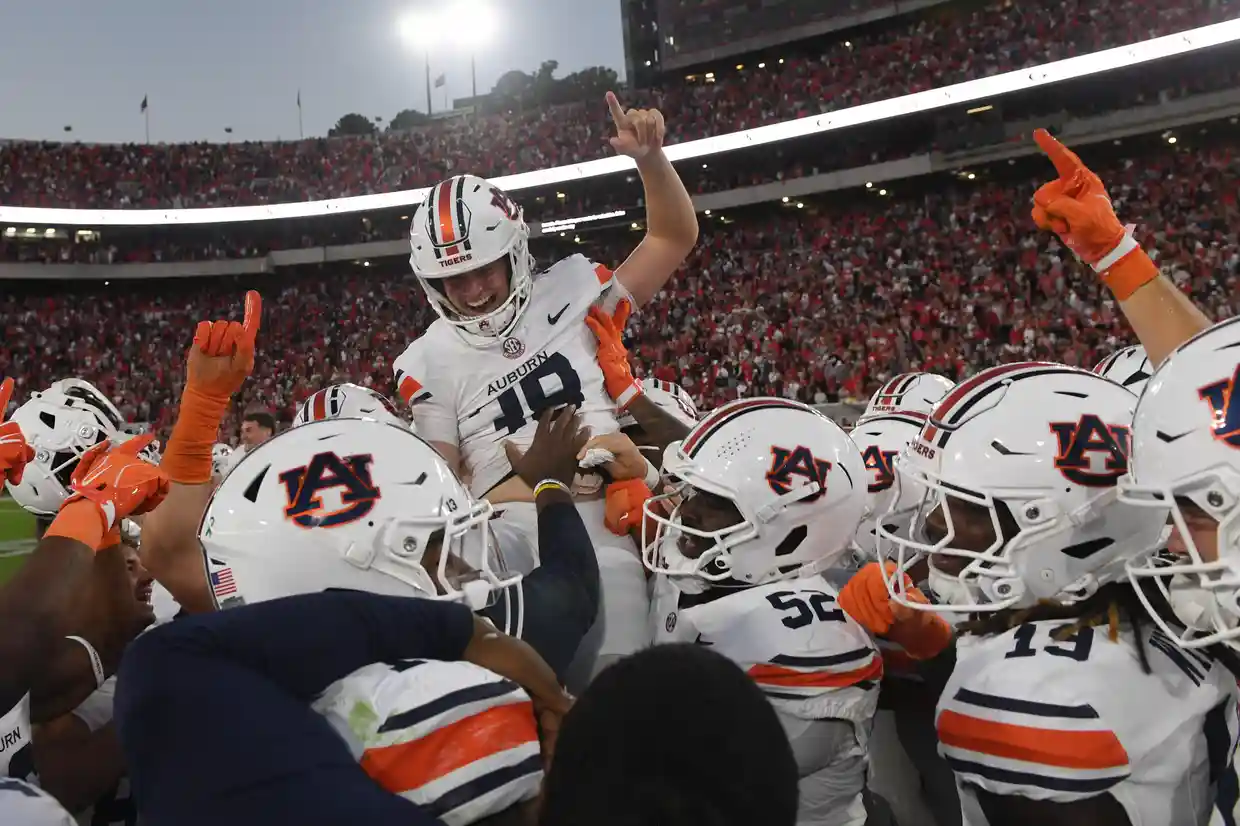
Auburn produced one of the biggest upsets of the College Football season, defeating No. 1 Georgia 27-24 with a dramatic field goal as time expired. Alex McPherson delivered the decisive 34-yard kick on Saturday, capping a remarkable comeback led by quarterback Byrum Brown and handing the Bulldogs a painful defeat that will reshape the national rankings.
The result was significant for more than the rivalry between the two Southeastern Conference programs. For the second consecutive week, the team ranked No. 1 in the Associated Press Top 25 lost to an unranked opponent. After Oklahoma defeated previously top-ranked Texas the week before, Auburn continued a remarkable sequence that had not occurred since October 1990, according to Sportradar.
Georgia appeared to have the contest under control after racing into a 14-0 lead. Auburn, however, responded with a physical rushing attack, controlled key stretches of the game and scored 24 consecutive points to turn the contest around. The Bulldogs fought back to level the score late in the fourth quarter, only for a costly fumble to give the Tigers one final opportunity.
McPherson made the most of it. His kick split the uprights as the clock expired, sending Auburn players onto the field in celebration and delivering a memorable victory for first-year head coach Alex Golesh.
Alex McPherson Delivers the Decisive Moment
The final minutes turned a tense rivalry game into a dramatic finish. Georgia had recovered from a 10-point deficit and appeared to be in position to attempt a go-ahead field goal after tying the score at 24-24. Instead, a turnover abruptly changed the direction of the game.
With 58 seconds remaining, Georgia quarterback Gunner Stockton fumbled while running near the Auburn 46-yard line. Auburn safety Sylvester Smith-Reed recovered the loose ball at the Tigers’ 44-yard line, ending Georgia’s possession and giving the home side a chance to win.
The turnover was particularly damaging because Georgia had worked so hard to recover from its earlier struggles. Stockton had guided a 94-yard touchdown drive to tie the game, and the Bulldogs looked capable of completing a late comeback. The fumble erased that opportunity and placed the outcome back in Auburn’s hands.
A roughing-the-passer penalty against Georgia’s Gabe Harris Jr helped Auburn move into position for the decisive kick. McPherson then converted from 34 yards as time expired, completing a finish that left the Bulldogs with no opportunity to respond.
The winning kick capped a game in which Auburn’s resilience proved just as important as its offensive production. After falling behind by two touchdowns, the Tigers did not abandon their approach. They leaned on Brown’s running ability, applied pressure on the ground and capitalized when Georgia made crucial mistakes.
Byrum Brown Powers Auburn’s Comeback
Quarterback Byrum Brown was central to Auburn’s success, providing the rushing production and offensive versatility needed to challenge Georgia’s defense. He finished with 115 rushing yards and a touchdown on 26 carries, while also throwing a touchdown pass.
Brown’s ability to run with the football gave Auburn an effective alternative to a conventional passing-led attack. At 235 pounds, he brought considerable physicality to designed runs and proved difficult to contain when he scrambled after dropping back to pass.
That threat helped Auburn establish a more consistent offensive rhythm after Georgia’s fast start. Rather than relying on explosive passing plays alone, the Tigers repeatedly tested the Bulldogs on the ground, forcing the defense to deal with Brown’s power and mobility.
The overall rushing numbers illustrated Auburn’s advantage. The Tigers finished with 192 rushing yards, compared with Georgia’s 113. That difference helped Auburn dictate important portions of the game and maintain pressure even as Georgia attempted to rally in the second half.
Brown’s contribution was especially important because Auburn needed to recover from an early deficit against the nation’s top-ranked team. His rushing touchdown and passing score helped transform the contest from a potential Georgia rout into a genuine fight for control.
For Golesh, the performance offered an encouraging sign that his team could compete with one of college football’s most established programs. Auburn’s comeback combined physical football with the discipline needed to take advantage of the opportunities that emerged late in the contest.
Georgia’s Costly Mistakes Turn the Game Around
Georgia’s defeat was not simply the result of Auburn’s physical approach. The Bulldogs also made a series of costly mistakes that prevented them from maintaining control after their strong opening period.
Stockton threw two interceptions, doubling his previous season total through six games. His late fumble added another damaging turnover, while three personal-foul penalties disrupted Georgia’s efforts to control the contest.
Those errors proved particularly expensive in a game decided by three points. Against a team capable of sustaining long rushing drives, every lost possession gave Auburn another opportunity to build momentum. Georgia’s mistakes also placed additional pressure on its defense, which struggled to contain Brown and the Tigers’ ground attack.
Head coach Kirby Smart acknowledged that Georgia had contributed to its own downfall. He pointed to the turnovers and critical penalties, describing several of the mistakes as untimely, uncharacteristic and undisciplined.
That assessment reflected the frustration of a team that had opportunities to win but failed to execute consistently when it mattered most. Georgia’s talent and early dominance were not enough to overcome the combination of Auburn’s offensive pressure and its own errors.
The final fumble was the clearest example. After Stockton had orchestrated a long scoring drive to tie the game, Georgia needed only to protect possession and create an opportunity for a potential winning kick. Instead, the turnover handed Auburn the chance to settle the contest immediately.
How Auburn Recovered From a 14-0 Deficit
Georgia appeared to be in complete control during the opening stages. Stockton briefly left the game after hitting the field helmet-first on the opening play, forcing the Bulldogs to turn to backup quarterback Ryan Puglisi.
Puglisi responded effectively. He completed all three of his passes, including a 41-yard connection with Craig Dandridge Jr that helped Georgia threaten the Auburn defense. Dwight Phillips then finished the sequence with a 15-yard touchdown run, giving the Bulldogs an early advantage.
Stockton returned for Georgia’s next possession and quickly made an impact. He threw a 24-yard touchdown pass to tight end Lawson Luckie, extending the lead to 14-0 and making it appear that the top-ranked team would be able to impose its will on the Tigers.
Auburn responded by changing the character of the game. Brown’s rushing ability helped the Tigers establish a physical presence, and the offense began to make progress without relying on long passing combinations. Each successful run put pressure on Georgia to defend another possession and prevented the Bulldogs from settling into a comfortable rhythm.
After trailing by two touchdowns, Auburn scored the next 24 points. The run transformed the game and gave the Tigers a 24-14 advantage before Georgia began its late recovery.
The turnaround demonstrated why early leads can be misleading in rivalry games. Georgia had started with authority, but Auburn found a way to make the contest increasingly physical. As the Tigers gained confidence, the Bulldogs were forced to respond to an opponent that was no longer intimidated by the No. 1 ranking.
Georgia’s Fourth-Quarter Rally Falls Short
Even after Auburn established a 10-point advantage, Georgia remained within reach of a comeback. The Bulldogs cut into the deficit with a 42-yard field goal from Peyton Woodring, reducing Auburn’s lead and giving the visitors a chance to make the final minutes competitive.
Georgia then produced one of its most important offensive sequences of the game. Starting at its own six-yard line, the Bulldogs covered 94 yards in 13 plays to level the score at 24-24.
Stockton completed the drive with a four-yard touchdown pass to London Humphreys. The scoring play appeared to restore Georgia’s momentum and set up a dramatic finish between the two SEC rivals.
The drive also highlighted Stockton’s ability to respond after earlier difficulties. Despite his interceptions, he guided Georgia down the field when the team desperately needed points. The touchdown showed that the Bulldogs still had the offensive capability to recover from their second-half struggles.
But the comeback was incomplete. Georgia’s defense needed to make a final stop after the offense had done enough to tie the score, and the Bulldogs needed to protect the ball on their last possession. Stockton’s fumble instead gave Auburn the opening it needed.
That sequence captured the difference between the teams on the day. Georgia showed enough quality to rally, but Auburn made the decisive play when the game was on the line. McPherson’s successful kick ensured that the Tigers’ defensive effort and offensive resilience would be rewarded.
Auburn Ends Georgia’s Remarkable Winning Streaks
The upset ended several impressive runs for Georgia. The Bulldogs had won nine consecutive games against Auburn before Saturday’s defeat, giving the Tigers a significant rivalry victory as well as a major national result.
Georgia also saw its streak of 53 consecutive victories against unranked opponents come to an end. That run illustrated the consistency with which the Bulldogs had handled teams outside the rankings, making Auburn’s performance all the more notable.
The defeat also ended Georgia’s brief stay at No. 1 in the AP Top 25. The Bulldogs had occupied the top position for just one week before falling to an unranked opponent, underscoring how quickly the college football rankings can change.
According to Sportradar, the result marked the first time since October 1990 that the AP’s No. 1 team lost to an unranked opponent in consecutive weeks. The previous weekend, Texas had suffered a defeat against Oklahoma while occupying the top spot.
That sequence has created fresh uncertainty at the top of the rankings. Teams hoping to move into contention for the leading positions now have another opportunity, while Georgia must respond to a setback that could affect its championship ambitions.
The End of a Long Home-Winning Run for Top-Ranked Teams
Auburn’s victory also ended an extraordinary run involving top-ranked teams playing at home against unranked opposition. According to the supplied report, No. 1 teams had won 93 consecutive home games against unranked opponents since LSU lost to Arkansas 50-48 in double overtime on November 23, 2007.
That streak underlined the advantage normally enjoyed by the nation’s leading teams when playing in familiar surroundings against opponents outside the rankings. Top-ranked programs typically combine deeper rosters with strong home support, making an upset difficult to achieve.
Auburn overcame those expectations by remaining competitive after its slow start and taking advantage of Georgia’s mistakes. The Tigers did not need to dominate every phase of the game. They needed to establish their running attack, stay within reach and make the critical plays when the opportunity arrived.
The final possession provided the decisive example. Smith-Reed’s recovery gave Auburn control, the penalty helped move the Tigers into field-goal range, and McPherson finished the job. A sequence of small but important moments produced a result that will stand out in the season’s history.
What the Result Means for Auburn and Georgia
For Auburn, the 27-24 victory represents an important milestone under first-year coach Alex Golesh. The Tigers improved to 4-2 overall and 2-2 in Southeastern Conference play, giving the program a major result to build on as the season continues.
Golesh praised his players after the game, expressing pride in their performance and emphasizing that the program’s progress would come one game at a time. His message reflected the importance of turning a headline-making upset into a foundation for sustained improvement.
Beating the No. 1 team can generate confidence and attention, but Auburn will need to reproduce the same intensity in its remaining games. The Tigers’ rushing performance provides a promising starting point, while their ability to recover from an early 14-point deficit demonstrates resilience.
Georgia, meanwhile, must address the mistakes that undermined its performance. Smart’s team remains experienced and talented, but the loss exposed vulnerabilities in ball security, discipline and the ability to sustain control when an opponent changes the game’s rhythm.
The Bulldogs will also need to assess Stockton’s performance. His fourth-quarter touchdown drive showed his potential, but the interceptions and late fumble were decisive setbacks. Reducing those errors will be essential if Georgia is to recover from the defeat and remain competitive in the SEC race.
Running back Nate Frazier’s return from a rib injury was another important storyline for Georgia, although his impact was limited. He started the game but managed only 19 yards on nine carries. Georgia’s overall rushing output fell well short of Auburn’s, making it difficult for the Bulldogs to control the contest on the ground.
Why This Upset Could Shape the College Football Season
College football’s rankings are never settled by reputation alone, and Auburn’s victory offered a powerful reminder of that principle. Georgia entered the game as the No. 1 team, but its position did not protect it from a determined opponent capable of exploiting mistakes.
The consecutive defeats suffered by top-ranked teams have also made the national picture more unpredictable. With Texas losing to Oklahoma the previous week and Georgia falling to Auburn, the race for the top spots has opened up at a crucial stage of the season.
For fans, the result reinforces the appeal of college football’s biggest rivalries. Auburn’s comeback featured a dramatic swing in momentum, a late defensive turnover and a field goal at the final whistle. It was the kind of finish that can define a season for a program and reshape the conversation around a championship contender.
The Tigers still have work to do, and one victory does not guarantee a successful campaign. Georgia also has the opportunity to respond, although its margin for error has narrowed. Both teams will now face pressure to show that Saturday’s result was either the beginning of Auburn’s progress or a temporary setback for the Bulldogs.
Conclusion: Auburn Seize Their Moment in a Dramatic Finish
Auburn’s 27-24 victory over No. 1 Georgia was built on resilience, a powerful rushing performance and a decisive finish. Byrum Brown led the Tigers with 115 rushing yards and a touchdown, while the defense produced the crucial fumble recovery that gave McPherson the opportunity to win the game.
Georgia had its chances. The Bulldogs raced into a 14-0 lead and mounted a determined fourth-quarter comeback, with Stockton throwing a touchdown pass to Humphreys to tie the score. But interceptions, penalties and the costly final fumble proved too much to overcome.
McPherson’s 34-yard field goal as time expired completed one of the season’s most dramatic upsets. Auburn ended Georgia’s long winning streaks against the Tigers and unranked opponents, while extending a remarkable run of top-ranked teams falling in consecutive weeks.
For Golesh and Auburn, the challenge now is to build on the victory. For Smart and Georgia, the priority is to correct the mistakes that turned a promising start into a painful defeat. One thing is certain: after another No. 1 team has fallen, the college football season has become considerably more unpredictable.
For breaking news and live news updates, like us on Facebook or follow us on Twitter and Instagram. Read more on Latest Sports on thefoxdaily.com.






COMMENTS 0