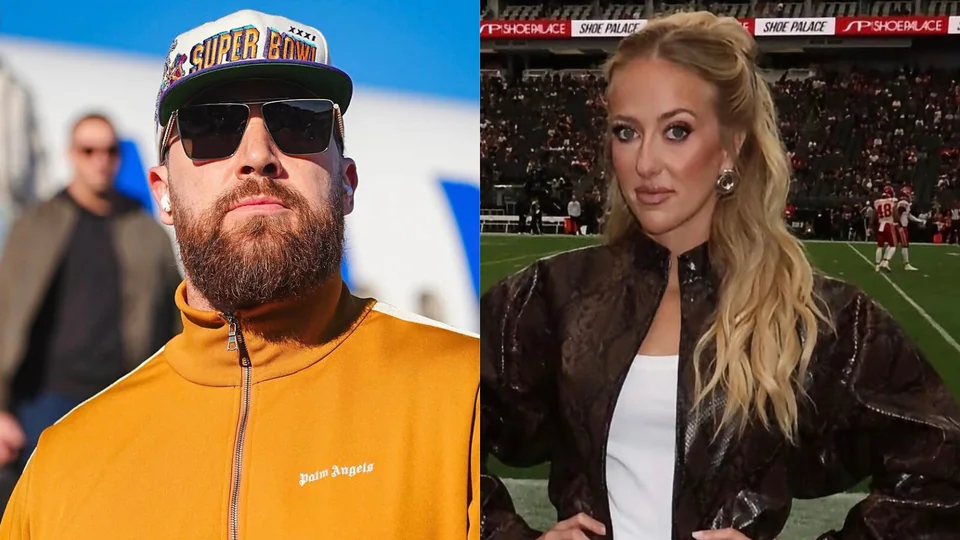
Travis Kelce has offered a different perspective on the controversial officiating decision that played a major role in the Kansas City Chiefs‘ 28-24 defeat to the Denver Broncos. While Brittany Mahomes publicly questioned the referees’ decision to penalise offensive lineman Jaylon Moore for a false start, the Chiefs tight end agreed with the officials after reviewing the incident during the latest episode of the New Heights podcast.
The disagreement has drawn attention because the penalty came during one of the most important moments of the game. Kansas City appeared to have scored a go-ahead touchdown through Patrick Mahomes and Rashee Rice, only for the officials’ flag to erase the play. The Chiefs subsequently failed to convert on fourth down, allowing Denver to hold on to its victory.
Rather than placing the entire responsibility for the defeat on the referees, Travis Kelce argued that Kansas City had another opportunity to execute and potentially win the game. His comments also highlighted a familiar challenge in professional football: teams must respond immediately to unexpected setbacks, particularly when the result is still within reach.
Why the Chiefs’ false-start penalty became a major talking point
The controversy developed during the closing stages of the Chiefs’ matchup against the Broncos. Kansas City was attempting to turn a late offensive opportunity into a game-winning score when Patrick Mahomes connected with Rashee Rice in the end zone.
For Chiefs supporters, the play appeared to provide the breakthrough the team needed. However, the officials called a false start against offensive lineman Jaylon Moore, wiping out the apparent touchdown and changing the situation for Kansas City’s offence.
Instead of benefiting from the scoring play, the Chiefs were pushed back to the six-yard line. The change in field position created another challenge for Mahomes and his teammates, who now needed to find a different way to reach the end zone.
The pressure increased on the following attempt. Denver’s defence managed to sack Mahomes on fourth down, bringing Kansas City’s opportunity to an end. The Broncos ultimately secured a 28-24 victory.
The sequence became particularly controversial because of its timing. A penalty during an ordinary offensive possession might not have generated the same reaction, but a flag that eliminates a potential go-ahead touchdown naturally attracts greater attention.
Brittany Mahomes strongly criticises the referees
Brittany Mahomes, the wife of Chiefs quarterback Patrick Mahomes, was among those who questioned the officials’ decision. She expressed her frustration on social media after the game, suggesting that the referees had made an especially questionable call during a crucial moment.
Her reaction reflected the disappointment surrounding a play that appeared to give Kansas City an opportunity to take control of the contest.
Brittany wrote:
“You can’t tell me you call that on a game winning [touchdown],” she wrote. “Oh wait yeah I can cause it’s us. That was the weakest call I have ever seen, you can’t tell me otherwise.”
Her comments quickly became part of the wider discussion surrounding the officiating controversy. The disagreement was not simply about whether Moore had committed a false start. It also concerned the importance of the moment and whether officials should be expected to make the same calls during decisive situations as they would earlier in a game.
For supporters who believed the penalty was unnecessary or overly strict, the timing made the decision even more frustrating. However, Travis Kelce’s subsequent comments presented a noticeably different interpretation.
Travis Kelce agrees with the NFL officials on the penalty
The controversy received further attention during an episode of the New Heights podcast, hosted by Travis Kelce and his brother Jason Kelce. The brothers discussed the false-start decision and examined whether the officials were justified in penalising Kansas City.
Jason made his position clear, saying that he believed the officials had made the correct decision.
“A lot of people are saying this wasn’t a penalty; I’m going to go on record and say that this is definitely a penalty.”
Travis agreed with his brother’s assessment. Responding to Jason’s observation about the play, he said:
“Yeah, he flinches.”
The short response was significant because it showed that Kelce did not share the criticism directed at the officials. While some Chiefs supporters viewed the flag as an unfortunate decision that changed the outcome, Travis acknowledged the movement that led to the penalty.
His comments also demonstrated a distinction between disagreeing with a result and accepting responsibility for what happens on the field. Kelce did not suggest that the penalty was irrelevant. Instead, he focused on how the Chiefs responded after the decision was made.
Why Travis Kelce refused to blame the penalty for the defeat
Perhaps the most interesting part of Travis Kelce’s reaction was not his agreement with the referees but his assessment of Kansas City’s final offensive opportunity.
He argued that the Chiefs still had a chance to win after the penalty. According to Kelce, Patrick Mahomes remained in a position where he could potentially deliver another decisive play.
Speaking about his confidence in the quarterback, Travis said:
“At the end of the day, we still had another play. I’ll take my guy Pat Mahomes on the six-yard line with the game on the line.
I’ll take that any day of the week. So we gotta execute at the end even more. We can’t let the penalty absolutely deflate us and not let us execute at the end of the game.”
His assessment placed the emphasis on execution rather than officiating. In professional football, penalties can change field position, remove successful plays and force offences to adjust their plans. However, teams must still respond to the new situation.
Kelce’s argument was that Kansas City had an opportunity to recover from the setback. The team needed to remain composed and execute another play instead of allowing frustration to affect its performance.
His comments also reflected confidence in Mahomes. The quarterback has been central to the Chiefs’ offensive identity, and Kelce made it clear that he would continue trusting him in a high-pressure situation, even when the team faced a difficult fourth-down opportunity.
From that perspective, the false-start penalty was an important moment, but it was not the only factor that determined the result. The failure to convert the subsequent opportunity also mattered.
Patrick Mahomes offers a measured response to the controversial call
Patrick Mahomes also addressed the officiating decision after the Broncos game. Unlike Kelce, who openly agreed with the officials, the Chiefs quarterback expressed some uncertainty about the severity of the movement that resulted in the flag.
Mahomes acknowledged that the penalty had been called but appeared unconvinced that the movement was significant enough to justify the decision during such an important moment.
Speaking to reporters, he said:
“It couldn’t have been big, but it was called.”
He also acknowledged that players have little choice but to accept the officials’ decisions once a penalty has been announced.
“At the end of the day, you have to go with whatever is called, but a lot of times in those big moments, the little stuff doesn’t get called like that.”
Mahomes’ response highlighted another aspect of the debate. His frustration appeared to concern the consistency of officiating in decisive situations rather than simply the existence of the penalty itself.
There is an important distinction between the quarterback’s reaction and Kelce’s analysis. Mahomes focused on how the call affected the Chiefs during a critical possession, while Kelce concentrated on the team’s responsibility to respond after the flag.
Both perspectives illustrate why controversial penalties can generate disagreements even among people connected to the same team.
Justin Simmons defends the referees and takes aim at Chiefs fans
The discussion extended beyond Kansas City’s locker room and the New Heights podcast. Former Denver Broncos safety Justin Simmons also addressed the controversy on his podcast, The Last Line.
Simmons defended the officials’ decision and criticised Chiefs supporters who argued that Jaylon Moore had not committed a false start.
He made his position clear with a provocative comment about the relationship between Kansas City and NFL officiating.
“Y’all been cheating the whole time you had Patrick Mahomes. Refs been cheating for y’all.”
Simmons also directed his criticism towards fans who continued to dispute the penalty. He argued that the movement was sufficient to justify the officials’ decision and suggested that Kansas City supporters were refusing to accept the result.
“My rant is at the Chiefs fans that are delusional enough to think that was not a false start. It was, y’all lost and y’all lost at the 1-yard line. Ha! I don’t feel bad for y’all.”
His remarks added another layer to the rivalry surrounding the game. The comments were particularly pointed because Simmons previously played for Denver, making his defence of the Broncos’ victory unsurprising.
However, his criticism also shifted the conversation away from the technical details of the penalty and towards the reactions of opposing fan bases.
Kareem Jackson compares the Chiefs to a frustrated neighbourhood kid
Former Broncos safety Kareem Jackson, who appeared alongside Simmons, also offered his opinion on Kansas City’s reaction to the defeat.
Jackson compared the Chiefs to a child who struggles to accept losing a neighbourhood game and decides to leave rather than acknowledge the result.
“The kid in the neighborhood who loses and they take their ball and they go home with it.”
The comparison reflected the frustration between supporters of the two teams. While Chiefs fans were questioning the officiating, the former Denver players believed the penalty was legitimate and that Kansas City needed to accept the outcome.
The exchange demonstrated how one disputed decision can become a much larger discussion involving players, former athletes, podcast hosts and supporters.
Why NFL penalty decisions attract so much attention in close games
The Chiefs-Broncos controversy highlights a recurring challenge in professional football: officiating decisions can become the defining moment of a game when they occur during a decisive possession.
A false start is an offensive penalty involving a player moving illegally before the snap. Such a decision can disrupt the timing of an offensive play and result in a loss of yardage. When the flag comes during a potential scoring opportunity, its consequences become especially visible.
However, the timing of a penalty does not automatically determine whether it should be called. The central question is whether the movement meets the requirements for an infraction.
This is where the different reactions become relevant. Jason Kelce and Travis Kelce believed the movement justified the flag. Brittany Mahomes questioned the decision, while Patrick Mahomes expressed reservations about how the call was made in such a significant moment.
Justin Simmons and Kareem Jackson, meanwhile, viewed the controversy from the perspective of Denver’s victory.
These competing reactions show why discussions about officiating rarely end immediately after a game. Supporters often focus on the consequences of a decision, while players and former athletes may examine the action itself and whether it justified a penalty.
What the Chiefs can take away from the Broncos defeat
Beyond the arguments about refereeing, Travis Kelce’s comments raise a more important question about how Kansas City should approach similar situations in future games.
The Chiefs cannot control every decision made by officials. What they can control is their response when a penalty changes the circumstances of a possession.
Kelce’s comments suggest three important lessons from the sequence:
- Maintaining composure: A controversial decision should not prevent players from concentrating on the next opportunity.
- Offensive execution: Teams must find ways to complete difficult plays, particularly when the game is on the line.
- Taking responsibility: Reviewing officiating decisions is reasonable, but players must also recognise opportunities they failed to convert.
These points are particularly relevant for a team that relies heavily on Mahomes’ ability to deliver under pressure. A difficult situation does not necessarily mean the offence has run out of opportunities.
Kelce’s confidence in his quarterback was clear. His position was that the Chiefs had enough of an opportunity to recover from the penalty, and the team needed to make the most of it.
What happens next in the Chiefs officiating debate?
The disagreement surrounding the false-start penalty is likely to remain a talking point among Chiefs and Broncos supporters, particularly because of how closely the decision was connected to the final result.
However, the different reactions from Travis Kelce, Brittany Mahomes and Patrick Mahomes reveal that there is no single shared interpretation of the incident within the Chiefs’ wider circle.
Kelce accepted the penalty and focused on the missed opportunity that followed. Brittany questioned the officials’ decision, while Patrick acknowledged the call but suggested that similar movement might not always be penalised in major moments.
Meanwhile, Simmons and Jackson defended the officials and criticised the reaction from Kansas City’s supporters.
The broader takeaway is that a controversial call and a team’s failure to capitalise on its remaining opportunity can both be part of the same game story. The Chiefs lost 28-24, but the debate over the final sequence has continued because it combined a potential winning touchdown, a disputed penalty and a decisive defensive stop.
For Travis Kelce, however, the central issue was straightforward: Kansas City had another chance, and the team needed to execute when it mattered most.
For breaking news and live news updates, like us on Facebook or follow us on Twitter and Instagram. Read more on Latest Sports on thefoxdaily.com.


COMMENTS 0