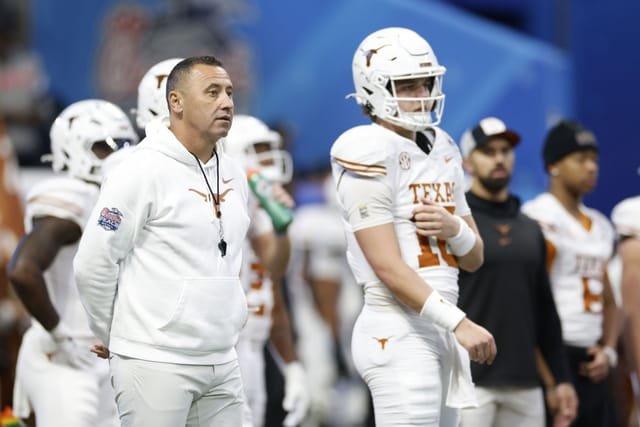
Few players in College Football generate as much attention as Arch Manning. Before becoming the full-time starting quarterback for the Texas Longhorns, Manning had already become one of the sport’s most recognizable names thanks to his family’s legendary football pedigree and immense recruiting profile.
Now, as he prepares for a pivotal 2026 season, discussions about his future are accelerating.
Will Manning enter the 2027 NFL Draft as expected, or could he remain at Texas for another year?
During an appearance on Kay Adams’ “Up & Adams” show, Texas head coach Steve Sarkisian offered his clearest public comments yet on the subject, revealing that neither scenario would surprise him.
The response reflects a new reality in college football, where name, image, and likeness (NIL) deals, player development, and personal preferences are becoming just as influential as traditional NFL timelines.
Steve Sarkisian Leaves the Door Open for an Arch Manning Return
When asked whether Manning could bypass the 2027 NFL Draft and return to Texas, Sarkisian acknowledged that the possibility is real.
“We haven’t had the discussion, but I will tell you, I would not be surprised.”
The Texas coach pointed to several factors that could influence Manning’s decision, including his appreciation for the college experience, his relationship with the university, and the significant financial opportunities available through NIL agreements.
Sarkisian emphasized that today’s elite college athletes no longer face the same financial pressures that previously pushed top quarterbacks toward the NFL as soon as they became draft-eligible.
At the same time, he stopped short of predicting Manning’s future.
“On the same token, I won’t be surprised if he declares and decides to go to the draft.”
Instead, Sarkisian stressed that the decision will ultimately depend on factors such as team success, individual performance, health, and Manning’s long-term goals.
Why Arch Manning’s Decision Could Redefine Modern Quarterback Development
For decades, the path for elite quarterbacks was straightforward: excel in college, become draft-eligible, and enter the NFL at the earliest opportunity.
However, the introduction of NIL has dramatically altered that equation.
Top college quarterbacks can now earn substantial income before turning professional, reducing the financial urgency that once drove early declarations.
Manning represents perhaps the clearest example of this shift.
With one of the most valuable personal brands in college sports, he already benefits from endorsement opportunities tied to his family name, his position at Texas, and his nationwide popularity.
Remaining in college for an additional season could provide benefits that extend beyond finances.
- More live-game experience as a starter
- Additional time to develop physically and mentally
- An opportunity to compete for championships
- Greater familiarity with Sarkisian’s offensive system
- Increased control over his NFL entry timeline
For quarterbacks, experience often translates directly into draft value and long-term professional success.
The NIL Factor: Why College Football’s Economics Have Changed
Before NIL, elite prospects faced a simple economic decision: turn professional as soon as possible.
Today, the calculation is far more complex.
High-profile quarterbacks can earn millions of dollars annually through endorsements, sponsorships, and partnerships while still competing at the collegiate level.
That financial flexibility allows players to prioritize development over immediate professional opportunities.
| Traditional Model | NIL Era Model |
|---|---|
| Leave college early to maximize earnings | Earn substantial income while remaining in school |
| NFL contract is the first major payday | NIL creates early financial security |
| Limited control over development timeline | Players can choose when they feel ready |
| Pressure to declare once draft stock rises | Greater flexibility to stay another season |
For a player like Manning, whose brand value extends beyond football performance alone, staying at Texas could be financially viable and strategically beneficial.
What Will Determine Arch Manning’s NFL Draft Timeline?
Sarkisian identified several factors that could shape Manning’s decision.
Team Success
If Texas competes for a national championship in 2026 but falls short, Manning may decide to return for unfinished business.
Conversely, leading the Longhorns to a title could make the transition to the NFL feel like a natural next step.
Individual Development
NFL teams evaluate more than arm strength and athleticism.
Decision-making, leadership, pocket awareness, and experience against elite competition all influence draft projections.
A dominant season could solidify Manning as a top selection in the 2027 NFL Draft.
Health and Durability
Injuries remain a major variable for every college athlete.
Remaining healthy throughout the season will likely play a critical role in any decision-making process.
Personal Goals
Not every quarterback prioritizes reaching the NFL as quickly as possible.
Some value the college experience, relationships with teammates, and opportunities to continue developing in familiar environments.
Why Texas Is the Ideal Environment for Manning
Few programs offer the combination of resources, visibility, and quarterback development that Texas currently provides.
Under Sarkisian, the Longhorns have established themselves as one of college football’s premier destinations for offensive talent.
The program offers:
- National championship aspirations
- Elite recruiting classes
- Strong NIL infrastructure
- Extensive media exposure
- An NFL-style offensive system
For Manning, remaining at Texas beyond 2026 would not represent a step backward. Instead, it could offer an ideal environment to continue preparing for the professional level.
Could the Pittsburgh Steelers Target Arch Manning?
Although Manning’s immediate focus remains on Texas, NFL speculation has already begun.
Several analysts believe quarterback-needy teams could position themselves to pursue him whenever he enters the draft.
The Pittsburgh Steelers have emerged as one frequently discussed destination.
After cycling through multiple veteran quarterbacks in recent years, the franchise continues searching for a long-term solution at the position.
Whether Manning enters the draft in 2027 or delays his decision, NFL teams are expected to closely monitor his development throughout the season.
However, projections this far in advance often change dramatically based on performance, team needs, and organizational priorities.
How the Manning Family Legacy Shapes Expectations
Arch Manning’s journey differs from that of most college quarterbacks because of the expectations attached to his surname.
As the grandson of Archie Manning and nephew of Peyton and Eli Manning, every decision receives intense scrutiny.
Yet the family’s history suggests patience may be prioritized over speed.
The Mannings have consistently emphasized preparation, long-term development, and finding the right situation over chasing immediate opportunities.
That philosophy could influence Arch’s approach to the NFL timeline.
Rather than focusing solely on draft position, he may prioritize entering the league when he feels fully prepared to succeed.
What This Means for the Future of College Football
Manning’s eventual decision could become a defining example of how NIL is transforming college athletics.
If one of the sport’s biggest stars chooses to remain in school despite first-round NFL projections, it may encourage other elite players to reconsider traditional timelines.
Programs with strong NIL ecosystems and championship potential could increasingly retain top talent for longer periods.
That shift would reshape roster building, recruiting strategies, and NFL scouting models across the sport.
Conclusion
Steve Sarkisian’s comments reveal an important truth about modern college football: predicting an elite quarterback’s future has never been more complicated.
Arch Manning could declare for the 2027 NFL Draft and immediately become one of the most sought-after prospects in football.
He could also decide that another season at Texas offers greater value, both personally and professionally.
For now, the conversation remains hypothetical.
The focus for Manning and the Longhorns is squarely on the 2026 season, where team success, individual growth, and health will ultimately shape what comes next.
Regardless of the timeline he chooses, one thing is certain: Arch Manning’s decision will have implications that extend far beyond Texas, influencing how future generations of college quarterbacks approach the path to the NFL.
For breaking news and live news updates, like us on Facebook or follow us on Twitter and Instagram. Read more on Latest Sports on thefoxdaily.com.





COMMENTS 0