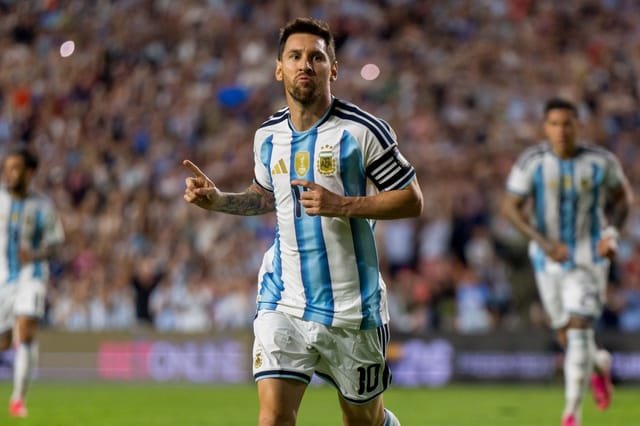
Argentina’s quest to retain the FIFA World Cup trophy begins on June 16 against Algeria at Arrowhead Stadium in Kansas City. However, rather than relying solely on the formula that brought success in Qatar four years ago, head coach Lionel Scaloni is reportedly exploring new tactical approaches.
According to reports emerging from Argentina’s training camp, the coaching staff has experimented with two distinct systems—a defensively solid 5-3-2 and a more familiar 4-4-2 setup—as preparations intensify for the opening group-stage encounter.
The decision highlights a defining characteristic of Scaloni’s reign: adaptability.
Since taking charge of the national team, the Argentine manager has built a side capable of adjusting its shape and style depending on the opponent, game situation, and available personnel. That tactical versatility has become one of the team’s biggest strengths.
Why Argentina Are Experimenting with New Formations
World Cup title defenses are notoriously difficult.
No nation has successfully retained the trophy since Brazil in 1962, underlining the challenge Argentina faces in North America.
Opponents now understand Argentina’s strengths, making unpredictability a valuable weapon.
By testing multiple systems ahead of their opener, Scaloni appears focused on ensuring his side remains difficult to analyze and even harder to stop.
Rather than committing to a single tactical identity, Argentina are preparing for different game scenarios—from controlling possession to protecting leads and countering dangerous transitions.
The 5-3-2 System: Defensive Stability with Tactical Flexibility
Reports suggest Argentina trialed a 5-3-2 formation during recent training sessions.
This setup would provide additional defensive security while allowing wing-backs to contribute in attack.
| Projected Argentina 5-3-2 Formation |
|---|
| Goalkeeper: Emiliano Martínez |
| Defense: Giuliano Simeone, Cristian Romero, Nicolás Otamendi, Lisandro Martínez, Nicolás González |
| Midfield: Rodrigo De Paul, Enzo Fernández, Alexis Mac Allister |
| Attack: Lionel Messi, Lautaro Martínez |
The formation offers several advantages.
- Greater protection against counterattacks.
- Additional defensive cover for aging players.
- More freedom for Messi to operate between the lines.
- Flexibility to switch seamlessly into a back four during possession phases.
Against physically demanding opponents, the extra defender could help Argentina maintain control without sacrificing attacking quality.
The Familiar 4-4-2 Remains the Preferred Option
Despite experimenting with a back five, reports indicate Scaloni still favors a traditional 4-4-2 formation for the opening whistle.
This system has delivered consistent success during Argentina’s recent golden era and allows the team to maximize its midfield balance.
| Projected Argentina 4-4-2 Formation |
|---|
| Goalkeeper: Emiliano Martínez |
| Defense: Nahuel Molina, Cristian Romero, Nicolás Otamendi, Lisandro Martínez |
| Midfield: Rodrigo De Paul, Enzo Fernández, Alexis Mac Allister, Thiago Almada |
| Attack: Lionel Messi, Lautaro Martínez |
Nicolás González remains an important alternative option, while Gonzalo Montiel is expected to share minutes at right-back with Nahuel Molina.
The ability to rotate without significantly altering the team’s structure gives Argentina a major advantage over many competitors.
Lautaro Martínez Emerges as Messi’s Preferred Strike Partner
One of the biggest selection questions surrounding Argentina concerns who will partner Lionel Messi in attack.
Current indications suggest Lautaro Martínez has secured the role ahead of Julián Álvarez.
The decision reflects Lautaro’s outstanding form at both club and international level.
Over the past two years, he has evolved into Argentina’s most reliable goalscorer outside of Messi, combining intelligent movement with clinical finishing.
His understanding with the captain continues to improve, making him a natural choice for the tournament opener.
Why Lautaro Martínez Holds the Edge Over Julián Álvarez
Choosing between Lautaro Martínez and Julián Álvarez is a challenge most national teams would gladly accept.
Both strikers offer different qualities.
| Player | Primary Strength | Ideal Role |
|---|---|---|
| Lautaro Martínez | Penalty-box movement and finishing | Starting center-forward |
| Julián Álvarez | Pressing intensity and versatility | Impact substitute or second striker |
Lautaro enters the World Cup after another impressive season at club level and remains one of the most prolific scorers in international football.
Meanwhile, Álvarez offers Scaloni tactical flexibility from the bench, particularly when Argentina need increased pressing intensity or greater movement in the final third.
Lionel Messi’s Role Continues to Evolve
At this stage of his career, Messi no longer influences matches through constant movement across the pitch.
Instead, Argentina’s system is increasingly designed to maximize his decision-making and creativity in key areas.
Both the 5-3-2 and 4-4-2 formations allow Messi to operate as a free-roaming playmaker with fewer defensive responsibilities.
That approach enables him to conserve energy while remaining decisive during critical moments.
Argentina’s challenge is straightforward: create a structure that gives Messi freedom without compromising defensive balance.
Scaloni’s tactical experiments suggest he is searching for exactly that balance.
What Algeria Can Expect from Argentina
Algeria enter the tournament as underdogs, but Argentina are unlikely to underestimate them.
Teams facing the defending champions often adopt compact defensive shapes and look to exploit transitions.
Scaloni’s willingness to consider multiple formations indicates he expects a tactical battle rather than a straightforward encounter.
Argentina’s ability to switch systems during matches could prove crucial if Algeria succeeds in limiting space around Messi.
Why Tactical Flexibility Could Define Argentina’s Title Defense
Modern international football increasingly rewards teams capable of adapting quickly.
The era of rigid systems is fading, especially in tournament football where opponents vary significantly from one match to the next.
Argentina’s greatest strength may not be individual talent alone but their collective understanding of multiple tactical approaches.
Whether defending a lead, chasing a goal, or controlling possession, Scaloni has built a squad comfortable operating in different structures.
That versatility could become the difference between an early exit and another deep World Cup run.
Can Argentina Become Back-to-Back World Champions?
Retaining the FIFA World Cup remains one of football’s most difficult achievements.
History suggests defending champions often struggle with increased expectations and tactical scrutiny.
However, Argentina possess several advantages:
- A settled coaching staff.
- Strong squad continuity.
- Elite experience in knockout football.
- Multiple attacking options.
- The leadership and creativity of Lionel Messi.
Most importantly, they appear willing to evolve rather than rely on past success.
Conclusion
Argentina’s reported experimentation with both 5-3-2 and 4-4-2 formations ahead of their FIFA World Cup opener against Algeria reflects a team determined to stay ahead of its rivals.
Lionel Scaloni understands that defending a World Cup title requires innovation, adaptability, and tactical courage.
With Lionel Messi leading the attack, Lautaro Martínez in outstanding form, and a squad capable of adjusting to different challenges, Argentina enter the tournament as genuine contenders once again.
Whether Scaloni opts for a back five or sticks with his trusted 4-4-2 system, one thing is clear: the reigning champions are leaving nothing to chance as they begin their quest for consecutive World Cup titles.
For breaking news and live news updates, like us on Facebook or follow us on Twitter and Instagram. Read more on Latest Sports on thefoxdaily.com.






COMMENTS 0