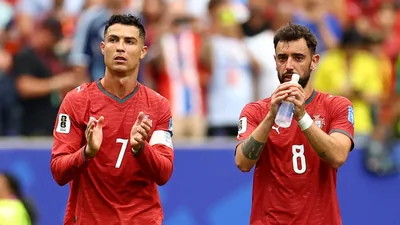
Few footballers have built careers around proving doubters wrong quite like cristiano Ronaldo. At FIFA World Cup 2026, the Portuguese captain once again found himself under intense scrutiny after a frustrating performance against DR Congo. Critics questioned whether the 41-year-old still possessed the quality required to influence football’s biggest stage.
Just days later, Ronaldo delivered the perfect response.
Portugal dismantled Uzbekistan 5-0 in one of their most complete performances of the tournament, with Ronaldo scoring twice to become the first player in history to score in six different FIFA World Cups. However, beneath the headlines and records lies a bigger story—one that involves tactical adjustments, midfield dominance, squad depth, and growing evidence that Portugal may have the tools needed to challenge for football’s ultimate prize.
Portugal’s Response After a Disappointing Opening Match
Portugal entered the Uzbekistan clash under pressure. Their opening draw against DR Congo raised concerns about creativity, attacking fluidity, and Ronaldo’s role within the team.
Against DR Congo, Portugal looked predictable. Their midfield struggled to break defensive lines, while Ronaldo frequently found himself isolated and surrounded by defenders. The team’s possession rarely translated into dangerous chances.
Roberto Martinez recognized the problem immediately.
Rather than stubbornly sticking to the same formula, the Portuguese manager adjusted both personnel and tactical structure, creating a system that better suited his squad’s strengths.
The result was one of Portugal’s most convincing World Cup performances in recent memory.
Cristiano Ronaldo’s Evolution: From Superstar Winger to Elite Penalty-Box Predator
The Ronaldo of 2026 is vastly different from the player who terrorized defenses during his Manchester United and Real Madrid peak years.
Age inevitably changes every athlete, but what separates Ronaldo from most footballers is his ability to reinvent himself.
Gone are the days when he would dribble past multiple defenders from midfield or relentlessly sprint down the wings for ninety minutes.
Today’s Ronaldo thrives inside the penalty area.
His movement remains world-class, his positioning is exceptional, and his finishing instincts continue to rank among the best in football.
Against Uzbekistan, he repeatedly found dangerous pockets of space. Every run carried purpose. Every touch inside the box looked threatening.
His first goal perfectly illustrated this transformation. Rather than creating the opportunity himself, Ronaldo simply arrived at exactly the right place at exactly the right time—a hallmark of elite goalscorers.
Why Uzbekistan Was the Perfect Opponent for Ronaldo
Football is often about matchups, and this fixture played directly into Ronaldo’s strengths.
Uzbekistan’s defensive line struggled throughout the contest. Their center-backs frequently lost track of runners, their positioning lacked coordination, and their response to quick attacking movements was slow.
Ronaldo identified these weaknesses immediately.
Unlike DR Congo, which compressed space effectively and disrupted Portugal’s attacking rhythm, Uzbekistan allowed Portugal’s creative players time and freedom on the ball.
For a striker who relies on service and intelligent movement, that environment was ideal.
Ronaldo’s two goals were not merely the result of defensive mistakes. They were the product of elite anticipation, experience, and understanding of space.
Bruno Fernandes: The Architect Behind Portugal’s Revival
While Ronaldo grabbed the headlines, Bruno Fernandes was arguably Portugal’s most influential player.
The Manchester United midfielder orchestrated the game from start to finish, controlling tempo, creating opportunities, and constantly finding gaps in Uzbekistan’s defensive structure.
His assist for Ronaldo’s second goal highlighted his vision and technical quality.
More importantly, Fernandes played with greater freedom than he had against DR Congo.
Instead of being restricted to safe possession, he was encouraged to play progressive passes and attack spaces between the lines.
That tactical adjustment transformed Portugal’s entire attacking approach.
Bruno Fernandes’ Key Contributions
| Area | Impact |
|---|---|
| Chance Creation | Constant attacking opportunities |
| Tempo Control | Dictated Portugal’s rhythm |
| Progressive Passing | Advanced the attack quickly |
| Partnership with Ronaldo | Created multiple goal-scoring chances |
| Leadership | Guided Portugal’s midfield dominance |
The Midfield That Could Win Portugal the World Cup
One of the biggest takeaways from the victory was the outstanding performance of Portugal’s midfield trio.
Joao Neves, Vitinha, and Bruno Fernandes complemented each other brilliantly.
Their combination offered balance, creativity, pressing intensity, and technical quality.
Modern international football is often decided in midfield, and Portugal’s engine room now appears capable of competing with any nation in the tournament.
Vitinha provided composure under pressure, Neves added energy and ball recovery, while Fernandes supplied creativity and attacking intent.
Together, they allowed Portugal to dominate possession without becoming predictable.
Roberto Martinez Deserves More Credit Than He Gets
For years, Portugal possessed world-class talent but often struggled to maximize it collectively.
Against Uzbekistan, Roberto Martinez demonstrated why tactical flexibility is essential in modern football.
The manager made several notable adjustments:
- Changes to the starting lineup
- Greater attacking freedom for midfielders
- Faster ball circulation
- Improved positioning around Ronaldo
- More direct attacking transitions
These modifications transformed Portugal from a possession-heavy side into a dynamic attacking force.
Perhaps most importantly, Martinez created a system designed around maximizing Ronaldo’s strengths rather than forcing him into roles he can no longer perform effectively.
An Overlooked Moment: Ronaldo’s Leadership Evolution
One of the most interesting moments came during Portugal’s free-kick opportunity.
Rather than insisting on taking the set-piece himself, Ronaldo allowed Nuno Mendes to step up from an angle that clearly favored a left-footed player.
Mendes rewarded that trust with a stunning goal.
This small moment reveals an important evolution in Ronaldo’s leadership.
Earlier in his career, he often carried the responsibility of delivering every decisive moment. Today’s Ronaldo appears more comfortable empowering teammates when they are better positioned to succeed.
That maturity could become invaluable as Portugal navigates the knockout rounds.
Defensive Stability Returns with Ruben Dias
Portugal’s attack deserved praise, but their defensive performance was equally encouraging.
The return of Ruben Dias brought organization, leadership, and composure to the back line.
His presence improved Portugal’s defensive structure and reduced the vulnerability that occasionally appeared in previous matches.
Championship-winning teams require balance, and Portugal looked considerably more complete with Dias anchoring the defense.
Can Portugal Actually Win FIFA World Cup 2026?
After this performance, the conversation naturally shifts toward Portugal’s title credentials.
Several factors support their case:
- World-class midfield depth
- Experienced leadership
- Elite attacking talent
- Tactical flexibility
- A proven goalscorer in Ronaldo
- Improved defensive stability
However, tougher challenges await.
Elite teams such as Argentina, France, Brazil, England, and Spain will not provide the same defensive generosity as Uzbekistan.
The true test of Portugal’s ambitions will come against opponents capable of matching their technical quality.
A Unique Insight Competitors Are Missing
Much of the discussion following the match focused on Ronaldo’s goals, but Portugal’s biggest strength may actually be their adaptability.
Many international teams rely on a single style of play.
Portugal have shown they can alter formations, change tempo, adjust attacking patterns, and modify player roles based on the opponent.
That flexibility often separates contenders from champions.
World Cups are won by teams that solve different tactical problems across multiple matches. Portugal’s willingness to evolve may prove more important than any individual performance.
What Comes Next for Portugal?
The victory over Uzbekistan has significantly boosted confidence inside the squad.
Momentum can be a powerful force during major tournaments, and Portugal now appears to be building exactly that.
Ronaldo has ended his scoring drought. Fernandes is finding top form. Martinez’s tactical adjustments are producing results.
Most importantly, Portugal finally look like a team rather than a collection of talented individuals.
If they continue combining tactical intelligence with individual brilliance, they could become one of the most dangerous sides in FIFA World Cup 2026.
Conclusion
Portugal’s 5-0 victory over Uzbekistan was about far more than Cristiano Ronaldo’s historic brace. It represented a tactical breakthrough, a midfield masterclass, and a glimpse of a team capable of competing for football’s biggest prize.
Ronaldo once again reminded the world why doubting him is risky, but the broader story belongs to Portugal’s collective growth. Bruno Fernandes orchestrated the attack, Roberto Martinez adapted intelligently, and the squad displayed the balance required for a deep World Cup run.
The road ahead will become significantly tougher, but for the first time in FIFA World Cup 2026, Portugal genuinely look like a team capable of turning potential into glory.
If this performance becomes the blueprint moving forward, Cristiano Ronaldo’s dream of lifting the World Cup may no longer seem impossible.
For breaking news and live news updates, like us on Facebook or follow us on Twitter and Instagram. Read more on Latest Sports on thefoxdaily.com.






COMMENTS 0