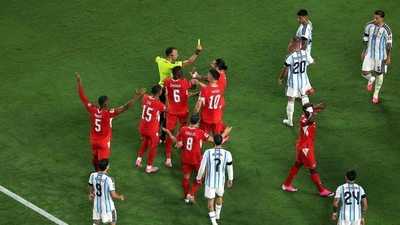
The Breel Embolo red card controversy has become one of the defining talking points of the FIFA World Cup 2026, raising fresh questions about the effectiveness of the Video Assistant Referee (VAR) system and the limitations of football’s current Laws of the Game. More than a week after the tournament concluded, the International Football Association Board (IFAB) admitted that Embolo’s dismissal during Switzerland’s quarterfinal against Argentina should never have happened.
The controversial decision not only changed the balance of one of the tournament’s biggest knockout matches but also sparked worldwide debate about whether football’s review system is keeping pace with the speed and complexity of the modern game. While Argentina eventually advanced to the semifinals, Switzerland was left wondering what might have been had the match remained eleven versus eleven.
What Happened During Argentina vs Switzerland?
The World Cup quarterfinal between Argentina and Switzerland had developed into one of the tournament’s most entertaining knockout matches. After conceding first, Switzerland responded with remarkable determination, pressing aggressively and forcing Argentina into defensive mistakes.
The European side eventually found an equalizer and looked increasingly capable of producing one of the biggest upsets of the competition. Their confidence grew with every attack, while Argentina struggled to regain control of possession.
Everything changed in the 72nd minute.
Breel Embolo went down after a challenge from Leandro Paredes. Initially, referee Joao Pinheiro penalized Paredes and showed him a yellow card. However, after a VAR review, the referee reversed the original decision, judged that no foul had occurred, and instead booked Embolo for simulation. Because Embolo had already received a yellow card earlier in the match, the second caution resulted in an automatic red card.
Reduced to ten players, Switzerland spent the remainder of the contest defending against relentless Argentine attacks before eventually conceding twice in extra time to lose 3-1.
Why IFAB’s Admission Matters
IFAB is responsible for writing and maintaining the Laws of the Game used across world football. When the organization publicly acknowledges that a key decision was incorrect, it carries enormous significance.
Its clarification effectively confirmed that the existing VAR protocol could not legally correct the situation once the referee issued the second yellow card. Rather than reviewing whether Embolo actually simulated, the system only allowed officials to confirm player identity in similar circumstances.
This exposed an important weakness within the current VAR framework: officials had video evidence available but lacked the authority under existing rules to overturn an incorrect disciplinary decision.
Understanding the VAR Protocol Limitation
Many football supporters assume VAR can review every major decision during a match. In reality, its authority is carefully restricted.
| Situation | Can VAR Review? | Reason |
|---|---|---|
| Direct red card | Yes | Considered a match-changing incident. |
| Goal decision | Yes | Checks for fouls, offside, or handball. |
| Penalty incident | Yes | VAR may recommend an on-field review. |
| Mistaken player identity | Yes | Corrects punishment given to the wrong player. |
| Second yellow card | No | Current Laws do not permit review of the offence itself. |
The Embolo incident highlighted perhaps the biggest loophole in the current system. Although technology existed to identify the mistake, the laws prevented officials from fixing it.
How the Decision Changed the Match
Football is often decided by moments rather than statistics, and Embolo’s dismissal proved exactly that.
- Switzerland lost its main attacking outlet.
- Argentina gained numerical superiority.
- Swiss players were forced into a defensive approach.
- The momentum shifted almost immediately.
- Extra time became significantly more difficult for the ten-man Swiss side.
Even though football can never guarantee a different outcome, the red card fundamentally altered the tactical landscape. Instead of pursuing victory, Switzerland focused on survival.
The Bigger Debate: Should Second Yellow Cards Become Reviewable?
The controversy has intensified discussions about expanding VAR’s authority.
Supporters of reform argue that any decision resulting in a player leaving the field deserves review because of its enormous influence on a match. Whether the dismissal comes from a straight red card or a second caution, the impact is effectively identical.
Opponents, however, warn that expanding reviews could increase stoppages, reduce game flow, and create additional pressure on referees. Football has spent years trying to balance technological accuracy with maintaining the sport’s natural rhythm.
The Embolo incident may ultimately become the strongest argument yet for changing that balance.
How Modern Football Is Evolving Through Technology
The FIFA World Cup 2026 showcased numerous technological innovations, from advanced offside detection to enhanced ball-tracking systems. Yet the Embolo controversy demonstrated that technology alone cannot eliminate controversy if competition rules restrict how it can be applied.
Football has increasingly embraced innovation over the past decade, but each technological advancement has required corresponding updates to the Laws of the Game. Without those legal adjustments, even the most sophisticated systems cannot prevent controversial outcomes.
Referee Accountability in the Spotlight
Elite referees operate under extraordinary pressure, often making split-second decisions before millions of viewers worldwide. VAR was introduced to reduce clear and obvious mistakes, not eliminate every controversial moment.
However, when governing bodies later acknowledge that an incorrect decision directly influenced a World Cup knockout match, public confidence inevitably comes under scrutiny.
The incident demonstrates that accountability extends beyond individual referees to the regulations governing how officials may use available technology.
Switzerland’s Perspective
For Switzerland, the admission offers emotional validation but little practical consolation.
The nation produced one of its strongest World Cup performances in decades and appeared capable of eliminating one of football’s traditional giants. Instead, the quarterfinal became remembered more for refereeing controversy than Swiss footballing quality.
Such moments can define generations of players, especially for countries that rarely reach the latter stages of the World Cup.
“The referee made the wrong decision. This rule destroyed our game today.”
Those post-match comments reflected the frustration of a team convinced that circumstances beyond its control shaped its World Cup fate.
Argentina’s Qualification Remains Official
Although IFAB acknowledged the error, the tournament results remain unchanged.
Football does not replay completed matches because of officiating mistakes, regardless of later admissions. Argentina’s progression therefore stands under existing FIFA competition regulations, even though debate surrounding the quarterfinal continues.
This principle preserves tournament integrity but also illustrates why improving officiating systems before future competitions is so important.
Historical Comparisons: Another Defining World Cup Officiating Debate
World Cups have repeatedly produced controversial refereeing moments that later prompted significant rule changes. Handball interpretations, goal-line technology, and the introduction of VAR itself all emerged after high-profile controversies highlighted weaknesses in existing regulations.
The Embolo incident may join that list as another turning point.
If football authorities eventually approve reviews for second yellow cards, historians may look back on this quarterfinal as the catalyst that accelerated reform.
Could IFAB Change the Rules?
IFAB has already indicated that expanding the review process will be considered during future evaluations of the VAR protocol.
Possible reforms include:
- Allowing VAR to review every second yellow card.
- Giving referees greater flexibility to reverse cautions after video review.
- Creating faster review procedures that minimize match interruptions.
- Clarifying simulation standards to improve consistency across competitions.
Any future amendment would likely undergo extensive testing before appearing in elite international tournaments.
Why This Matters Beyond One Match
The significance of the Embolo controversy extends far beyond Switzerland or Argentina.
Every major football competition depends on trust that rules are applied fairly and consistently. When technology identifies a mistake but regulations prevent correction, confidence in the system inevitably weakens.
The debate therefore concerns more than one red card—it concerns how football balances fairness, entertainment, and efficiency in the modern era.
Future Outlook
The FIFA World Cup 2026 may ultimately be remembered not only for its champions but also for accelerating another evolution of football’s laws.
IFAB’s unusually direct acknowledgment has opened the door to meaningful discussions about improving VAR and ensuring similar situations are avoided in future tournaments. Whether those conversations lead to formal rule changes remains to be seen, but pressure from players, coaches, supporters, and analysts is unlikely to fade anytime soon.
Conclusion
The Breel Embolo red card controversy has become one of the most significant officiating debates in recent World Cup history. IFAB’s admission that the dismissal should never have occurred exposed a critical gap in football’s VAR regulations rather than simply highlighting an individual refereeing mistake.
For Switzerland, the acknowledgment cannot erase the disappointment of elimination. For Argentina, the result remains part of World Cup history. For football itself, however, the incident may prove far more influential, serving as the catalyst for future VAR reforms designed to ensure that decisive knockout matches are determined by players on the pitch rather than limitations within the rulebook.
For breaking news and live news updates, like us on Facebook or follow us on Twitter and Instagram. Read more on Latest Sports on thefoxdaily.com.






COMMENTS 0