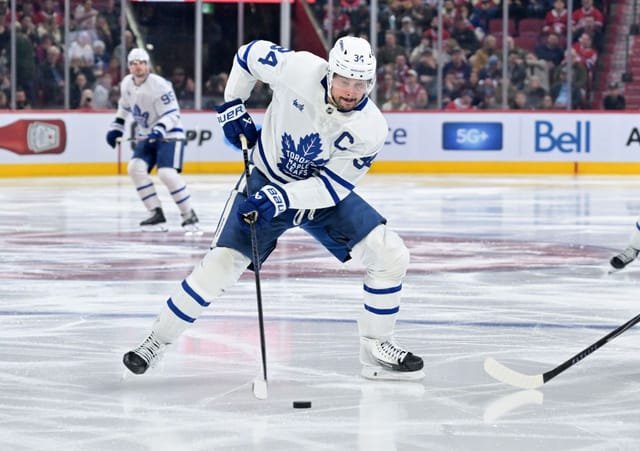
Auston Matthews NHL goal record chase has become one of the biggest long-term storylines in hockey, with the Toronto Maple Leafs captain already producing at a scoring rate that places him among the most prolific goal scorers of his generation. The obvious question is whether Matthews can eventually surpass Alex Ovechkin’s all-time NHL goals record.
Former NHL player and analyst Mike Rupp recently offered a cautious assessment of Matthews’ chances. Rupp acknowledged that Matthews possesses the ability to score at an extraordinary rate but argued that maintaining that production for many seasons is the real challenge.
The debate is not simply about who can score the most goals in a single season. It is about the combination of elite scoring, health, consistency, games played and longevity that has allowed Ovechkin to establish one of the most difficult records in professional sports.
Matthews has already shown that he can reach scoring levels that few players in modern hockey can match. However, his route to the top would require him to maintain that level while avoiding the interruptions that can dramatically change a player’s career trajectory.
Why Mike Rupp is skeptical about Matthews breaking Ovechkin’s record
Rupp’s argument is built around one central issue: consistency over an exceptionally long period.
Matthews has repeatedly demonstrated that he can produce at an elite scoring pace. He has also recorded multiple seasons with 60 or more goals, showing that his peak scoring ability is not in question.
The concern is what happens during the seasons when his production dips.
According to Rupp, Matthews has occasionally experienced downturns before responding with another outstanding campaign. That pattern is manageable for a normal superstar, but it becomes a major problem when the target is an all-time record that demands extraordinary accumulation over many seasons.
Rupp believes Matthews may need to remain in the 60-goal range or even higher for extended stretches to maintain a realistic pace toward Ovechkin’s record.
That is an enormous requirement, particularly because scoring 60 goals in an NHL season is itself an exceptional achievement.
Matthews has already proved he can score 60
One reason the record conversation exists in the first place is Matthews’ remarkable goal-scoring ceiling.
He has reached the 60-goal mark twice in his NHL career, demonstrating that he can produce at a level normally associated with the very best scoring seasons in league history.
Ovechkin, meanwhile, has reached 60 goals once during his career.
That comparison gives Matthews an important advantage when discussing pure peak scoring ability.
However, the all-time record is not determined by the highest individual season. It is determined by how often a player can remain productive over the course of an entire career.
That is where the comparison becomes much more complicated.
Ovechkin’s longevity is the biggest obstacle
Alex Ovechkin’s career provides the clearest explanation for why breaking the NHL goal record is so difficult.
His success has not depended solely on extraordinary seasons. He has repeatedly returned to the top of the scoring charts or remained among the league’s most dangerous goal scorers over a remarkably long period.
That sustained production has created an enormous cumulative total.
Even when Ovechkin was no longer producing at the peak level of his younger years, his ability to continue contributing goals remained extremely valuable to his record chase.
This is the distinction Rupp highlighted.
Matthews may be capable of producing more goals in an individual season, but Ovechkin’s advantage has been the ability to keep playing and scoring for season after season.
The first-689-game comparison tells an important story
The early-career comparison between Matthews, Ovechkin and Wayne Gretzky offers another interesting perspective.
Gretzky scored 580 goals through his first 689 games, while Matthews sits second on the referenced list. Ovechkin was third with 427 goals at that stage, with Matthews one goal ahead of him in the comparison cited.
Those numbers demonstrate just how unusual Matthews’ early scoring pace has been.
But early-career scoring pace does not automatically translate into the highest career total.
Career records are ultimately endurance tests.
A player can start faster and still finish behind someone whose career remains remarkably productive over a longer period.
Peak scoring versus career longevity
The Matthews-Ovechkin debate can be simplified into two different measurements of greatness.
| Factor | Auston Matthews | Alex Ovechkin |
|---|---|---|
| Peak goal-scoring ability | Elite, including multiple 60-goal seasons | Elite, including a 60-goal season |
| Career longevity | Still building his career | One of the defining strengths of his career |
| Consistency | Outstanding but has experienced occasional dips | Remarkably consistent over a long period |
| Health and availability | Recent injury interruption is a concern | Long-term availability has aided record chase |
| Record outlook | Possible but requires sustained elite production | Set an exceptionally difficult benchmark |
This comparison explains why the debate cannot be settled simply by counting 60-goal seasons.
Health could become the deciding factor
One of the most important elements in Matthews’ record pursuit is something no player can completely control: availability.
Matthews’ 2025-26 season was cut short after he suffered a Grade 3 MCL tear and a quad contusion in his left leg following a knee-on-knee collision with Radko Gudas.
He played 60 games during the season before the injury ended his campaign.
That matters because every missed game represents an opportunity lost in a career-long accumulation race.
A player targeting an all-time record does not necessarily need to avoid every injury, but repeated interruptions can make the mathematical challenge considerably harder.
Matthews is recovering after knee surgery
Matthews underwent successful knee surgery in March and has been working toward a return for the 2026-27 season.
His rehabilitation is therefore one of the most closely watched developments surrounding the Maple Leafs captain.
Matthews was recently seen working with sports chiropractor Shawn Robek in Arizona. The sighting generated concern among some Maple Leafs supporters because Robek is associated with treating back-related issues.
However, the mere fact that an athlete is working with a particular sports professional does not establish that he has suffered a new injury.
Matthews remains expected to be fit for the 2026-27 season, making his eventual return to competitive action the more meaningful indicator of his recovery.
Why missed games matter in an all-time scoring race
Imagine two players scoring at almost identical rates per game.
If one player appears in 80 games every season while the other misses 15 to 20 games regularly, the difference in career totals can become enormous over time.
This is particularly relevant to Matthews because his scoring efficiency has never been the primary question.
The bigger question is how many games he can play while maintaining that efficiency.
Ovechkin’s record is partly a monument to his durability. His ability to remain available for a huge number of games allowed him to turn elite scoring into an extraordinary career total.
Matthews’ biggest advantage is his age profile
There is also an important reason not to dismiss Matthews’ chances.
Unlike Ovechkin, Matthews is still building the majority of his career total.
That means he has time to accumulate goals, and his existing scoring rate gives him a strong foundation.
If he returns from his knee injury fully healthy and produces another series of elite seasons, the conversation could become much more serious.
Matthews does not necessarily need to replicate his best scoring season every year. But he does need to avoid a prolonged decline and maximize the number of games in which he can play at his usual level.
The 60-goal benchmark could become Matthews’ measuring stick
For Matthews, the 60-goal mark may become more than a statistical milestone.
It could become the benchmark by which his record chances are evaluated.
One 60-goal season proves that a player can reach that level. Multiple 60-goal seasons establish a pattern. Repeatedly approaching that territory deep into a career would make the Ovechkin comparison increasingly credible.
However, expecting 60 goals every year would be unrealistic.
The NHL is too competitive, injuries are unpredictable and scoring environments can change.
The more practical requirement is sustained high-end production, combined with enough games played to turn that production into cumulative totals.
Why Matthews’ scoring style makes the comparison fascinating
Matthews has built his reputation around an elite shooting ability and an exceptional understanding of scoring areas.
His ability to generate dangerous shots from the slot and release the puck quickly makes him a constant threat around the net.
That style can potentially age well because goal-scoring intelligence and shooting technique do not necessarily disappear as quickly as raw speed or athletic explosiveness.
That could help Matthews later in his career.
At the same time, his effectiveness still depends on staying healthy enough to reach those scoring areas consistently.
Ovechkin’s career offers Matthews a blueprint
Rather than viewing Ovechkin only as the player Matthews must surpass, his career can also be viewed as a blueprint for how to pursue such a record.
Ovechkin’s career demonstrates the value of adapting while maintaining a reliable scoring identity.
As players age, their physical abilities change. The challenge is finding ways to remain productive despite those changes.
If Matthews can make similar adjustments later in his career, his chances of remaining an elite scorer could improve.
What Matthews needs to do to make the record chase realistic
- Stay healthy: Availability is essential in a cumulative statistical race.
- Maintain elite efficiency: His scoring rate needs to remain among the league’s best.
- Limit prolonged slumps: Occasional dips are normal, but extended downturns can create a major gap.
- Continue playing deep into his career: Longevity is one of Ovechkin’s greatest advantages.
- Adapt his game: Maintaining scoring production as his career progresses will be crucial.
Could Matthews actually surpass Ovechkin?
The honest answer is that it remains possible, but extremely difficult.
Matthews possesses the scoring ability required to make the conversation legitimate. His multiple 60-goal seasons and exceptional early-career production demonstrate that his ceiling is high enough.
But breaking an all-time NHL goal record requires more than a high ceiling.
It requires years of elite production, strong health, consistent availability and the willingness to continue competing when the body naturally begins to slow down.
That is why Rupp’s skepticism is understandable.
Matthews may be one of the best pure goal scorers of his era, but Ovechkin’s record reflects something broader: sustained excellence over an extraordinary career.
The 2026-27 season could be an important checkpoint
Matthews’ next season will not decide whether he breaks the record, but it could provide an important indication of how realistic the chase remains.
His return from knee surgery will be closely monitored, particularly because he played only 60 games during the previous campaign.
A healthy season with strong goal production would immediately restore momentum to the discussion.
A season affected by further injury or a significant scoring decline would make the challenge considerably more difficult.
For now, the priority is not the record itself. It is getting Matthews back on the ice and allowing him to rebuild his rhythm.
The biggest insight: this is a durability race disguised as a scoring race
The most overlooked part of the Matthews-Ovechkin debate is that the record chase is not simply about scoring talent.
It is fundamentally about how long elite scoring can be sustained.
Matthews has already shown that he can score goals at a remarkable pace. The question is whether he can combine that ability with the kind of availability that made Ovechkin’s career so extraordinary.
That is why every healthy season from Matthews matters.
Every 50-goal campaign keeps the pressure on. Every 60-goal season accelerates the chase. Every missed stretch of games, meanwhile, makes the mountain slightly higher.
Conclusion: Matthews has the talent, but Ovechkin set an extraordinary standard
Auston Matthews’ pursuit of Alex Ovechkin’s NHL goal record remains one of the most fascinating long-term statistical debates in hockey.
Matthews has already demonstrated a scoring ceiling that few players can match, including multiple 60-goal seasons. His early-career goal production also places him among the most prolific scorers in NHL history at comparable stages.
But Mike Rupp’s warning highlights the central problem. Matthews needs more than spectacular individual seasons. He needs sustained production, strong health and exceptional longevity.
Ovechkin’s greatest advantage has never been simply his ability to score 50 or 60 goals. It has been his ability to keep doing it, year after year, while remaining available.
Matthews still has time to build his case. If he returns healthy for the 2026-27 season and begins another sustained period of elite scoring, the record conversation will become even more compelling.
For now, however, Ovechkin’s benchmark remains exactly what Rupp described it as: a record that demands not just brilliance, but extraordinary endurance.
For breaking news and live news updates, like us on Facebook or follow us on Twitter and Instagram. Read more on Latest NHL on thefoxdaily.com.






COMMENTS 0