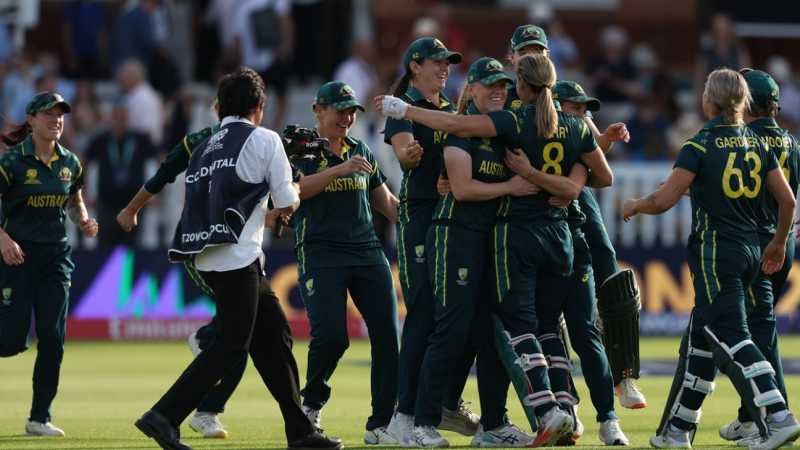
Australia Women once again proved why they remain the benchmark of international cricket, defeating England Women by seven wickets in the ICC Women’s T20 World Cup 2026 final at Lord’s. Chasing a target of 151, Australia produced a commanding batting display led by Beth Mooney and Phoebe Litchfield to secure a record-extending seventh Women’s T20 World Cup title.
The victory was about far more than another trophy. It represented a statement from a team determined to reclaim its place at the summit of world cricket after experiencing disappointment in recent ICC tournaments. On one of the sport’s most iconic stages, Australia combined tactical discipline, elite execution, and championship composure to remind the cricketing world why they have become the most successful team in Women’s T20 World Cup history.
For England, the defeat was painful. Playing a World Cup final at home offered a golden opportunity to end a long wait for another T20 crown. Despite a fighting innings from captain Nat Sciver-Brunt and a late surge from Freya Kemp, England ultimately found themselves outclassed by an Australian side that looked in control for most of the contest.
Australia’s Seventh T20 World Cup Title: A Historic Achievement
Winning a single World Cup is difficult. Winning seven is the kind of achievement that defines a sporting dynasty.
Australia’s triumph at Lord’s further cements their status as the most dominant team in the history of women’s cricket. Across multiple generations, coaching staffs, and playing groups, Australia have consistently maintained elite standards that few international teams in any sport have matched.
The latest title extends an extraordinary record in Women’s T20 World Cup finals.
| Achievement | Australia Women |
|---|---|
| Women’s T20 World Cup Titles | 7 |
| T20 World Cup Final Appearances Won | 7 |
| Finals Lost | 0 |
| Success Rate in Finals | 100% |
Few teams in global sport can claim such a remarkable record in championship matches. The ability to perform under pressure repeatedly is what separates great teams from legendary ones.
How the Final Unfolded at Lord’s
England entered the final hoping to leverage home conditions and a passionate crowd at Lord’s, widely regarded as the “Home of Cricket.” The atmosphere was electric as fans anticipated a clash between two of the strongest teams in the tournament.
Australia won the toss and elected to field first, a decision that immediately placed pressure on England’s batting lineup.
England struggled to establish momentum during the early and middle overs. Australia’s bowlers maintained disciplined lines and lengths, preventing England’s power hitters from dominating.
Despite the challenges, captain Nat Sciver-Brunt anchored the innings with a composed unbeaten half-century. Her knock ensured England remained competitive even when scoring opportunities were limited.
Freya Kemp then provided the acceleration England desperately needed. Her aggressive unbeaten innings transformed what looked like a below-par total into a more respectable score of 150 for 4.
At the innings break, England had given themselves a chance. However, against an Australian batting lineup packed with experience and firepower, many observers felt the target was still below what would be required in a World Cup final.
England’s Innings: Stability Without Enough Acceleration
One of the defining features of England’s batting performance was the contrast between stability and explosiveness.
While wickets were preserved reasonably well, the innings lacked sustained scoring momentum through crucial phases.
Several factors contributed to England’s total:
- Strong Australian bowling discipline
- Limited boundary opportunities in the middle overs
- Pressure created by the occasion
- Excellent field placements
- Controlled death-over execution by Australia
Nat Sciver-Brunt’s unbeaten 58 demonstrated leadership and composure. Yet in modern T20 cricket, individual half-centuries are often not enough unless supported by aggressive partnerships throughout the innings.
The late partnership involving Freya Kemp helped England recover, but many analysts believed a score closer to 170 would have been necessary to seriously challenge Australia.
Beth Mooney Delivers Yet Again on the Biggest Stage
Big players define big matches, and Beth Mooney once again proved why she is regarded as one of the greatest performers in Women’s T20 World Cup history.
Her innings of 64 provided the foundation for Australia’s successful chase. More importantly, it showcased the qualities that have made her such a consistent performer in major tournaments.
Mooney’s strengths were evident throughout the innings:
- Exceptional shot selection
- Calm decision-making under pressure
- Ability to rotate strike consistently
- Boundary-hitting at crucial moments
- Control against both pace and spin
Remarkably, this was another major final in which Mooney rose to the occasion. The ability to repeatedly deliver on cricket’s biggest stages is a hallmark of truly elite athletes.
Her innings removed any pressure from the chase and ensured Australia remained firmly in command.
Phoebe Litchfield Announces Herself on the Grandest Stage
While Mooney’s brilliance was expected, Phoebe Litchfield’s contribution represented the arrival of another major Australian star.
Playing in her first Women’s T20 World Cup final, Litchfield displayed remarkable confidence. Rather than appearing overwhelmed by the occasion, she attacked England’s bowlers with maturity and intent.
Her 48-run innings may have fallen just short of a half-century, but its impact was enormous.
The partnership between Litchfield and Mooney effectively decided the match. By building a century stand, they removed any possibility of England creating sustained pressure during the chase.
For Australia, Litchfield’s performance also highlighted an important long-term trend: the seamless integration of emerging talent into an already successful team.
The Partnership That Broke England’s Resistance
In T20 cricket, partnerships often determine outcomes more than individual performances.
Australia’s match-winning stand between Beth Mooney and Phoebe Litchfield transformed the contest from a competitive final into a largely one-sided chase.
| Partnership Factor | Impact on Match |
|---|---|
| Century Partnership | Removed scoreboard pressure |
| Strike Rotation | Prevented dot-ball pressure |
| Boundary Frequency | Maintained required run rate |
| Partnership Duration | Controlled middle overs |
| Wicket Preservation | Kept England out of the game |
By the halfway stage of the chase, Australia had effectively taken control, forcing England into increasingly desperate tactical decisions.
Why Australia Remain the Gold Standard in Women’s Cricket
Australia’s latest World Cup triumph was not simply the result of superior talent. It reflected a broader system that consistently produces world-class cricketers.
Several factors contribute to Australia’s sustained success:
- Strong domestic cricket structure
- Investment in player development
- Elite coaching systems
- Deep talent pool
- Winning culture built over decades
Unlike teams that rely heavily on a few star players, Australia regularly introduces new match-winners without losing competitiveness.
This ability to regenerate talent while maintaining elite performance levels has become the defining characteristic of their cricketing dominance.
England’s Positives Despite the Defeat
Although England fell short, the tournament provided several encouraging signs for the future.
Reaching a World Cup final demonstrates significant progress and confirms that England remains among the strongest teams in international women’s cricket.
Key positives included:
- Leadership from Nat Sciver-Brunt
- Emergence of Freya Kemp in pressure situations
- Consistent performances throughout the tournament
- Ability to compete against elite opposition
- Strong support from home crowds
The experience gained from competing in a World Cup final could prove invaluable for England’s next generation of players.
What This Victory Means for Women’s Cricket Globally
The significance of Australia’s victory extends beyond the trophy itself.
Women’s cricket continues to experience unprecedented growth in popularity, investment, and global visibility. High-quality finals played at iconic venues such as Lord’s help accelerate that momentum.
The tournament showcased:
- Rising standards of competition
- Increasing fan engagement
- Growing commercial opportunities
- Enhanced global media coverage
- The emergence of new cricketing stars
As more countries invest in women’s cricket, the overall quality and competitiveness of international tournaments are expected to continue improving.
A Comparison of the Finalists
| Category | Australia Women | England Women |
|---|---|---|
| Batting Execution | Excellent | Good |
| Bowling Discipline | Outstanding | Competitive |
| Fielding | Sharp and Efficient | Solid |
| Pressure Management | Elite | Mixed |
| Key Partnerships | Match-Winning | Late Recovery |
The comparison reflects why Australia ultimately emerged as deserving champions.
Lessons From Another Australian Championship Performance
If there was one lesson from the 2026 Women’s T20 World Cup final, it is that championship teams understand how to control big moments.
Australia rarely appeared rushed, nervous, or reactive. Their bowlers executed plans with precision, their batters paced the chase perfectly, and their overall game management was exemplary.
These qualities are often invisible in scorecards but become decisive in finals where pressure can overwhelm even the most talented players.
Championship cricket is not only about skill—it is about decision-making under pressure, and Australia once again mastered that challenge.
Conclusion: Australia’s Dynasty Continues at Lord’s
Australia Women’s seven-wicket victory over England Women in the ICC Women’s T20 World Cup 2026 final will be remembered as another landmark achievement in an extraordinary era of dominance. Led by Beth Mooney’s match-winning innings and supported by Phoebe Litchfield’s fearless contribution, Australia chased down 151 with authority to secure a record seventh title.
For England, the defeat will hurt, but reaching the final demonstrates that they remain a major force in world cricket. The experience gained at Lord’s could serve as a foundation for future success.
For Australia, however, this was another reminder of why they continue to set the standard in women’s cricket. Their blend of experience, talent, preparation, and mental strength has created one of the greatest dynasties in modern sport.
As the celebrations begin and another World Cup trophy heads to Australia, the rest of the cricketing world faces a familiar challenge: finding a way to catch a team that continues to redefine excellence on the biggest stage.
For breaking news and live news updates, like us on Facebook or follow us on Twitter and Instagram. Read more on Latest Sports on thefoxdaily.com.






COMMENTS 0