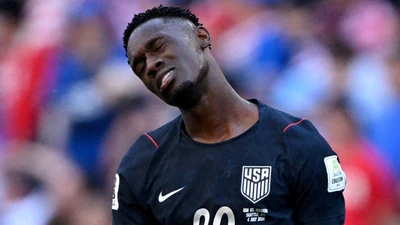
The 2026 FIFA World Cup Round of 16 clash between Belgium and the United States was expected to be remembered for its high stakes and quarterfinal implications. Instead, it became one of the tournament’s most controversial storylines, combining disciplinary drama, FIFA sanctions, social media reactions, and a commanding Belgian performance.
Belgium’s emphatic 4-1 victory over the US Men’s National Team (USMNT) secured a place in the quarterfinals, but much of the discussion afterward centered on Folarin Balogun, whose eligibility became a major talking point following a red-card incident in the previous round.
As FIFA officially confirmed disciplinary action against Balogun and the United States Soccer Federation, Belgium’s players and supporters appeared eager to highlight the controversy, adding another chapter to what has already become one of the most debated moments of the 2026 World Cup.
The result not only ended America’s World Cup dream but also raised broader questions about disciplinary consistency, tournament governance, and the increasing influence of off-field narratives on football’s biggest stage.
How Belgium Dominated the United States
While the controversy surrounding Balogun attracted headlines, Belgium’s performance on the pitch ultimately decided the match.
The Red Devils displayed a level of efficiency and attacking quality that the United States struggled to match over ninety minutes.
Belgium controlled critical moments of the game, capitalized on defensive mistakes, and demonstrated the experience expected from a nation with deep World Cup ambitions.
Despite a competitive opening period, Belgium gradually imposed itself through superior finishing and composure under pressure.
| Match Detail | Belgium | United States |
|---|---|---|
| Goals Scored | 4 | 1 |
| Result | Quarterfinal Qualification | Eliminated |
| Top Performer | Charles De Ketelaere | Malik Tillman |
| Next Stage | Quarterfinal vs Spain | Tournament Ended |
The scoreline reflected Belgium’s clinical execution rather than mere luck. Every major mistake by the United States was punished, highlighting the fine margins that often determine success in knockout football.
The Folarin Balogun Controversy Explained
The biggest off-field story surrounding the match involved Folarin Balogun and a disciplinary decision that divided fans, analysts, and former players.
The controversy began when Balogun received a red card during a previous World Cup match after a VAR review determined that his challenge constituted serious foul play.
Normally, such incidents result in an automatic suspension. However, the circumstances surrounding the case became increasingly complicated after FIFA reviewed the situation.
Balogun was ultimately available for selection against Belgium, triggering widespread debate about whether the decision was fair and consistent with previous disciplinary rulings.
Supporters from multiple countries questioned the process, while football commentators spent days discussing the implications for tournament integrity.
FIFA’s Official Decision and Sanctions
Following the controversy, FIFA released a detailed explanation regarding the disciplinary outcome.
According to the governing body, Balogun was found guilty of multiple infringements related to the incident.
The sanctions included:
- A one-match suspension that was suspended on probation for one year.
- A financial penalty of USD 40,000.
- Joint liability assigned to the United States Soccer Federation for payment of the fine.
The decision effectively allowed Balogun to remain available while still imposing disciplinary consequences.
This compromise generated mixed reactions across the football community.
Some observers viewed it as a balanced resolution, while others argued that it created confusion regarding how red-card offenses should be handled at major tournaments.
Why the Decision Became Such a Big Story
World Cup controversies often gain momentum because of the tournament’s global visibility.
Every disciplinary ruling, refereeing decision, or VAR review is scrutinized by millions of fans around the world.
In Balogun’s case, the situation became even more explosive because it occurred during the knockout stage, where every decision can significantly impact a nation’s chances of advancing.
The debate expanded beyond the player himself and evolved into a discussion about transparency, consistency, and trust in football governance.
For FIFA, maintaining credibility during such situations is critical because perceptions of fairness can influence how fans view the competition as a whole.
Belgium’s Social Media Reaction Sparks More Debate
Following the victory, Belgium’s social media activity attracted considerable attention.
A celebratory post featuring Romelu Lukaku appeared to reference the controversy directly, with messaging that many interpreted as a playful jab at the decision involving Balogun.
In modern football, social media has become an extension of competition itself.
Teams increasingly use online platforms to engage supporters, celebrate victories, and occasionally take subtle digs at opponents.
While some fans appreciated the humor, others felt the timing was unnecessary given the seriousness of the disciplinary discussion.
The reaction demonstrated how quickly sporting moments can evolve into broader cultural conversations in the digital era.
Charles De Ketelaere Emerges as Belgium’s Match Winner
Amid the controversy, one footballing performance deserves significant recognition.
Charles De Ketelaere delivered one of his finest displays of the tournament, scoring twice and consistently troubling the American defense.
His movement between defensive lines created problems throughout the match, while his finishing showcased the confidence of a player entering his prime years.
Belgium has long been associated with world-class attacking talent, and De Ketelaere’s performance suggested he could become one of the key figures in the country’s next footballing generation.
For a team aiming to challenge for the World Cup title, emerging stars often prove just as important as established veterans.
The Moment That Changed Everything: Matt Freese’s Error
Knockout matches are often decided by individual moments, and Belgium’s third goal became the turning point of the contest.
Until that stage, the United States remained competitive and appeared capable of mounting a comeback.
However, a costly mistake from goalkeeper Matt Freese dramatically shifted momentum.
Attempting to clear danger outside his penalty area, Freese found himself caught out of position. Belgium reacted instantly, regaining possession and finishing into an empty net.
The goal transformed the atmosphere of the match.
Instead of chasing an equalizer, the United States suddenly faced a two-goal deficit against one of the tournament’s most experienced sides.
From that point forward, Belgium controlled proceedings with increasing confidence.
What Went Wrong for the USMNT?
The defeat exposed several challenges facing the American team.
While the USMNT showed moments of attacking promise, consistency remained an issue throughout the match.
Several key factors contributed to the loss:
- Defensive lapses in crucial moments.
- Failure to capitalize on scoring opportunities.
- Difficulty controlling possession under pressure.
- Mental impact following the third goal.
- Belgium’s superior experience in knockout situations.
The performance highlighted how difficult it remains to compete against elite European nations when small mistakes are punished so ruthlessly.
What This Result Means for Belgium’s World Cup Ambitions
Belgium’s victory was about more than simply advancing.
It reinforced the idea that the Red Devils remain genuine contenders despite entering the tournament with less hype than some traditional favorites.
The squad combines experienced leaders with emerging talent, creating a balanced team capable of adapting to different tactical situations.
Most importantly, Belgium demonstrated composure under pressure—a characteristic often associated with teams that make deep World Cup runs.
The challenge now becomes significantly harder.
A quarterfinal showdown against Spain awaits, presenting one of the most demanding tests remaining in the tournament.
Belgium vs Spain: A Quarterfinal Worth Watching
The upcoming clash between Belgium and Spain has all the ingredients of a classic World Cup encounter.
| Category | Belgium | Spain |
|---|---|---|
| Round of 16 Result | Defeated USA 4-1 | Defeated Portugal 1-0 |
| Strength | Direct attacking football | Possession-based control |
| Key Advantage | Physicality and finishing | Midfield dominance |
| World Cup Goal | Reach semifinals | Win the tournament |
The matchup will pit contrasting football philosophies against one another, making it one of the most anticipated quarterfinals of the competition.
A Unique Insight: Why This Controversy Reflects Modern Football’s Biggest Challenge
The Balogun situation highlights a broader issue facing football governance.
Technology has improved decision-making accuracy through tools such as VAR, but it has also increased expectations for absolute consistency.
Fans now analyze every disciplinary ruling in extraordinary detail.
As a result, governing bodies face growing pressure to communicate decisions clearly and transparently.
Future tournaments may require even more detailed explanations and standardized disciplinary frameworks to avoid similar controversies.
In that sense, the Balogun case may influence how football handles disciplinary appeals long after the 2026 World Cup concludes.
Conclusion: Belgium Advances, but the Debate Is Far From Over
Belgium’s 4-1 victory over the United States secured its place in the FIFA World Cup quarterfinals and showcased the quality required to compete for football’s biggest prize.
However, the match will also be remembered for the controversy surrounding Folarin Balogun, FIFA’s disciplinary decision, and the debates that followed.
On the pitch, Belgium proved too strong, with Charles De Ketelaere, Romelu Lukaku, and the rest of the squad delivering a convincing performance. Off the pitch, questions about consistency, governance, and disciplinary procedures continued to dominate headlines.
As the tournament moves into its decisive stages, Belgium now turns its attention to Spain. Meanwhile, the Balogun controversy serves as a reminder that in modern football, the biggest stories are not always decided solely by what happens between the lines.
For breaking news and live news updates, like us on Facebook or follow us on Twitter and Instagram. Read more on Latest Sports on thefoxdaily.com.





COMMENTS 0