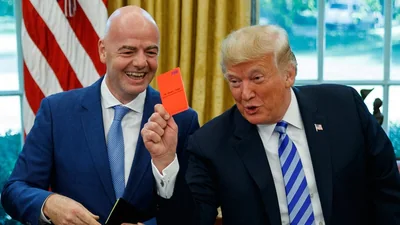
The FIFA World Cup 2026 has delivered unforgettable goals, dramatic upsets, and emotional moments. Yet one of the tournament’s most talked-about stories has emerged away from the pitch.
The controversy surrounding United States striker Folarin Balogun’s red card and the subsequent reversal of his automatic suspension has ignited debate across football, politics, and international sports governance.
What began as a refereeing decision during a knockout-stage match quickly evolved into a much larger conversation involving FIFA officials, government figures, football associations, and questions about how disciplinary rulings should be handled during major international tournaments.
At the center of the debate are three critical issues: the role of technology in officiating, the independence of football governing bodies, and whether external pressure should ever influence sporting decisions.
Regardless of where fans stand on the incident, the controversy highlights challenges that modern football increasingly faces in an era where sports, politics, media, and global influence frequently intersect.
How the Folarin Balogun Red Card Became a Major World Cup Story
Red cards are not unusual in World Cup competitions. Every tournament produces controversial decisions that divide supporters, players, and analysts.
What made this situation different was the aftermath.
The disciplinary process became a headline story because the decision did not end with the referee’s final whistle. Instead, discussions surrounding the incident continued through official reviews, public statements, and widespread scrutiny from multiple stakeholders.
The incident quickly moved beyond a simple refereeing debate and became a test of how football authorities respond when controversial decisions attract global attention.
In today’s digital age, major sporting controversies can generate worldwide reactions within minutes, placing governing bodies under immense pressure to explain and defend their decisions.
Why Refereeing Decisions Have Become More Controversial in Modern Football
Football has never been free from controversy.
For decades, debates over penalties, offsides, fouls, and disciplinary actions have fueled passionate discussions among fans.
However, the introduction of modern technologies such as video review systems has fundamentally changed expectations.
Supporters increasingly believe that technology should eliminate clear mistakes. When controversial decisions still occur despite technological assistance, scrutiny becomes even greater.
This creates a difficult environment for referees.
Every decision is analyzed from multiple camera angles, slowed down frame by frame, and debated across television broadcasts and social media platforms.
As a result, refereeing standards are often judged more intensely than at any point in football history.
| Era | Refereeing Challenge | Public Reaction |
|---|---|---|
| Pre-Technology Era | Limited camera evidence | Debates based on opinion |
| VAR Era | Decisions reviewed repeatedly | Higher expectations of accuracy |
| Modern World Cups | Global scrutiny in real time | Instant worldwide reactions |
The Bigger Issue: Should Politics Influence Sporting Decisions?
One reason this controversy gained extraordinary attention is that it extended beyond football circles.
Whenever political figures become involved in sporting matters, questions naturally emerge regarding influence, independence, and fairness.
Sporting organizations typically emphasize that decisions should be based on established rules and disciplinary procedures rather than outside pressure.
This principle is fundamental to maintaining credibility.
Fans expect results, suspensions, and disciplinary outcomes to be determined by sporting regulations rather than political considerations.
The debate surrounding Balogun’s case has therefore become a broader discussion about where the line should be drawn between advocacy and interference.
While public figures often express opinions about sports, governing bodies must ensure that final decisions remain grounded in transparent procedures.
Why FIFA’s Disciplinary System Matters
The World Cup is football’s most prestigious tournament, meaning every disciplinary decision carries enormous consequences.
A suspension can impact not only an individual player but also a nation’s chances of progressing in the competition.
Because the stakes are so high, FIFA maintains disciplinary mechanisms designed to review incidents and ensure consistency.
These systems exist for a reason.
Football matches occur at incredible speed, and even with technological assistance, difficult situations occasionally require further examination after games conclude.
The credibility of any tournament depends on participants believing that these review processes are applied fairly and consistently.
Whenever a high-profile decision is altered, transparency becomes particularly important.
The Impact on the United States World Cup Campaign
From a purely sporting perspective, the decision carries significant implications for the United States national team.
Major tournaments are often decided by squad depth, availability, and momentum.
Losing an important attacking player during the knockout stages can dramatically alter tactical plans and reduce offensive flexibility.
The availability of key players becomes even more important as opponents become stronger deeper into the tournament.
For the United States, maintaining access to attacking options could prove crucial as the competition intensifies.
World Cup success frequently depends on fine margins, and personnel decisions can influence outcomes just as much as tactics.
Why Belgium’s Response Matters
Another significant aspect of the controversy is the reaction from Belgium’s football authorities.
Disagreements over disciplinary rulings are not uncommon in international sport. However, formal challenges from national associations elevate disputes beyond ordinary post-match discussions.
Such responses reflect concerns about consistency and competitive fairness.
Football’s governing institutions rely heavily on trust. Competing nations must believe that regulations are applied equally regardless of status, popularity, or external pressure.
When disputes emerge, governing bodies face the challenge of balancing legal procedures, sporting integrity, and public confidence.
This is often more difficult than making the original decision itself.
The Growing Pressure on FIFA in the Modern Era
Football’s governing authorities operate in an environment unlike any previous generation.
Every controversial decision is immediately dissected by:
- Players and coaches.
- National football associations.
- Sports analysts.
- Government officials.
- Media organizations.
- Millions of fans worldwide.
This unprecedented level of attention increases pressure on decision-makers.
Even well-reasoned rulings can become controversial if communication is unclear or stakeholders feel excluded from the process.
As football continues expanding globally, effective governance will become increasingly important to maintaining trust in major competitions.
Technology Has Improved Football—But It Hasn’t Eliminated Debate
One of the most interesting lessons from the Balogun controversy is that technology cannot remove every disagreement from sport.
Video reviews can provide additional evidence, but interpretation remains a human responsibility.
Questions such as intent, recklessness, excessive force, and player safety often involve subjective judgment.
Two qualified observers can view the same footage and reach different conclusions.
This reality explains why debates continue despite significant technological advances.
Football remains a sport governed by rules, but it is also a sport governed by interpretation.
Technology can provide information, but judgment ultimately determines how that information is applied.
What This Controversy Reveals About Modern Sports Culture
Perhaps the most fascinating aspect of this story is how quickly it expanded beyond football.
Modern sports no longer exist in isolation.
They intersect with politics, economics, media, branding, and public opinion in ways that were unimaginable decades ago.
A single disciplinary decision can become a global news story because sports now occupy a central position within popular culture.
This interconnected environment creates opportunities for growth and engagement, but it also introduces new challenges.
Organizations must balance transparency with independence while managing increasingly diverse stakeholder interests.
Could This Influence Future FIFA Policies?
Major controversies often become catalysts for change.
Throughout football history, debates over officiating, discipline, and governance have frequently led to reforms.
Whether this particular case results in policy adjustments remains uncertain, but it may encourage further discussions regarding:
- Disciplinary review procedures.
- Transparency standards.
- Appeals processes.
- Communication with stakeholders.
- Public explanations of major rulings.
Football’s governing bodies continuously evolve, and high-profile incidents often accelerate those conversations.
Key Takeaways From the Balogun Suspension Debate
| Issue | Why It Matters |
|---|---|
| Refereeing Decisions | Directly impact tournament outcomes |
| Disciplinary Reviews | Ensure fairness and consistency |
| Political Involvement | Raises questions about independence |
| FIFA Governance | Central to maintaining credibility |
| Player Availability | Can significantly affect team performance |
| Public Trust | Essential for confidence in competition integrity |
Conclusion: A Football Decision With Global Implications
The controversy surrounding Folarin Balogun’s red card and subsequent suspension review is about far more than a single incident in a football match.
It highlights the growing complexity of modern sports governance, where decisions are scrutinized by global audiences and influenced by broader conversations about fairness, transparency, and accountability.
For FIFA, the episode serves as another reminder that maintaining public trust requires clear communication and consistent application of rules.
For national teams, it demonstrates how disciplinary rulings can significantly impact tournament ambitions.
For fans, it reinforces an enduring truth about football: even in an age of advanced technology and detailed regulations, controversy remains an unavoidable part of the sport.
As the FIFA World Cup 2026 progresses, attention will inevitably shift back to the action on the field. Yet the debates sparked by the Balogun case are likely to continue long after the final whistle of the tournament, influencing discussions about officiating, governance, and the future direction of international football.
For breaking news and live news updates, like us on Facebook or follow us on Twitter and Instagram. Read more on Latest Sports on thefoxdaily.com.






COMMENTS 0