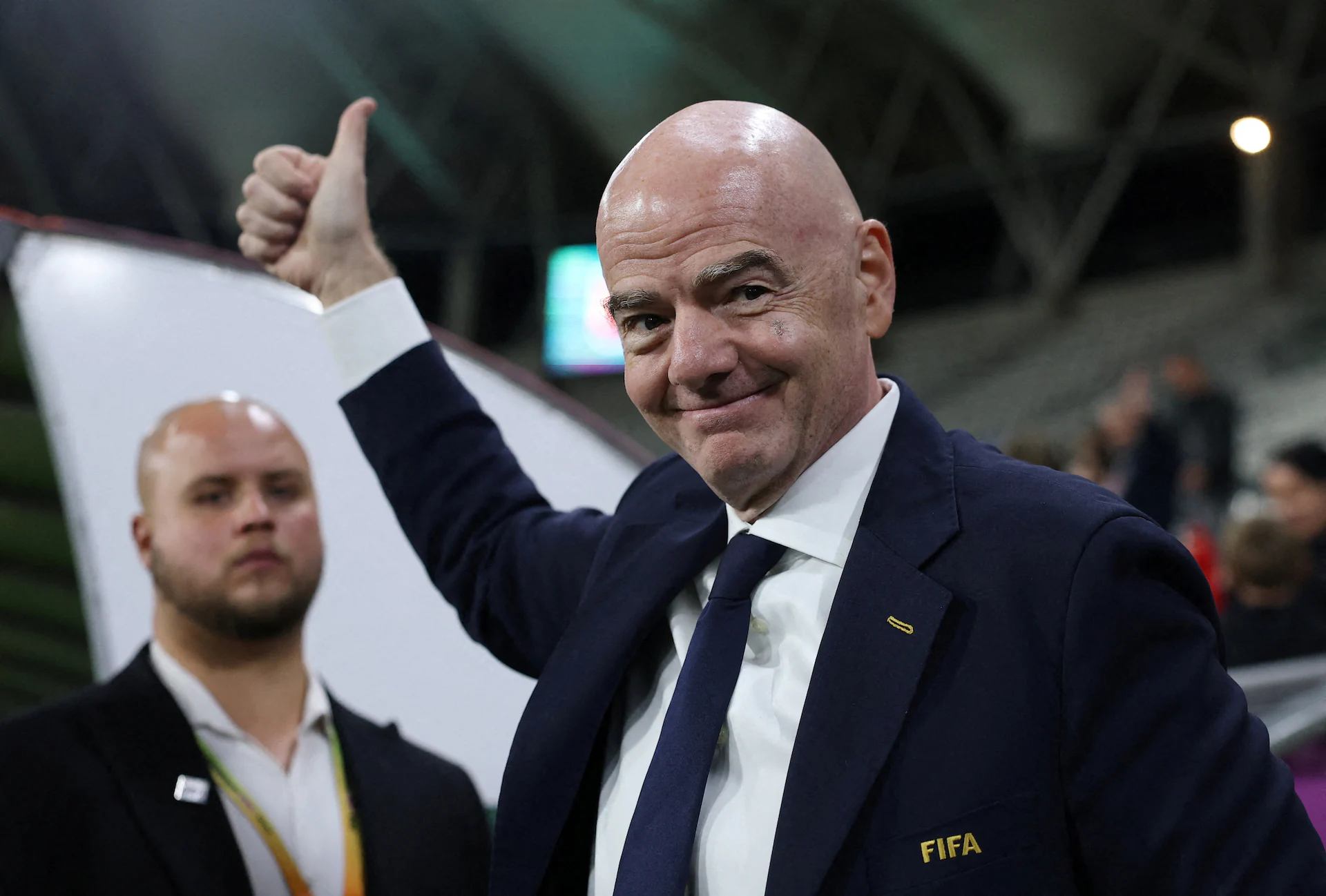
Asian Football Confederation (AFC) president Sheikh Salman bin Ibrahim Al-Khalifa has publicly endorsed Gianni Infantino‘s bid for another term as FIFA president, signalling a renewed partnership between the two football administrators despite a recent dispute over a proposed investment plan involving FIFA’s commercial rights.
Speaking at the AFC’s extraordinary congress in Tokyo on Friday, October 23, Sheikh Salman reaffirmed the Asian confederation’s commitment to supporting Infantino as he prepares to seek reelection in March 2027. The endorsement comes just two months after Sheikh Salman joined other senior football officials in criticising Infantino’s handling of the FIFA Forward Enterprise (FFE) project, which sought to attract private investment into a new commercial entity connected to FIFA competitions.
The change in tone is significant because support from Asia could prove important in Infantino’s effort to secure another mandate. The AFC represents 47 member associations, giving the confederation considerable influence within international football governance. However, questions remain over whether all its members share the same position, with Japan Football Association president Tsuneyasu Miyamoto indicating that national associations may not be completely aligned.
Infantino, who has led FIFA since 2016, is seeking a fourth term that would extend his presidency until 2031. With the nomination deadline approaching on November 18, endorsements from continental confederations are likely to become increasingly important as the election campaign develops.
Sheikh Salman Reaffirms Support for Gianni Infantino
Sheikh Salman used his address at the AFC congress to make clear that his organisation was prepared to move beyond its earlier disagreements with the FIFA president. Infantino attended the meeting in Tokyo, where the Bahraini administrator delivered a direct message of support for his reelection campaign.
“I think that we reaffirm our full commitment, of course, to supporting you and your leadership as you seek a new mandate as a FIFA president,” Sheikh Salman said.
He also acknowledged that the two officials had experienced disagreements in the past but insisted that those differences should not define their current relationship.
“I want to make it clear: yes, we had some issues we spoke about in the past but let’s not relate the two things together,” he added.
According to Sheikh Salman, discussions with Infantino in Zurich in recent days had helped establish a clearer understanding between them. He said football would be stronger if its administrators worked together around a shared vision and common purpose.
“As one Asian family we are ready to move forward, united in your support Gianni. I just want to make that clear today,” he said.
The remarks represented a notable shift from the criticism directed at Infantino earlier in the year. Sheikh Salman’s decision to publicly separate the previous dispute from the reelection campaign suggests that the AFC leadership considers cooperation with FIFA important enough to move forward after the controversy.
However, the endorsement does not necessarily establish that every national association within Asia has reached the same conclusion. The confederation’s public position and the individual voting intentions of its members are related but distinct questions, particularly when national football associations have their own interests and governance priorities.
What Was the FIFA Forward Enterprise Controversy?
The recent disagreement centred on FIFA Forward Enterprise, a proposed commercial initiative intended to bring private investors into a new entity holding rights linked to major football competitions, including the World Cup.
The project attracted criticism from senior football officials who questioned the way the proposal was handled. In July, Infantino faced calls to resign after the investment plan failed to progress as intended. Sheikh Salman joined the presidents of UEFA and CONCACAF in signing an open letter criticising the FIFA president’s conduct over the issue.
Sheikh Salman described the proposal as a “breach of trust”, a strong assessment that highlighted the seriousness of the disagreement among football’s senior administrators.
The controversy raised questions about how FIFA should manage its commercial assets, communicate major proposals to its governing bodies and maintain confidence among the organisations that make up international football. FIFA’s tournaments generate substantial commercial interest, and decisions about how their rights are managed can have consequences for revenue, investment and the distribution of financial benefits throughout the sport.
Bringing private investors into a commercial structure can potentially provide access to additional capital and new business opportunities. However, such arrangements also raise questions about the rights being transferred, the length and terms of investment agreements, the distribution of profits and the degree of oversight exercised by football’s governing institutions.
Those questions make transparency particularly important. National associations and continental confederations have a stake in understanding how commercial decisions are made and how the resulting resources might affect football development across different regions.
According to the Reuters report, Infantino apologised over the handling of the FFE project at a FIFA Council meeting in Zurich in October. He also made clear that the proposal was being withdrawn and would not be pursued further.
That reversal appears to have helped ease tensions with at least some of the officials who had challenged the initiative. Sheikh Salman’s latest comments indicate that the two leaders have agreed to move forward, although the public endorsement does not erase the questions that prompted the original criticism.
Why the AFC’s Support Matters in the FIFA Election
The AFC’s backing could be an important development in Infantino’s campaign because of the confederation’s size and position within international football governance.
The organisation represents 47 member associations across Asia. While a public endorsement from the confederation’s president does not automatically mean every member will vote identically, it provides a visible signal of support from one of FIFA’s major continental bodies.
FIFA presidential elections are shaped by national associations, each of which has a vote within the organisation’s congress. Continental confederations can influence the political environment by coordinating positions, facilitating discussions and publicly supporting candidates, but the final decision rests with the voting associations.
For Infantino, the AFC endorsement offers an opportunity to demonstrate that the earlier disagreement over FFE has not permanently damaged his relationship with Asian football leaders. It also strengthens his position as he seeks to build support ahead of the nomination deadline.
The endorsement is particularly relevant because the dispute involved senior figures from more than one confederation. If opposition to the FFE project had developed into a wider challenge to Infantino’s leadership, it could have complicated his reelection campaign. The AFC’s latest position suggests that at least one important part of that opposition has been willing to put the dispute aside.
Still, it would be premature to interpret the announcement as proof of unanimous support throughout Asian football. Japan’s response indicates that the views of national associations may differ, even when their continental confederation has publicly endorsed a candidate.
The election campaign will therefore depend not only on endorsements from prominent administrators but also on the positions taken by individual associations as the vote approaches.
UEFA Continues to Seek Answers From FIFA
Although the AFC has backed Infantino, opposition from European football’s governing body remains an important part of the story.
UEFA has sent a letter to FIFA seeking answers about Infantino’s presidency. According to the Reuters report, the questions include the handling of the FFE project and the FIFA Peace Prize.
The letter demonstrates that concerns about FIFA’s leadership and decision-making have not disappeared simply because the commercial investment proposal has been withdrawn. The dispute has also become part of a wider discussion about accountability, communication and the relationship between FIFA’s leadership and its member organisations.
UEFA’s position matters because European football represents a major part of the global game, with powerful national associations, prominent domestic leagues and clubs that attract significant international audiences. Continued disagreement between UEFA and FIFA could complicate cooperation on commercial, regulatory and competition-related matters.
However, the precise implications of UEFA’s questions for the election remain uncertain. Seeking explanations from FIFA does not, by itself, establish how European associations will vote or whether a rival candidate will emerge before the nomination deadline.
Reuters said it had contacted UEFA for a response to Sheikh Salman’s endorsement of Infantino. The organisation’s position will be important in determining whether the AFC’s support marks the beginning of a broader reconciliation or instead highlights continuing differences among the continental confederations.
Africa and Key Asian Members Also Back Infantino
The AFC is not the only continental organisation or group of national associations to have expressed support for Infantino. The Reuters report states that African football has also backed his reelection bid.
Within Asia, Saudi Arabia and Qatar are among the key members that have publicly declared their support. Their positions add weight to the campaign, although the stance of individual associations should not automatically be treated as identical to that of the entire confederation.
Support from major national associations can help a candidate demonstrate that his leadership retains backing across different regions. It may also influence discussions among other federations as they assess the available candidates and consider the direction of FIFA over the coming years.
For Infantino, the endorsements provide a positive signal at a time when he remains under scrutiny over the handling of the FFE proposal. They suggest that the controversy has not prevented him from retaining important relationships within international football.
Yet the political landscape remains fluid. Public endorsements made months before an election can provide an indication of current sentiment, but the final voting picture may depend on further discussions, policy commitments and developments during the campaign.
Japan Football Association Urges Caution Over Claims of Unity
Japan Football Association president Tsuneyasu Miyamoto offered a more cautious assessment of the AFC’s position following Sheikh Salman’s announcement in Tokyo.
Miyamoto said the Japanese association was looking to align itself with the AFC but had not made a final decision on its own position. He also expressed uncertainty about whether all 47 members of the confederation were united behind Infantino.
“I don’t think the AFC members’ opinions are all aligned together, but I believe the AFC and FIFA have been holding meetings on an ongoing basis,” Miyamoto said.
His comments are important because they distinguish between the public stance of the confederation’s leadership and the individual decisions of its member associations. Even when national federations participate in a common regional structure, they may assess a presidential candidate according to their own priorities and relationships.
Miyamoto also referred to discussions at the recent FIFA Council meeting in Zurich. He said he understood that Infantino had withdrawn the FFE proposal and apologised over its handling, adding that people had taken his words into account.
The Japanese official’s comments suggest that the withdrawal and apology may have contributed to a more constructive atmosphere. However, his statement that Japan had not yet decided its position means it would be inaccurate to describe the entire Asian bloc as definitively united behind Infantino at this stage.
Reuters said it had contacted the AFC’s member associations to clarify their positions. Their responses could help establish how broadly the endorsement is shared across the confederation.
Infantino Returns the Favour to Sheikh Salman
The Tokyo congress also provided an opportunity for Infantino to demonstrate his support for Sheikh Salman, who is seeking a fourth term as AFC president next year.
Addressing the delegates, Infantino praised the Bahraini administrator’s leadership of Asian football over the previous 13 years.
“You’ve been doing a fantastic job in AFC in the last 13 years, my dear Salman,” Infantino said.
He also expressed support for Sheikh Salman’s continued leadership, saying he would have FIFA’s backing for as long as he wished to remain in office.
The exchange illustrates the reciprocal nature of relationships among football administrators. Sheikh Salman endorsed Infantino’s reelection campaign, while Infantino publicly supported the AFC president’s bid for another term. Their statements indicate a desire to maintain cooperation between the two organisations after the dispute over FFE.
Asked later about the AFC’s endorsement, Infantino said he felt great about the support.
The relationship could have practical significance beyond the election itself. FIFA and the continental confederations cooperate on competitions, development programmes, administration and the wider organisation of international football. Maintaining productive working relationships can help those bodies coordinate their activities, although disagreements over governance and commercial decisions may still arise.
Infantino Seeks a Fourth Term Until 2031
Infantino, 56, is seeking reelection for a fourth term that would keep him in office until 2031, according to the Reuters report. Potential candidates must submit their nominations by November 18, making the coming weeks an important period for anyone considering a challenge.
His campaign now has visible support from the AFC and African football, while several influential Asian associations have also publicly backed him. At the same time, UEFA continues to seek answers over matters relating to his presidency.
The withdrawal of the FFE proposal and Infantino’s apology appear to have helped restore some confidence, but the episode remains relevant to questions about leadership and institutional accountability. The extent to which it influences the election will depend on how national associations evaluate the controversy and the alternatives available to them.
Another term would give Infantino the opportunity to continue his existing direction for FIFA, while a contested election could bring questions about governance, commercial strategy and the distribution of resources further into focus. The nomination deadline will help clarify whether a credible challenger emerges and how competitive the race is likely to become.
At this stage, the AFC’s endorsement is a clear political boost, but it does not settle the election. Support from a continental confederation can influence the campaign, yet individual national associations retain their own voting decisions.
What the AFC Endorsement Means for FIFA’s Future
Sheikh Salman’s backing of Infantino reflects a shift from confrontation toward cooperation after a dispute that raised questions about the handling of FIFA’s commercial plans. The decision is significant not only because of the AFC’s size but also because the earlier criticism had involved senior officials from several parts of international football.
The withdrawal of the FFE proposal appears to have helped create conditions for reconciliation. However, the wider issues surrounding the initiative remain relevant to how FIFA communicates major decisions, manages its commercial interests and maintains confidence among its members.
For Infantino, the immediate benefit is the public support of an influential confederation as he seeks another term. Backing from Africa and several prominent Asian associations adds to that position, although UEFA’s continued questions and Japan’s cautious response show that the broader picture is not entirely settled.
For Asian football, the episode highlights the balance between maintaining a unified regional voice and recognising that individual associations may have different views. Sheikh Salman has made the AFC leadership’s position clear, but the decisions of its members will ultimately determine how much support Infantino can count on from the continent.
The next major milestones will be the November 18 nomination deadline and the presidential election scheduled for March 2027. Until then, further statements from national associations and responses from FIFA and UEFA could shape the debate.
For now, Sheikh Salman’s endorsement represents an important boost for Infantino’s reelection bid, but not a guarantee of victory. The FIFA president has regained the public support of a major continental leader after the FFE controversy, while questions about governance and the unity of the Asian bloc remain unresolved. The coming months will show whether this reconciliation develops into a wider consensus behind Infantino’s leadership or whether divisions within international football continue to influence the race for FIFA’s presidency.
For breaking news and live news updates, like us on Facebook or follow us on Twitter and Instagram. Read more on Latest Sports on thefoxdaily.com.






COMMENTS 0