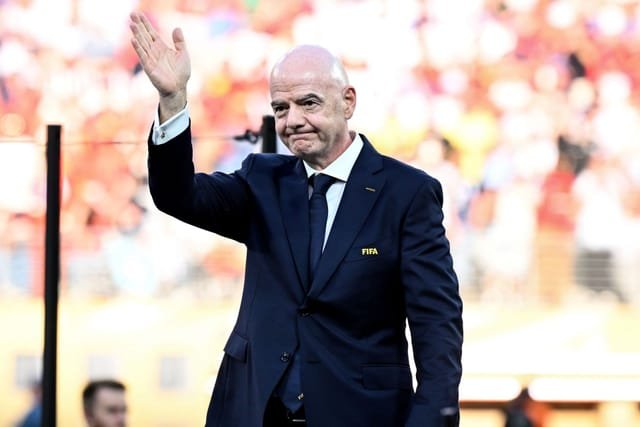
Gianni Infantino has strongly denied allegations that UEFA paid a six-figure sum to a former employee who was reportedly linked to him during his time as the organisation’s general secretary. The claims emerged in a report published by The Telegraph on August 7, 2026, alleging that the woman received a substantial departure payment and financial support for an MBA course after leaving UEFA.
UEFA has confirmed that a departure payment and MBA-related fees were paid, but the organisation insists the arrangement complied with the staff regulations that were in force at the time. FIFA, meanwhile, has rejected the allegations involving Infantino and said there had never been a complaint about his conduct from an employee at either UEFA or FIFA.
The controversy has arrived at a particularly sensitive point for the FIFA president. Infantino is already facing criticism over his proposed commercial restructuring of the World Cup, opposition from European football authorities and calls for his resignation from the Norwegian Football Federation.
The central issue is therefore bigger than the reported payment itself. It involves questions about governance, conflicts of interest, executive accountability and the level of institutional trust surrounding one of the most powerful figures in world football.
What the Report Says About Gianni Infantino and the Former UEFA Employee
Infantino’s relationship with UEFA stretches back to 2000, when he began working for the European governing body. He eventually became its general secretary before leaving in 2016 to take over as FIFA president.
The Telegraph’s report alleged that Infantino had a relationship with a woman who worked at UEFA in an administrative capacity. According to the report, she was later promoted into a managerial position and eventually left the organisation.
The report further alleged that UEFA provided the former employee with a six-figure departure payment and covered fees for an MBA course at a local business school.
Those details have created obvious questions about whether the employment decisions received appropriate independent scrutiny. However, the existence of a payment does not, by itself, prove that the payment was improper or that it resulted from a personal relationship.
That distinction is particularly important because UEFA has acknowledged the financial arrangement while defending it under the rules that existed at the time.
UEFA Confirms Payment but Defends Its Legality
UEFA’s response is one of the most important elements of the controversy because the organisation did not deny that the former employee received the reported benefits.
Instead, UEFA said the departure payment was made according to the regulations applicable to departing employees at the time. The governing body also acknowledged the MBA fees and stressed that its regulations have since been tightened.
This creates an important distinction between an authorised employment payment and an allegation of preferential treatment.
An employment package can be legitimate under organisational rules while still attracting questions about the circumstances in which it was approved. For that reason, the most relevant governance question is not simply how much money was paid but who authorised the arrangement, what safeguards were applied and whether any potential conflict of interest was independently managed.
UEFA’s statement that its rules have been strengthened since 2016 also provides important historical context. Organisations often revise internal policies after identifying weaknesses or adapting to higher expectations around transparency and accountability.
FIFA’s Response: Infantino Calls Allegations Untrue
FIFA has responded forcefully to the report and rejected the allegations against its president.
A FIFA spokesperson said Infantino “strongly denies” the allegations and described them as categorically untrue. The governing body also objected to suggestions that Infantino had breached regulations or engaged in inappropriate conduct.
FIFA further stated that no employee at UEFA or FIFA had ever submitted a complaint about Infantino’s behaviour.
The organisation also defended the broader employment procedures involved, saying that actions relating to employees, including departure and severance packages, had been approved by the appropriate directors in accordance with the applicable regulations.
That response means the allegations remain disputed. UEFA has confirmed the payment, but FIFA rejects the interpretation that the payment demonstrates inappropriate conduct by Infantino.
For accurate reporting, those two facts need to remain separate. The financial arrangement has been acknowledged by UEFA, while the allegations concerning Infantino’s personal conduct have been denied.
Why the Distinction Matters for the FIFA President
Infantino’s position makes the allegations particularly sensitive. FIFA presidents operate at the centre of a global organisation involving national associations, continental confederations, broadcasters, sponsors and some of the largest sporting events in the world.
At that level, perception can become almost as important as formal compliance.
A payment can comply with an organisation’s written regulations and still raise questions about whether those regulations provided sufficient protection against conflicts of interest. Conversely, the existence of an unusual or sizeable employment package does not automatically establish misconduct.
This is why the controversy could ultimately become a test of FIFA and UEFA’s transparency standards rather than simply a dispute about one former employee.
If football authorities want to restore confidence, the strongest response would involve demonstrating that senior executives are subject to clear conflict-of-interest rules, independent approval procedures and transparent employment processes.
Infantino’s Commercial Plans Have Already Created a Leadership Crisis
The allegations have emerged against the backdrop of another major controversy surrounding Infantino’s leadership.
The FIFA president had proposed creating a new subsidiary to oversee commercial operations connected to football while potentially selling a stake of up to 20 percent to private equity investors.
The proposal was presented as a way of increasing the commercial value of FIFA’s assets and generating additional financial resources. Critics, however, questioned whether private investment could change the balance of power over some of football’s most valuable commercial properties.
The controversy escalated rapidly as member associations and European football figures pushed back against the plan.
Ultimately, Infantino was forced to abandon the proposal following widespread opposition and the threat of a boycott.
This development matters because it transformed what could have been a commercial disagreement into a much wider debate about FIFA’s leadership and governance.
Why the World Cup Commercial Dispute Matters
The proposed private investment structure touched on a fundamental question: who should control the commercial future of international football?
FIFA controls one of the most commercially powerful sporting brands in the world through the World Cup and its related competitions, sponsorship agreements and broadcasting rights.
Allowing private investors to acquire a minority stake would not necessarily mean that FIFA surrendered sporting control. However, it would introduce external financial interests into an organisation whose decisions have traditionally been shaped primarily by its member associations and football institutions.
That is why opposition became so intense.
The failure of the plan also created a political problem for Infantino. A president who loses a major commercial initiative after resistance from member associations may face questions about whether he still has the institutional support required to pursue major reforms.
That question is now being raised openly by national football officials.
Norway FA Calls for Gianni Infantino’s Resignation
The Norwegian Football Federation has become one of the clearest institutional voices calling for Infantino to leave the FIFA presidency.
NFF president Lise Klaveness said Infantino no longer had the institutional trust required to govern FIFA effectively. She argued that international football cooperation was facing serious difficulties and called on him to resign.
Klaveness also said Norway would raise the issue through its dialogue with FIFA and indicated that other countries could potentially join the opposition depending on how UEFA and its members proceed.
Her comments are significant because they shift the controversy from criticism by individuals to a direct challenge from a national football association.
The political consequences could become much larger if additional national associations adopt the same position.
Other Decisions Have Added to the Criticism
Klaveness also pointed to other decisions during Infantino’s presidency that she considers controversial.
Among the issues highlighted were FIFA’s decision to award US President Donald Trump a FIFA Peace Prize and the overturning of a ban involving USMNT forward Folarin Balogun.
These issues are separate from the UEFA payment allegations, but their inclusion in the Norwegian FA’s criticism demonstrates how several different disputes are now being combined into a broader assessment of Infantino’s leadership.
This is an important development politically. A leader rarely faces a serious challenge because of one isolated controversy. Pressure becomes more difficult to contain when opponents begin presenting multiple decisions as evidence of a wider leadership problem.
Gianni Infantino Controversies: What Is Confirmed and What Is Disputed?
| Issue | What Is Established | What Remains Disputed |
|---|---|---|
| Former UEFA employee payment | UEFA has confirmed that a departure payment was made. | The allegation that the payment was connected to a personal relationship remains disputed. |
| MBA funding | UEFA confirmed payment of fees for an MBA course. | Whether the benefit represented preferential treatment is not established by the available information. |
| Infantino’s conduct | FIFA has publicly rejected the allegations. | The alleged relationship and claims of inappropriate conduct remain denied. |
| Commercial restructuring plan | Infantino proposed a structure involving private investment. | The long-term consequences of the abandoned proposal remain a matter of debate. |
| Resignation calls | The Norwegian FA has publicly called for Infantino to resign. | Whether broader FIFA membership will support such a move remains uncertain. |
The Bigger Story Is Institutional Trust
The most important angle competitors can miss is that the latest allegations should be viewed within the broader question of institutional trust.
Infantino is not simply defending himself against a historical allegation. He is doing so while facing resistance over the commercial direction of FIFA and direct calls for his resignation.
That changes how every new controversy is interpreted.
If an organisation enjoys overwhelming confidence among its stakeholders, a disputed historical employment issue may have limited political consequences. But when confidence is already weakening, even an allegation that remains unproven can become politically damaging.
This is why transparency matters so much.
FIFA and UEFA do not necessarily need to prove that every criticism is justified. They need to demonstrate that their decision-making systems are strong enough to withstand independent scrutiny.
That means clear rules, proper documentation, independent oversight and credible mechanisms for handling potential conflicts of interest.
Could the Dispute Affect the 2026 FIFA World Cup?
The leadership dispute could have implications for the wider football ecosystem if the disagreement between FIFA and UEFA continues to escalate.
UEFA represents some of the world’s most influential national football associations, clubs, players and commercial markets. Any serious confrontation between the European confederation and FIFA could therefore create significant uncertainty around international football.
A boycott would represent an extreme outcome and would carry enormous costs for all sides. European teams, broadcasters, sponsors and supporters would have much to lose, while FIFA would face a major challenge to the prestige and competitive strength of its flagship tournament.
That creates a powerful incentive for compromise.
The more likely scenario is continued political pressure, negotiations and demands for greater transparency rather than an immediate collapse of cooperation.
What Could Happen Next?
The next stage of the controversy is likely to focus on whether football authorities seek additional information about the historical employment arrangement.
The key questions include how the payment was authorised, what regulations applied, whether appropriate officials approved it and whether potential conflicts of interest were properly considered.
At the same time, Infantino’s political future will depend heavily on whether opposition to his leadership expands.
If only a small number of associations call for his resignation, FIFA may be able to contain the challenge. If major confederations and a growing number of national associations unite around the same demand, the pressure could become much harder to ignore.
There is also a possibility that the abandoned commercial plan becomes the central issue rather than the personal allegations. The commercial dispute directly concerns FIFA’s future financial structure, making it potentially more consequential for member associations than a historical employment controversy.
Why This Could Become a Defining Moment for FIFA Governance
The controversy arrives at a time when football’s governing bodies face increasing demands to operate with the same transparency expected of major global institutions.
Modern sports organisations manage billions of dollars in commercial interests, negotiate with governments and corporations, and make decisions that affect athletes and supporters across continents.
That scale makes traditional informal approaches to governance increasingly difficult to defend.
The Infantino controversy therefore offers a broader lesson: rules are only as credible as the transparency surrounding their application.
If UEFA can demonstrate that its historical employment decision was properly authorised, it may reduce concerns about the payment itself. If FIFA can demonstrate that Infantino’s leadership remains supported by its membership and that its governance mechanisms are functioning effectively, the resignation campaign may struggle to gain momentum.
But if unanswered questions accumulate, the political narrative could become increasingly difficult for FIFA to control.
Conclusion: Gianni Infantino Faces a Test of Leadership and Trust
Gianni Infantino’s denial of the allegations surrounding a former UEFA employee comes at one of the most politically challenging moments of his FIFA presidency. UEFA has confirmed that the former employee received a departure payment and MBA funding, while maintaining that the arrangement complied with the regulations in force at the time. FIFA has strongly rejected the allegations concerning Infantino’s conduct.
The distinction between confirmed financial arrangements and disputed personal allegations is essential. There is currently no basis to present the allegations themselves as established fact.
Nevertheless, the controversy matters because of its timing. Infantino is already facing criticism over his abandoned private-investment plan, opposition from European football stakeholders and a direct resignation call from the Norwegian Football Federation.
The real test now is whether those separate disputes remain isolated or develop into a coordinated challenge to his authority.
For Infantino, the battle is increasingly about more than defending individual decisions. It is about convincing FIFA’s members that he still possesses the institutional trust, political support and governance credibility required to lead world football through its next chapter.
For breaking news and live news updates, like us on Facebook or follow us on Twitter and Instagram. Read more on Latest Football on thefoxdaily.com.


COMMENTS 0