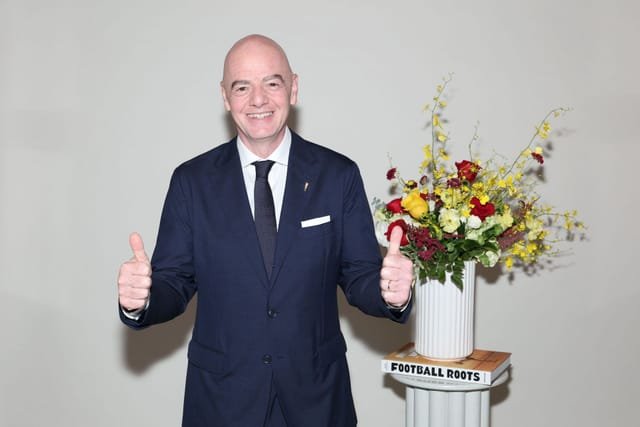
Gianni Infantino is facing renewed scrutiny after UEFA confirmed that a former employee received a six-figure departure payment and funding for an MBA course during his time as the organisation’s general secretary. The development, reported by The Telegraph on August 7, 2026, concerns an employee whom the newspaper linked to allegations of a personal relationship with Infantino.
UEFA has acknowledged that the payment and education fees were made, while insisting that the arrangement complied with the staff regulations that existed at the time. FIFA, meanwhile, has strongly rejected the allegations surrounding Infantino, describing them as categorically untrue and saying no employee had ever raised a complaint about his conduct.
The distinction between an allegation of personal misconduct and the legality of an employment payment is central to understanding the story. UEFA has not said that the payment itself was improper. Instead, the organisation said its rules have since been tightened and that its current staff regulations reflect the standards expected of a modern international sports body.
The controversy arrives at a particularly difficult moment for Infantino. His leadership is already being challenged over FIFA’s proposed commercial investment structure, opposition from UEFA, calls for his resignation and questions about the direction of football’s global governing body.
What the UEFA Payment Controversy Is About
The reported arrangement dates back to Infantino’s long period at UEFA. He joined the organisation in 2000 and eventually became its general secretary, a position he held before becoming UEFA president in 2016 and subsequently FIFA president.
According to the investigation reported by The Telegraph, an administrative-level employee allegedly involved in a relationship with Infantino was later promoted into management. The employee subsequently received a six-figure departure payment, while UEFA also covered fees connected to an MBA course at a local business school.
UEFA confirmed the existence of both elements of the arrangement.
UEFA said the departure payment was made under the regulations applicable to departing employees at the time and that the organisation has since strengthened those rules.
That response matters because it separates two questions that can easily become blurred in public debate: whether a personal relationship existed, which FIFA strongly denies, and whether the employment package was authorised under UEFA’s rules, which UEFA says it was.
In other words, confirmation of a payment does not by itself establish wrongdoing. The significance comes from the circumstances surrounding the payment and the questions it creates about governance, conflicts of interest, internal controls and whether rules were sufficiently robust at the time.
Why UEFA’s Response Is Significant
UEFA’s statement is notable because the organisation did not deny that the former employee received the benefits described in the report. Instead, it defended the transaction as compliant with the regulations then in force.
That distinction is particularly important for an international sporting organisation. Employment packages can include severance payments, educational benefits and other contractual arrangements. The existence of a large payment does not automatically prove that an individual received preferential treatment.
The more difficult governance question is whether the same decision would have been made if the employee had not allegedly been connected personally to a senior executive.
That is ultimately where scrutiny is likely to remain focused. Modern governance systems are designed not merely to prevent illegal conduct but also to manage situations that create the appearance of conflicts of interest.
UEFA’s acknowledgement that its staff regulations were subsequently tightened adds another important layer. It suggests that the organisation’s framework has evolved since the period in which the reported payment occurred.
For football’s governing institutions, that evolution is more than a technical employment issue. It reflects a wider shift in expectations around transparency, executive accountability and institutional independence.
What FIFA Says About the Allegations
FIFA has rejected the allegations against Infantino in strong terms.
The governing body said the claims were untrue and stated that there had never been a complaint from an employee concerning Infantino’s behaviour during his time at UEFA or FIFA. FIFA also argued that employment-related decisions, including departure and severance packages, were approved by the appropriate directors under applicable regulations.
This is an important part of the story because the current controversy remains based on reported allegations rather than an established finding of misconduct.
There is therefore a significant difference between reporting that a payment occurred and declaring that the payment was evidence of improper behaviour. The first has been acknowledged by UEFA. The second remains disputed.
For Infantino, the immediate challenge is therefore reputational rather than simply financial. Even when an organisation can demonstrate that a payment complied with written rules, public confidence can still be affected if people believe those rules allowed excessive discretion at the highest levels.
Infantino’s Wider Leadership Crisis
The timing of the controversy makes it considerably more consequential than it might have been in isolation.
Infantino is already under intense pressure over FIFA’s proposed commercial investment structure, which was designed to bring together major revenue-generating activities such as broadcasting, sponsorship, ticketing and licensing.
FIFA’s proposal involved creating a major commercial entity and allowing outside investors to acquire a minority stake. FIFA maintained that it would retain control, but the proposal triggered fierce opposition from UEFA and other football stakeholders.
The dispute became particularly explosive because FIFA had offered member associations a financial incentive connected to the proposal. Reports indicated that associations could receive substantial funding if they supported the plan.
Critics argued that the structure could fundamentally change the relationship between football’s governing body and private capital. Supporters of the proposal presented it as a way to unlock greater commercial value and distribute more resources throughout global football.
The disagreement eventually became a much larger argument about who should control football’s commercial future.
A Timeline of the Pressure on Infantino
| Period | Development | Why It Matters |
|---|---|---|
| 2000 | Infantino begins working at UEFA | Marks the beginning of his long association with European football administration. |
| 2016 | Infantino becomes FIFA president | He moves from European football administration to global football leadership. |
| July 2026 | FIFA unveils commercial investment plans | The proposal to involve private investment triggers strong opposition. |
| Late July 2026 | UEFA and other stakeholders intensify criticism | The commercial proposal becomes a major governance dispute. |
| Early August 2026 | Luis Figo publicly calls for Infantino to resign | Criticism expands beyond football administrators to a prominent former player. |
| August 7, 2026 | UEFA confirms the reported departure payment and MBA funding | The new report creates another source of scrutiny surrounding Infantino’s past at UEFA. |
Why the Alleged Relationship and Payment Must Be Treated Separately
One of the easiest mistakes in covering this controversy would be to treat the reported payment as proof that the underlying allegation is true.
That conclusion would go beyond the available evidence.
UEFA has confirmed the payment and MBA fees. FIFA has categorically denied the allegations about Infantino’s conduct. No independent finding establishing the alleged relationship or proving that the employment benefits were granted because of it has been presented in the material surrounding the report.
The responsible way to assess the situation is therefore to examine the institutional questions created by the reported arrangement without presenting disputed allegations as established facts.
This distinction is especially important because Infantino occupies one of the most powerful positions in international sport. Claims involving senior officials can quickly become part of political and commercial battles between institutions, making precision in reporting essential.
The Bigger Issue: Governance Rather Than One Payment
The most important insight from the controversy may not be the size of the payment at all. It is the question of whether football’s governing institutions have sufficient safeguards when senior executives are personally connected to employees.
A strong governance system should make it difficult for personal relationships, professional promotions and financial settlements to overlap without independent oversight.
That does not mean every employment decision involving a senior executive is automatically suspicious. It means the decision-making process needs to be transparent enough to withstand scrutiny.
This is where UEFA’s reference to strengthened regulations becomes significant. Modern organisations increasingly use conflict-of-interest declarations, independent approval mechanisms, documentation requirements and recusal procedures to protect both the institution and the individuals involved.
For UEFA and FIFA, the reputational cost of weak governance can be much greater than the financial value of any individual employment package.
How the FIFA Commercial Dispute Changes the Picture
The reported UEFA payment might have remained a relatively contained employment story under different circumstances. Instead, it has emerged while Infantino is already fighting a much broader battle over FIFA’s future direction.
The proposed commercial restructuring was controversial because it attempted to place many of FIFA’s major revenue-generating activities inside one commercially focused structure. Reports said the venture could be valued at approximately $20 billion, with FIFA considering the sale of a minority stake to external investors.
The proposal raised a fundamental question: should the commercial assets of international football become partly owned by private investors, even if FIFA retains sporting and governance control?
That question is separate from the employment allegations, but the two controversies now reinforce the same broader narrative about transparency and leadership.
Infantino’s critics can point to the commercial dispute as evidence of an increasingly centralised approach to FIFA’s finances, while the latest UEFA report creates additional scrutiny around how decisions were handled during his earlier career.
Infantino, however, retains a strong institutional position and FIFA continues to defend him. The latest developments therefore do not automatically translate into an imminent change of leadership.
Why Luis Figo’s Criticism Matters
The involvement of Luis Figo has added another dimension to the crisis.
The former Portugal international and prominent figure in European football publicly called for Infantino to resign earlier in August. His intervention matters because criticism from a highly recognised former player carries a different public weight from an internal administrative disagreement.
Figo’s criticism also illustrates how the dispute has moved beyond a narrow argument between football executives. It has begun to involve former players, national associations and senior figures questioning the direction of global football governance.
The crucial question now is whether those individual criticisms develop into coordinated institutional opposition.
Could the Controversy Affect the 2026 FIFA World Cup?
The immediate sporting impact is difficult to separate from the political conflict because UEFA has threatened serious action in response to FIFA’s wider disputes.
European football represents an enormous part of FIFA’s competitive, commercial and cultural ecosystem. A genuine boycott involving European national teams would have consequences far beyond FIFA’s headquarters.
It would affect broadcasters, sponsors, supporters, players, national associations and the competitive credibility of international football.
That makes a complete breakdown between UEFA and FIFA a scenario in which both sides have significant incentives to avoid lasting damage.
The more realistic battleground is therefore likely to remain governance, commercial control and leadership rather than the sport itself. Football’s institutions can disagree intensely while still having powerful reasons to prevent an irreparable split.
What Happens Next for Gianni Infantino?
The latest allegations do not, by themselves, establish that Infantino violated UEFA or FIFA rules. FIFA’s denial and UEFA’s explanation of the payment mean the controversy is unlikely to be resolved simply through competing statements.
The bigger test will be whether football authorities demand further documentation, independent scrutiny or a formal review of the historical employment arrangements.
Infantino’s political position will also depend heavily on the outcome of the wider FIFA governance dispute. If opposition to his commercial strategy continues to grow, every additional controversy can become politically significant even when it does not independently establish wrongdoing.
Conversely, if FIFA maintains sufficient support among its member associations and the commercial dispute fades, the latest allegations may remain primarily a reputational challenge rather than a leadership-ending event.
The Key Question Is Trust
At its core, the Infantino controversy is about trust.
UEFA says the reported departure payment complied with the rules of the time. FIFA says the allegations against its president are categorically false. Yet the fact that the payment, promotion and MBA funding have become public during an already intense dispute shows how quickly historical employment decisions can become relevant to present-day leadership battles.
For football supporters, the issue is not simply whether a six-figure payment was technically permitted. It is whether the organisations governing the world’s most popular sport can demonstrate that their rules are strong enough to protect against conflicts of interest and that senior officials are subject to meaningful accountability.
That question will probably matter more than the payment itself.
Conclusion: Infantino’s Biggest Challenge May Be Credibility
The newly reported UEFA payment adds another difficult chapter to Gianni Infantino’s increasingly turbulent period as FIFA president. UEFA has confirmed the departure payment and MBA funding but defended them as compliant with the regulations that existed at the time. FIFA has firmly rejected the allegations concerning Infantino’s conduct.
The controversy therefore should not be presented as proof of misconduct that has not been established. Its significance lies instead in the governance questions it raises and the timing of the revelations.
Infantino is already facing opposition over FIFA’s proposed commercial investment plans, public calls for his resignation and a widening debate about transparency within football’s global administration.
The coming months will reveal whether those disputes remain separate controversies or combine into a broader challenge to his authority. For now, one conclusion is clear: the biggest issue facing Gianni Infantino may no longer be defending individual decisions, but restoring confidence in the way FIFA and its leadership operate.
For breaking news and live news updates, like us on Facebook or follow us on Twitter and Instagram. Read more on Latest Football on thefoxdaily.com.


COMMENTS 0