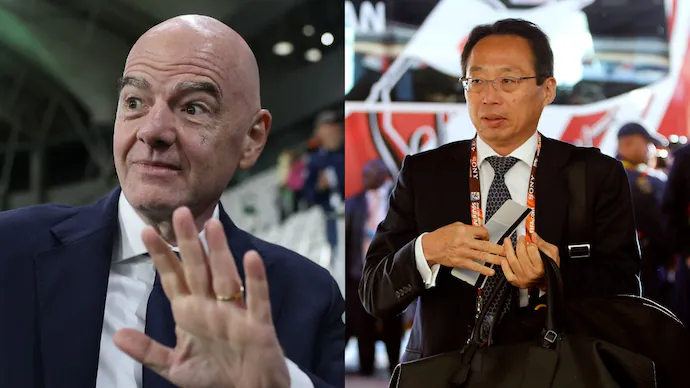
Takeshi Okada has resigned as vice president of the Japan Football Association (JFA), citing concerns about the politics surrounding FIFA president Gianni Infantino’s re-election campaign and developments linked to the 2026 FIFA World Cup. The former Japan national team coach said the recent direction of International Football governance conflicted with his belief that sport must be guided by integrity.
Okada’s departure comes as Infantino seeks another term as FIFA president, with the election scheduled for March 18, 2027, in Rabat, Morocco. The resignation also follows the Asian Football Confederation’s (AFC) public endorsement of Infantino, a decision that has drawn attention amid an ongoing debate about transparency, commercial interests and the influence of politics in international football.
In his resignation statement, Okada acknowledged that the JFA must navigate the practical realities of its relationship with the AFC. However, he made clear that he could not personally accept the developments surrounding FIFA and this year’s World Cup. His decision adds another voice to the discussion about the responsibilities of football administrators and the standards expected of the sport’s governing institutions.
Takeshi Okada Resigns Over FIFA Governance Concerns
The JFA published Okada’s resignation statement on October 28, with the document dated October 24. The announcement came one day after the AFC publicly backed Infantino for another term, placing Okada’s decision in the middle of an increasingly significant debate over FIFA’s leadership.
Okada said his objection was rooted in his understanding of sport as an institution that should demonstrate integrity and contribute positively to society. He argued that the actions surrounding the 2026 World Cup had moved too far away from those principles.
“However, the series of actions surrounding this year’s FIFA World Cup represent a significant divergence from my personal convictions,” Okada wrote. “As a sportsman, I cannot accept this.”
The statement did not amount to a declaration that Japan had withdrawn its support from the AFC or that the JFA had formally changed its position on Infantino’s candidacy. Instead, Okada explained why he could no longer continue in his own administrative role.
He recognised that the JFA operates within a wider international structure and that maintaining a constructive relationship with the AFC is important for Japanese football. Nevertheless, he distinguished the association’s practical responsibilities from his personal convictions about the direction of FIFA.
The resignation illustrates the tension that can arise when football officials are required to balance institutional relationships with their views on governance. National associations depend on regional and global bodies for competition organisation, development programmes and international representation. At the same time, their officials may feel compelled to speak out when they believe that decisions conflict with the values they associate with sport.
Who Is Takeshi Okada?
Okada is a prominent figure in Japanese football, having coached the national team at the 1998 and 2010 FIFA World Cups. His experience spans two important stages in Japan’s development as an established presence in international men’s football.
Japan made its debut at the men’s World Cup in 1998, with Okada leading the team in France. He returned as head coach for the 2010 tournament in South Africa, where Japan advanced to the round of 16 before being eliminated by Paraguay in a penalty shootout.
His work with the national team gave him considerable experience of the demands placed on players and coaches at the highest level. His later involvement in football administration brought him closer to the decisions and relationships that shape the sport beyond the playing field.
As JFA vice president, Okada occupied a senior position within Japanese football’s governing structure. His resignation therefore carries significance beyond an individual departure, particularly because he has publicly linked his decision to questions about integrity and international football leadership.
However, his personal position should be distinguished from the formal policies of the JFA. Okada acknowledged the practical considerations facing Japanese football and did not suggest that the association should abandon its relationship with the AFC. His decision was based on his own assessment of the developments he cited.
Why Infantino’s Re-Election Campaign Is Under Scrutiny
Infantino has faced criticism over a proposed arrangement involving private investment in revenues associated with FIFA competitions. Reports about the proposal emerged in July and described a potential deal valued at approximately $4.2 billion, involving investors led by Joshua Kushner.
The proposal raised questions among senior football figures about transparency, decision-making and the possible long-term implications of selling private investors a permanent stake in World Cup-related revenues. Critics questioned how such an arrangement would be structured and whether the process adequately addressed the interests of football’s governing bodies and member associations.
Senior figures who voiced objections included AFC president Sheikh Salman bin Ibrahim Al Khalifa, UEFA president Aleksander Ceferin and CONCACAF president Victor Montagliani. Their concerns helped turn the proposed investment arrangement into a wider debate about FIFA’s governance and Infantino’s management of the organisation.
The proposal was subsequently abandoned, but the controversy continued to affect discussions about FIFA’s leadership. The dispute was not simply about the potential financial value of a commercial agreement. It also raised questions about how decisions of major significance should be communicated, reviewed and approved.
For an organisation responsible for the world’s most prominent international football competitions, commercial strategy and public confidence are closely connected. FIFA must generate revenue to support competitions and development programmes, but decisions involving major financial interests can attract scrutiny when stakeholders believe that the process lacks sufficient transparency.
Infantino’s re-election campaign has consequently unfolded amid a debate that extends beyond his record as president. The questions include how FIFA should manage its commercial assets, how much influence member associations should have in major decisions and how the organisation can maintain confidence among football’s governing bodies.
AFC Changes Course and Endorses Infantino
The AFC’s endorsement of Infantino represented a notable shift after the confederation had previously criticised FIFA over the proposed private investment arrangement.
Sheikh Salman had earlier accused Infantino of a “fundamental breach of trust” in relation to the controversy. The criticism highlighted the seriousness of the disagreement between senior figures in Asian football and FIFA’s leadership.
However, the AFC subsequently announced its support for Infantino’s re-election. The endorsement was made at an extraordinary congress in Tokyo on October 23, one day before the date on Okada’s resignation statement.
The change prompted questions about how the confederation had reassessed its position following the earlier dispute. It also highlighted the importance of the AFC in the presidential election, given the number of national associations represented within the Asian football structure.
The AFC has 47 member associations, making it an influential bloc among FIFA’s 211 member associations. Its public support provides Infantino with an important endorsement, although it does not automatically demonstrate that every official or national association within Asia shares the same view.
Okada’s resignation illustrates that distinction. While the AFC leadership has backed Infantino, the former Japan coach has made clear that the direction of FIFA conflicts with his personal convictions. His decision demonstrates that views within the broader Asian football community are not necessarily uniform.
The episode also raises a wider question for football governance: how should regional confederations respond when commercial or administrative decisions provoke criticism from their own officials and members? Maintaining institutional unity can be important, but so too are transparency, accountability and the ability to discuss disagreements openly.
Prince Ali Questions Claims of Asian Unity
The AFC’s endorsement triggered a public dispute involving Jordanian football official Prince Ali bin Al Hussein, a former FIFA vice president who challenged Infantino in the 2016 presidential election.
Prince Ali criticised the AFC gathering in Tokyo, describing it as “pure politics at the behest of Gianni Infantino”. He argued that the endorsement did not mean that Asian football was united behind the incumbent FIFA president.
He also warned against the use of “coercion, threats or bribes” in the election process. These were allegations and concerns expressed by Prince Ali and should not be treated as established findings of misconduct.
The AFC rejected his claims as unsubstantiated and referred his comments to its judicial officials for possible disciplinary action. Prince Ali later clarified that his remarks were intended to underline the importance of transparency in football governance. He also said Jordan’s vote would be cast independently.
The exchange reflects the political tensions surrounding the presidential campaign. Public endorsements can signal support from influential organisations, but they do not necessarily reveal the individual positions of every member association or official.
The dispute also highlights why the credibility of an election depends on more than the number of endorsements a candidate receives. Clear procedures, independent voting decisions and confidence in the absence of improper pressure are important to ensuring that the result is regarded as legitimate.
World Cup Revenue and Development Funding
Another issue attracting attention during Infantino’s re-election campaign is FIFA’s approach to development funding. According to the supplied report, Infantino has promised each member association $25 million for development and operating costs over the next four years.
Development funding can play an important role in countries where football associations have limited domestic resources. Investment may support grassroots participation, facilities, coaching, youth competitions and the development of women’s football. For many member associations, FIFA programmes represent an important source of financial support.
However, the scale and timing of funding commitments can become politically sensitive during a presidential election. When a sitting president seeks another term while announcing substantial development support, associations and observers may question how the programme will be administered and how funding decisions relate to the wider electoral environment.
The existence of a funding commitment does not, by itself, prove that money is being offered in exchange for votes or that associations are being pressured to support a candidate. Such claims require evidence. Nevertheless, transparent eligibility rules, clear spending requirements and independent oversight are important safeguards for any large-scale development programme.
FIFA’s challenge is to demonstrate that development funding is allocated according to football-related needs and established rules, rather than perceived political considerations. Clear reporting and accountability can help member associations and the public assess whether financial programmes are serving their stated purposes.
The proposed private investment arrangement and the development funding commitments are separate issues, but both have become part of the wider conversation about FIFA’s commercial and governance practices. Together, they illustrate the need for major financial decisions to be supported by processes that stakeholders can understand and scrutinise.
Qatar and Saudi Arabia Remain Important Regional Players
Infantino has also sought support from influential football nations in Asia and the Middle East. Qatar, host of the 2022 FIFA World Cup, has remained supportive of the FIFA president, according to the supplied report.
Saudi Arabia, which is scheduled to host the 2034 World Cup, also appeared to restore its relationship with Infantino after hosting him in Jeddah during October. The country is an important player in international football because of its role as a future World Cup host and its growing involvement in the global game.
Relationships between FIFA and major host nations can involve competition preparations, infrastructure, commercial partnerships and long-term development objectives. Those relationships can be important to the organisation of major tournaments, but they can also attract scrutiny when they intersect with presidential elections.
Support from influential football nations may strengthen a candidate’s position, but it does not replace the formal voting process. FIFA’s president is elected by member associations, and the final outcome will depend on the votes cast in accordance with the organisation’s rules.
The role of Asian football will therefore remain important as the campaign develops. The AFC’s public endorsement offers Infantino a significant source of support, while Okada’s resignation and Prince Ali’s criticism show that questions about governance and the election process have not disappeared.
UEFA Seeks a Potential Challenger
European football’s governing body, UEFA, has committed to finding a candidate who could challenge Infantino in the presidential election. The nomination deadline is November 18, leaving a limited period for potential candidates to secure the necessary backing and formally enter the race.
A challenger would give FIFA’s member associations an alternative to consider, but the strength of any campaign would depend on the candidate’s platform, record and ability to build support across different regions.
UEFA has been among the governing bodies critical of the proposed private investment arrangement. Its effort to identify a challenger indicates that concerns about FIFA’s direction could influence the election campaign, although opposition to a particular decision does not necessarily mean that all critics agree on a single alternative.
The election is likely to involve debate over governance, commercial strategy, development funding and the relationship between FIFA and its confederations. Candidates will have to explain how they would address these issues and maintain confidence among associations with different priorities and financial circumstances.
The nomination process will be an important next step. Until candidates formally enter the race, it remains uncertain whether Infantino will face a challenger capable of uniting a broad coalition of member associations.
What Okada’s Resignation Means for Japanese Football
Okada’s departure creates a significant moment for the JFA, particularly as international football moves closer to the presidential election. His statement places integrity and the social value of sport at the centre of the debate, while acknowledging that Japan must also consider the practical realities of its relationship with the AFC.
The resignation does not automatically change Japan’s official position on Infantino’s candidacy. Nor does it mean that the JFA has withdrawn from the Asian football structure. Instead, it shows that a senior Japanese football figure believes the developments surrounding FIFA and the World Cup have crossed a line that he personally cannot accept.
For the JFA, the immediate challenge will be to continue its administrative responsibilities while navigating the wider debate about international football governance. National associations must maintain working relationships with regional and global bodies, but they also have an interest in ensuring that major decisions are transparent and consistent with the principles they publicly support.
Okada’s decision may encourage further discussion about the role of individual officials in challenging governing bodies. Resignations do not necessarily change institutional policy, but they can draw attention to issues that might otherwise remain within administrative discussions.
For FIFA, the episode is a reminder that endorsements from confederation leaders do not necessarily eliminate criticism among officials within their member associations. Confidence in a governing body depends not only on electoral support but also on the credibility of its decisions and the processes through which they are made.
FIFA Re-Election Debate Intensifies Ahead of March 2027
Takeshi Okada’s resignation has added a prominent Japanese voice to the debate over Gianni Infantino’s leadership as FIFA prepares for its presidential election on March 18, 2027, in Rabat, Morocco.
The former Japan coach said the developments surrounding the 2026 World Cup conflicted with his personal convictions about integrity. His departure came after the AFC endorsed Infantino, despite earlier criticism over a proposed private investment arrangement involving World Cup revenues.
The controversy has exposed disagreements among football officials over transparency, commercial decision-making and the role of regional confederations in the presidential campaign. Prince Ali’s criticism of the AFC endorsement and UEFA’s search for a possible challenger indicate that the election will take place amid continued debate.
Development funding and the influence of FIFA’s member associations will also remain central issues. While financial support can help football grow in countries with fewer resources, clear rules and oversight are essential to ensuring that funding decisions retain public confidence.
Infantino remains the incumbent and is seeking another term, but the wider debate is about more than the outcome of the election. It concerns the standards expected of football’s governing institutions and the relationship between sporting values, commercial interests and international politics.
Okada has made his position clear by resigning. As the March election approaches, FIFA and its member associations will face continuing questions about governance, accountability and how the sport’s leadership can maintain the trust of the football community.
For breaking news and live news updates, like us on Facebook or follow us on Twitter and Instagram. Read more on Latest Football on thefoxdaily.com.





COMMENTS 0