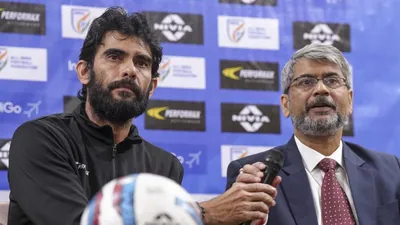
India football team have withdrawn from the inaugural FIFA ASEAN Cup, choosing to prioritise their highly anticipated international friendly against five-time FIFA World Cup champions Brazil in October. The decision was confirmed by All India Football Federation (AIFF) deputy secretary general M Satyanarayanan on August 13.
India were originally set to participate in the new FIFA-sanctioned competition during the September 21 to October 6 international window. However, their confirmed fixture against Brazil on October 3 at Kolkata’s Salt Lake Stadium created a scheduling conflict that the AIFF ultimately decided could not be resolved by participating in both competitions.
The withdrawal means India will miss the opportunity to compete against several leading Southeast Asian teams in the inaugural tournament. It also represents a major shift from the federation’s earlier plans, when India had accepted FIFA’s invitation and subsequently been drawn in Division 1 Group A alongside Indonesia, Malaysia and Singapore.
Why India chose Brazil over the ASEAN Cup
The central reason behind India’s decision is the clash between the FIFA ASEAN Cup and the Brazil friendly.
Satyanarayanan confirmed that the AIFF could not accommodate both commitments within the same international window. Rather than attempting to split resources or send a separate squad, the federation has decided to withdraw from the ASEAN Cup altogether.
The Brazil fixture carries enormous significance because India rarely get the opportunity to face a team of Brazil’s stature. Brazil are one of the most successful nations in international football and have won the FIFA World Cup five times.
For Indian Football, a match against Brazil represents more than another fixture on the calendar. It offers players the chance to test themselves against elite opposition while giving the national team an enormous global spotlight.
India’s original FIFA ASEAN Cup plans
India had initially accepted FIFA’s invitation to participate in the inaugural ASEAN Cup as a non-ASEAN participant.
The team was subsequently placed in Division 1 Group A with Indonesia, Malaysia and Singapore. The tournament was designed to provide additional competitive opportunities during the international window and bring together teams from the Southeast Asian region.
For India, participation would have offered several meaningful fixtures against opponents with different tactical styles and regional experience.
| Competition | India’s situation | Key detail |
|---|---|---|
| FIFA ASEAN Cup | Withdrawn | India will no longer participate in the inaugural tournament |
| Brazil friendly | Confirmed | Scheduled for October 3 at Salt Lake Stadium, Kolkata |
| International window | September 21-October 6 | The scheduling period created the conflict |
| Original ASEAN Cup group | Division 1 Group A | India were drawn with Indonesia, Malaysia and Singapore |
Brazil match gives India a rare opportunity
The biggest argument in favour of the AIFF’s decision is the quality and profile of the opponent India have chosen to prioritise.
Playing Brazil provides a completely different challenge from facing regional opponents. Brazil’s footballing history, technical quality and depth make them one of the most demanding opponents India could face.
For Indian players, such a fixture can provide a valuable benchmark. It can reveal areas where the team needs improvement while exposing players to the speed, technical quality and tactical intensity associated with elite international football.
The match is scheduled to take place at Salt Lake Stadium in Kolkata on October 3, making it a major event for Indian football fans.
Why playing Brazil matters for Indian football
India have struggled in recent years to consistently secure matches against top-ranked international teams. That makes the Brazil fixture particularly valuable.
Competitive development requires exposure to different levels of opposition. Matches against regional teams can help a national side build confidence and develop consistency, while games against elite nations reveal the gap between the current level and the standards required at the highest level.
For India, the Brazil game can therefore serve as a measuring stick.
The result will obviously matter, but the performance could be even more informative. India’s ability to defend against Brazil’s attacking movement, retain possession under pressure and create opportunities could provide useful information for future squad planning.
India had considered using a developmental squad
The AIFF had previously explored whether India could participate in the ASEAN Cup with a separate or developmental squad while keeping the strongest players available for the Brazil fixture.
That option would have allowed more players to gain international experience, particularly those who are not regular starters for the senior national team.
However, the federation has now decided against that approach and will withdraw from the competition altogether.
The decision suggests that the AIFF believes the Brazil fixture deserves maximum preparation and focus rather than dividing the squad’s attention across two commitments.
What India lose by withdrawing from the ASEAN Cup
While the Brazil match provides an exceptional opportunity, India’s withdrawal also has disadvantages.
The ASEAN Cup would have offered India multiple competitive matches in a tournament environment. Those games could have helped the coaching staff evaluate players, experiment with tactical systems and build squad depth.
Playing Indonesia, Malaysia and Singapore would also have provided India with opponents that are geographically closer and potentially more comparable in terms of regional football development.
A tournament environment can also teach players how to manage short recovery periods, pressure from consecutive fixtures and the importance of collecting results consistently.
By withdrawing, India give up those opportunities in favour of a single high-profile friendly.
Brazil friendly versus ASEAN Cup: the strategic trade-off
The AIFF’s decision essentially represents a choice between quantity and quality of international exposure.
| Factor | Brazil friendly | FIFA ASEAN Cup |
|---|---|---|
| Opponent quality | Elite global opposition | Strong regional opposition |
| Competitive format | International friendly | Tournament competition |
| Global exposure | Extremely high | More regionally focused |
| Player development | Major test of current level | Multiple opportunities for squad evaluation |
| Strategic value | Benchmark against a global powerhouse | Build consistency through several matches |
From a long-term development perspective, both options have advantages. The AIFF has chosen the high-profile route, betting that the value of facing Brazil outweighs the benefits of participating in the new regional tournament.
India could seek more World Cup-level opponents
India’s decision comes at a time when the national team needs more opportunities to play strong international opposition.
India failed to qualify for the 2027 AFC Asian Cup, making the international calendar particularly important for rebuilding the team’s competitive programme.
Reports have suggested that the AIFF is exploring friendlies against teams that participated in the 2026 FIFA World Cup. Cabo Verde and Iran have reportedly been discussed as possible opponents, although those fixtures have not been officially confirmed by the AIFF.
If such matches are eventually arranged, they could complement the Brazil fixture and provide India with a sustained run of high-level international tests.
Why unconfirmed fixtures should be treated carefully
The reported interest in playing Cabo Verde and Iran is encouraging, but there is an important distinction between discussions and confirmed fixtures.
International friendlies require agreement between federations, suitable dates, travel arrangements, venues and player availability. Until the AIFF officially confirms a match, it should not be considered part of India’s final schedule.
For Indian football, this distinction is important because expectations can rise quickly when high-profile opponents are mentioned.
The bigger challenge facing Indian football
The Brazil friendly can generate excitement, but one high-profile match cannot solve India’s broader international football challenges.
India need a consistent calendar that allows the national team to play quality opposition regularly rather than relying on occasional marquee fixtures.
Regular international exposure can help players adapt to different tactical systems, improve decision-making under pressure and give coaches a clearer understanding of the squad’s strengths and weaknesses.
The absence of regular high-level competition becomes even more important when a national team is outside a major continental tournament.
What India should take from the Brazil match
The most valuable outcome of the Brazil friendly may not necessarily be the scoreline.
India should use the match as a detailed assessment of their international level. The coaching staff can examine how the team performs during different phases of the game and identify areas that require improvement.
- Defensive organisation: How effectively can India maintain their shape against elite attacking players?
- Ball retention: Can Indian players keep possession when placed under intense pressure?
- Transition play: Can India quickly move from defence into attack?
- Physical intensity: Can the team maintain its performance level throughout the match?
- Mental resilience: How does India respond if Brazil scores early?
These lessons could become more valuable than the immediate result if they are incorporated into future training and squad selection.
A huge occasion for Indian football fans
Beyond sporting development, the Brazil match is likely to generate enormous public interest.
Brazil have one of the most recognizable football identities in the world, and their arrival in India would provide a rare opportunity for domestic fans to watch the national team face a global powerhouse.
Such matches can also inspire younger footballers. Seeing elite international players compete in India can strengthen interest in the sport and create a stronger connection between Indian supporters and the global game.
Will withdrawing from the ASEAN Cup prove to be the right decision?
The answer will ultimately depend on what India do with the opportunity.
If the Brazil fixture becomes part of a broader strategy to regularly face stronger international opponents, the decision could prove valuable. It would demonstrate that India are deliberately prioritising high-quality exposure rather than simply maximizing the number of fixtures.
However, if the Brazil match remains an isolated event without a consistent programme of challenging friendlies afterward, India could lose some of the developmental benefits the ASEAN Cup would have provided.
That makes the matches reportedly being explored against other strong international teams potentially important, although those fixtures remain unconfirmed.
Conclusion: India choose quality over quantity
India’s withdrawal from the FIFA ASEAN Cup represents a significant change in the national team’s international plans. The AIFF has chosen to prioritize the October 3 friendly against five-time world champions Brazil rather than attempt to manage both commitments during the same international window.
The decision comes with clear benefits and drawbacks. India lose the chance to play multiple matches against Indonesia, Malaysia and Singapore, but gain an opportunity to test themselves against one of football’s most successful nations.
For a team that failed to qualify for the 2027 AFC Asian Cup and needs more high-quality international exposure, the Brazil match could become an important benchmark.
The real value, however, will depend on what comes next. If India use the Brazil fixture as the beginning of a sustained programme against strong international opponents, the decision to withdraw from the ASEAN Cup could become an important step in rebuilding the national team’s competitive pathway.
For breaking news and live news updates, like us on Facebook or follow us on Twitter and Instagram. Read more on Latest Football on thefoxdaily.com.






COMMENTS 0