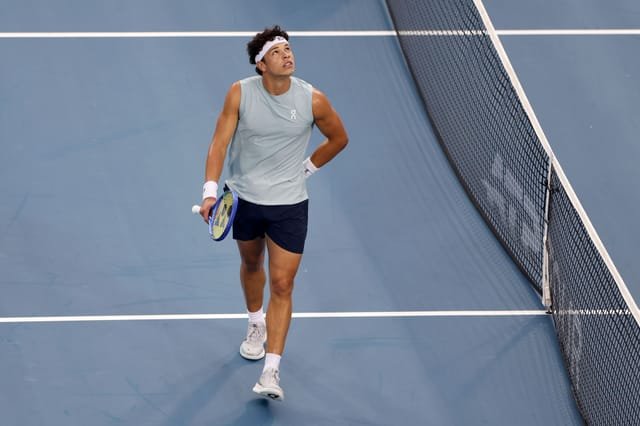
Ben Shelton Cincinnati Open defeat has sparked a wider debate about the scheduling of the North American hard-court swing after the American No. 1 suffered a surprise second-round loss to Portugal’s Jaime Faria. Shelton entered Cincinnati after successfully defending his Canadian Open title in Montreal, but the short turnaround appeared to leave little room for recovery before another demanding Masters 1000 tournament.
The World No. 6 was beaten 6-4, 6-4 by the World No. 79, ending his Cincinnati campaign immediately after his first-round bye. While Faria deserves full credit for producing the biggest result of his tournament, the defeat has also raised questions about whether the current sequence of the Canadian Open, Cincinnati Open and US Open gives leading players enough time to recover.
Tennis insider Jose Moron argued that the existing calendar makes it extremely difficult for a player to perform deep into both Canadian and Cincinnati events while still arriving in New York completely fresh. His comments have added another layer to an already familiar debate: should the biggest tournaments of the American summer hard-court swing be separated by more recovery time?
Why Ben Shelton’s Loss Has Started a Bigger Scheduling Debate
On its own, Shelton losing to a lower-ranked opponent would normally be treated as a major upset and nothing more. Tennis is unpredictable, and a ranking does not guarantee a victory.
However, the timing of the defeat made it particularly interesting.
Shelton had just completed a successful Canadian Open campaign in Montreal, where he defended his title. He then travelled to Cincinnati for another Masters 1000 tournament, receiving a first-round bye because of his ranking.
That meant his first match in Cincinnati came after the travel and physical demands of the previous tournament rather than after an extended recovery period.
Moron’s argument was that the calendar places too much pressure on players who want to compete seriously at both Masters 1000 tournaments before the US Open.
The central issue is not simply the number of matches. It is the combination of travel, changing tournament conditions, practice requirements, media commitments and the physical demands of competing against elite opposition several weeks in succession.
How the Canada-Cincinnati-US Open Sequence Creates a Problem
The North American hard-court swing is one of the most important periods of the ATP season.
Players are expected to compete at major Masters 1000 events in Canada and Cincinnati before heading to New York for the final Grand Slam of the season.
For top players, this creates an uncomfortable balancing act.
- Play deep in Canada: More matches provide valuable preparation but increase physical fatigue.
- Travel to Cincinnati: Players must quickly adjust to another tournament environment.
- Compete in Cincinnati: Another Masters 1000 event can require several high-intensity matches.
- Prepare for New York: Players then need recovery and practice before the US Open.
The problem becomes especially obvious for a player who reaches the latter stages of the Canadian Open. A deep run can mean several consecutive matches, followed by travel and another tournament almost immediately.
A player who exits early in Canada gets more recovery time, while a champion or finalist has to carry the physical cost of success into Cincinnati.
Success in One Tournament Can Become a Disadvantage in the Next
This is perhaps the most unusual aspect of the current schedule.
Winning a Masters 1000 tournament is supposed to be a sign that a player is in excellent form. Yet when two major events are positioned so close together, that success can create an immediate physical disadvantage.
Shelton’s situation illustrates the dilemma perfectly.
He arrived in Cincinnati as the defending Canadian Open champion. Instead of enjoying the momentum that should come with winning a major event, he had to transition almost immediately into another demanding tournament.
That does not prove that fatigue caused his defeat. Faria still had to execute the tennis necessary to beat a top-10 opponent.
But it does raise a legitimate question about whether the schedule rewards players for managing their workload rather than competing fully in every major tournament.
Jaime Faria Deserves Credit for the Upset
Any discussion about scheduling should not diminish Faria’s achievement.
The Portuguese player entered the match ranked No. 79 in the world and produced a straight-sets victory over a player ranked sixth.
Winning 6-4, 6-4 requires more than an opponent being tired. Faria had to maintain his level, handle the pressure of playing a top-ranked American in a major tournament and close out both sets successfully.
Upsets are one of tennis’s defining features, and lower-ranked players often take advantage when they find themselves facing a vulnerable favourite.
Therefore, Shelton’s loss should be viewed through two lenses: Faria’s outstanding performance and the broader physical demands placed on players during this part of the season.
Why the US Open Makes the Scheduling Question More Important
The US Open is not another ordinary tournament.
It is the final Grand Slam of the season, meaning players want to arrive in New York with enough energy to survive potentially seven rounds of best-of-five-set tennis.
That creates a different preparation requirement from a Masters 1000 event.
A player may be willing to push through fatigue in Cincinnati because the tournament offers valuable ranking points and prize money. But doing so immediately before a Grand Slam can have consequences later.
The goal is therefore not simply to reach the US Open. It is to reach it in the best possible physical condition.
Could Top Players Start Skipping One Masters 1000 Event?
This is where the scheduling debate could have a direct effect on tournament fields.
If the calendar remains extremely demanding, elite players may increasingly decide that competing in both Canada and Cincinnati is unnecessary.
Instead, they could choose one Masters 1000 event, use the other period for recovery and preparation, and then target the US Open.
That strategy could make sense from a player’s perspective.
Skipping one tournament may reduce the risk of arriving at the US Open exhausted. However, it could also reduce the quality of the field at one of the Masters 1000 events and potentially affect the tournament’s overall appeal.
That creates a difficult question for tennis authorities: is a packed schedule actually producing more high-level tennis, or is it encouraging the biggest stars to participate selectively?
The Other American Stars Are Still Alive in Cincinnati
Shelton’s elimination does not mean American tennis has lost all its hopes at the Cincinnati Open.
Several other leading American players remain in the tournament and have already advanced through the second round.
| American Player | Seed | Second-Round Result |
|---|---|---|
| Brandon Nakashima | No. 27 | Defeated Aleksandar Kovacevic |
| Tommy Paul | No. 18 | Defeated Hubert Hurkacz in three sets |
| Frances Tiafoe | No. 17 | Defeated Lorenzo Sonego in straight sets |
| Learner Tien | No. 16 | Defeated Sebastian Baez |
| Taylor Fritz | No. 6 | Defeated Alex Michelsen |
The results mean American fans still have plenty to watch in Cincinnati despite Shelton’s early exit.
For these players, however, the same scheduling challenge remains. The deeper they go in Cincinnati, the less recovery time they will have before the US Open.
Cincinnati Has Its Own Physical Challenges
The scheduling debate also cannot be separated from the conditions players face in Cincinnati.
Heat and humidity can make hard-court tennis particularly demanding. Players must deal not only with the physical intensity of long rallies but also with environmental conditions that can increase fatigue.
Novak Djokovic also struggled with Cincinnati’s heat and humidity before losing in the second round.
That adds another factor to the equation. Players are not simply moving between two tournaments; they are adapting to different weather conditions, court environments and travel demands while operating at the highest level of professional tennis.
Why Travel and Recovery Matter More Than Rankings Suggest
Professional tennis rankings can sometimes hide the physical cost of a tournament run.
A player who wins a title may collect a huge number of ranking points, but those points do not show how many hours were spent competing, practising and travelling.
A top player may also need to complete media obligations, sponsor appearances and training sessions between matches.
Recovery is therefore not simply about taking a day off.
It involves sleep, treatment, nutrition, training adjustments and careful workload management. When tournaments are closely packed together, every part of that process becomes more difficult.
The Bigger Problem: Tennis Has to Balance Players and Fans
There is a legitimate reason tournaments are scheduled so closely together.
Fans want to watch the world’s best players competing regularly, while tournaments want strong fields and broadcasters want premium matches throughout the season.
Players, however, have finite physical limits.
The challenge for tennis authorities is finding a balance between commercial demands and athlete welfare without making the calendar less attractive to fans.
Simply removing tournaments is not necessarily the answer. A better approach could involve examining the spacing between major events, travel requirements and the amount of mandatory participation expected from leading players.
A Possible Scheduling Solution
One potential solution would be to create a larger recovery window between the Canadian Open and Cincinnati Open, or between Cincinnati and the US Open.
Another option could involve adjusting tournament duration or providing additional protected recovery periods for players who reach the latter stages of the previous event.
The key objective would be straightforward: make it possible for a player to compete deeply in Canada and Cincinnati without being forced to choose between performance and physical freshness before the US Open.
Any change would need to consider the ATP calendar, player ranking requirements, tournament economics and broadcast commitments. That makes the problem complicated, but the conversation is becoming increasingly difficult to ignore.
Could Scheduling Affect the US Open Title Race?
This is the most important competitive implication.
The US Open title is often decided by tiny margins. A player does not necessarily need to be injured to be affected by fatigue. A small reduction in movement, reaction speed or recovery can influence a long Grand Slam match.
That means the effects of the summer schedule could potentially appear in New York even if a player successfully completes the tournaments beforehand.
In other words, the schedule may influence the US Open before the first ball is even struck.
What Ben Shelton’s Defeat Really Tells Us
It would be unfair to claim that Shelton lost because of scheduling alone.
Tennis matches are decided by performance, and Faria produced the better performance on the day.
But the timing of the result makes Shelton’s defeat a useful case study.
A top-10 player arrived immediately after defending a Masters 1000 title, travelled to another major tournament and then lost his opening match. That sequence naturally invites questions about whether the calendar is giving elite players enough time to recover.
The real concern is not that one player lost.
It is what could happen if the same pattern becomes common among multiple top players before a Grand Slam.
Conclusion
Ben Shelton’s Cincinnati Open defeat has become more than a surprise result. His straight-sets loss to Jaime Faria has reignited the debate surrounding the demanding Canadian Open-Cincinnati Open-US Open sequence.
Shelton arrived in Cincinnati after successfully defending his Canadian Open title, leaving little time between two demanding Masters 1000 tournaments. Although his defeat cannot automatically be blamed on fatigue, the circumstances have highlighted the difficult balance top players must maintain during the North American hard-court swing.
The concern is particularly important because the US Open follows soon afterward. Players who compete deeply in both Masters 1000 events could potentially arrive in New York carrying a significant physical workload, while those who manage their schedules more conservatively may gain a preparation advantage.
For tennis, the long-term question is whether the current calendar encourages the world’s best players to compete at their highest level or pushes them toward selective participation. If more stars begin skipping either Canada or Cincinnati to protect their US Open chances, tournament organisers may eventually have to reconsider the structure.
For now, Shelton’s early exit is a reminder that success on the North American hard courts comes with a physical price. The real test of the schedule may come in New York, when the players who survive this demanding stretch attempt to produce their best tennis at the season’s final Grand Slam.
For breaking news and live news updates, like us on Facebook or follow us on Twitter and Instagram. Read more on Latest Sports on thefoxdaily.com.






COMMENTS 0