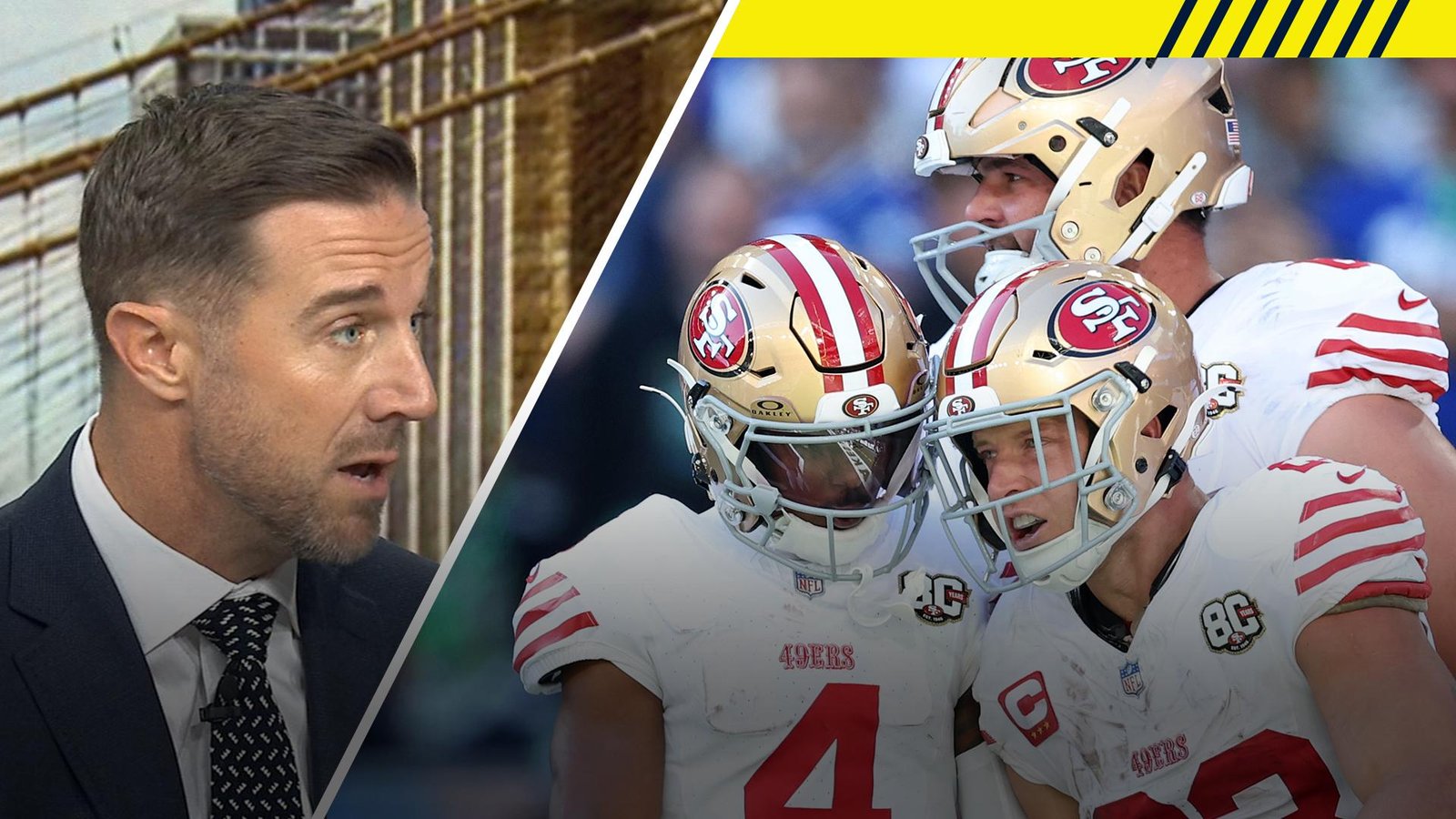
San Francisco 49ers quarterback Brock Purdy has developed a reputation for delivering precise passes into tight windows, particularly over linebackers and in front of defensive backs. His ability to layer throws between defenders has become a defining feature of his game, helping explain his impressive performances and growing reputation as one of the NFL’s top quarterbacks.
Purdy’s development has been shaped by meticulous film study, countless practice repetitions, detailed coaching, and a willingness to challenge opposing defenses. In Kyle Shanahan’s offensive system, throwing over the middle of the field requires more than arm strength. It demands anticipation, timing, spatial awareness, and an understanding of how defenders move in response to offensive formations.
The quarterback has refined those skills through repeated training camp battles with San Francisco linebacker Fred Warner, widely regarded as one of the NFL’s premier defensive players. Their competitive exchanges provide Purdy with an opportunity to test his passing accuracy against elite coverage while forcing Warner to improve his ability to anticipate and disrupt throws.
That work has paid dividends. Through the first five weeks of the 2026 season, Purdy led the NFL in QBR at 85.5 and touchdown passes with 13, according to the supplied report. His ability to fit passes into narrow windows has become a major part of the 49ers’ offensive identity.
Coaches, teammates, and Hall of Fame quarterback Kurt Warner have all highlighted the mental precision behind Purdy’s passing. While his physical tools may differ from those of some of the league’s biggest-armed quarterbacks, his preparation and anticipation allow him to attack defensive coverage with remarkable efficiency.
Training Camp Battles With Fred Warner Help Purdy Improve
For Purdy and Fred Warner, training camp is more than an opportunity to prepare for the upcoming season. Their repeated one-on-one battles have become a competition in which both players attempt to outsmart and outperform the other.
The middle of the field is particularly important in Shanahan’s offense. It offers opportunities for explosive gains, but it is also one of the most dangerous areas for a quarterback because linebackers and defensive backs can converge quickly on an incoming pass.
To succeed, Purdy must deliver the ball over linebackers dropping into coverage while ensuring that it arrives before safeties or other defenders can make a play. A pass that travels too high or too slowly can become an interception or expose the receiver to a punishing hit.
During the 49ers’ 16th training camp practice in August, Purdy completed a pass over Fred Warner’s outstretched arms to wide receiver Mike Evans for a significant gain. Warner responded later in practice by breaking up similar attempts intended for wide receiver Demarcus Robinson and running back Kaelon Black.
After each defensive stop, Warner made sure Purdy heard about it. Their competitive exchanges illustrated the intensity of their practice battles, with neither player willing to give the other an easy victory.
Near the end of the session, Purdy dropped back and saw Warner retreat into coverage. The quarterback delivered another carefully placed pass just beyond the linebacker’s fingertips and into Deebo Samuel Sr.’s hands.
Purdy followed the successful throw with a loud expletive directed at Warner, prompting laughter between the two players shortly afterward. The exchange captured the competitive spirit behind their relationship: each player pushes the other to improve, even when the competition becomes heated.
San Francisco defensive coordinator Raheem Morris has given Purdy a nickname that reflects his growing expertise in this area.
“The ‘Layer King’ has some really intensive intensity, and I like that about him,” Morris said in August. “When he does those things, it just makes the team go.”
The nickname reflects more than Purdy’s ability to throw a ball over a defender. It represents his willingness to attempt difficult passes, learn from failures, and develop the confidence required to make those throws in actual games.
What Does It Mean to Layer a Pass Over Defenders?
Layering a pass involves placing the football in a precise space between defenders, usually over a linebacker and ahead of a safety or defensive back. The quarterback must generate enough height to clear the first defender without giving the second defender time to reach the ball.
The technique requires a careful balance between touch and velocity. A quarterback cannot simply lob the football toward a receiver and hope it arrives safely. Instead, the pass must travel on the correct trajectory and reach its destination at the precise moment the receiver enters the opening.
That challenge becomes more difficult when defenders are moving in opposite directions. A linebacker might retreat into a passing lane while a safety approaches from deeper coverage. The quarterback must anticipate both movements and identify the narrow window that will remain available when the ball arrives.
Purdy described the technique as a process that depends heavily on timing and precision.
“There’s a timing to it,” Purdy said. “It’s not just, ‘Hey, drop back and take a couple hitches and if it’s there, lob it.’ … This kind of ball is like you’re throwing over a guy, but it needs to be just strong enough and just enough touch to get there before the safety hits him.”
For Purdy, successful layering begins before the ball is snapped. He studies the offensive route concept, identifies the likely defensive coverage, evaluates the protection, and anticipates where his receiver should be when the pass needs to arrive.
He also considers the physical characteristics of the players involved. A receiver’s speed, height, and movement out of a route break can influence where the quarterback should place the ball. At the same time, the wingspan of a linebacker and the short-area speed of a safety can determine whether a passing lane is safe to attack.
The objective is to place the football where the receiver can catch it and continue running, ideally without giving defenders an opportunity to deliver a heavy hit.
These decisions often happen in a fraction of a second. Purdy’s preparation allows him to recognize familiar patterns and anticipate openings before they become obvious to other players.
Why Brock Purdy Studies Drew Brees
Purdy has acknowledged that his physical characteristics influence how he approaches the quarterback position. At 6-foot-1, he does not have the same height or imposing physical profile as quarterbacks such as Josh Allen or Joe Burrow.
Rather than viewing that difference as a limitation he cannot overcome, Purdy has studied quarterbacks who succeeded through anticipation, precision, and an advanced understanding of defensive coverage.
One of his most important influences is Hall of Fame quarterback Drew Brees, who stood 6 feet tall. Brees built an outstanding career by combining accuracy with quick decisions, intelligent pocket movement, and the ability to manipulate defenders.
Purdy pays close attention to how Brees used his eyes to create passing lanes, released the ball before receivers completed their breaks, and moved within the pocket to find opportunities.
Those techniques are particularly valuable when a quarterback cannot consistently see every receiver over the defensive line. Instead of waiting for a target to become completely visible, the quarterback must understand the route concept and trust that the receiver will reach the expected location.
Purdy explained why anticipating those openings is essential to his game.
“I’m not the Josh Allen – or Joe Burrow -type quarterbacks where they’re really big and you’d think they could [see the whole field better],” Purdy said. “But I have to take everything into account. … That’s why I’m huge on like, ‘This receiver’s taking eight steps and he’s breaking to daylight on this coverage. I know this hole’s going to be there.’ And taking those kinds of things into factor because I can’t always see.”
His approach demonstrates that quarterback play is not determined by physical measurements alone. Recognizing patterns, understanding defensive responsibilities, and anticipating how a play will develop can help a quarterback overcome limitations in visibility or arm strength.
For Purdy, the lessons from Brees provide a blueprint for making difficult throws with confidence. The goal is to understand where the opening will appear and release the football before defenders have time to close it.
Vision Training Helps Purdy Process Information Faster
Purdy’s preparation extends beyond traditional football practice and film sessions. During the offseason, he also works on vision training to improve how quickly his eyes track movement and process information.
Whether he is at home in Nashville, Tennessee, or training in Florida, Purdy dedicates time to exercises designed to sharpen his visual awareness. His equipment includes an iPad and 3D glasses, which he uses to follow moving shapes and identify how their positions change.
One exercise involves watching two squares move toward, away from, and around one another. Purdy must identify when the squares converge or diverge while shifting his visual focus rapidly.
He also practices saccades, a type of eye movement in which the eyes quickly shift from one point to another. During these sessions, arrows appear in different parts of a screen, and he must identify and touch the correct one when prompted.
According to Purdy, these exercises typically last between two and four minutes. Their purpose is to make him process movement and visual information quickly while working on depth perception and decision-making.
“All those things help me just work on my eyesight, my eyes moving, being quick with my eyes, making quick decisions,” Purdy said. “And then it records my decision-making, how fast, the percentage of getting right and wrong. I do think it helps.”
These exercises complement the mental preparation required to read NFL defenses. During a game, Purdy must process the movements of multiple defenders, identify potential passing windows, and decide whether a throw is worth attempting before the pocket collapses.
Although vision training is only one component of his preparation, it reflects the attention he gives to small details that can influence his performance. Improving the speed at which he recognizes information may help him make decisions more efficiently under pressure.
Advanced Film Study Gives Purdy a Competitive Edge
Purdy credits Shanahan, quarterbacks coach Mick Lombardi, and offensive coordinator Klay Kubiak with helping him refine his understanding of the 49ers’ passing game.
Shanahan’s system places considerable emphasis on route precision and timing. Receivers must reach specific locations at particular moments, while the quarterback must understand exactly when and where to deliver the football.
One example is a route called “skid.” On this route, the receiver takes eight steps at a 45-degree angle as he comes out of his break. Purdy’s objective is to throw the ball approximately 20 yards downfield and two yards outside the hashmarks after taking a five-step drop and one hitch.
Those details help synchronize the quarterback and receiver. If the quarterback releases the ball too early or too late, the passing window can disappear, allowing a defender to break up the play.
Purdy said that this level of precision was not something he had broken down in the same way during high school or college. His time with Shanahan has taught him to approach the passing game with a greater understanding of timing, positioning, and execution.
“I never would have broken it down like that in high school or college,” Purdy said. “But being here with Kyle, there’s a detail to it. This is where it should be. It’s just rep after rep watching film with Kyle and trusting how he’s coaching me.”
The detailed preparation gives Purdy a clearer understanding of where his receivers should be and how opposing defenders might react. Over time, repeated exposure to the same concepts can help him recognize developing situations more quickly.
That familiarity becomes particularly important against NFL defenses, where even a slight delay can allow a linebacker or safety to close a passing window.
The 45-Yard Throw That Showcased Purdy’s Anticipation
One of the clearest examples of Purdy’s ability to layer a pass came during the 49ers’ wild-card playoff victory over the Philadelphia Eagles in January.
With 5:38 remaining in the second quarter, Shanahan called a play featuring four players running the “skid” route. Purdy later walked through the sequence on film, explaining how he identified the defensive coverage and determined where the best opportunity would develop.
He first recognized Eagles safety Marcus Epps rotating toward tight end Jake Tonges. When running back Christian McCaffrey motioned across the formation, linebacker Nakobe Dean followed him, leaving safety Reed Blankenship as the lone deep safety on the backside.
Purdy initially looked toward Tonges but already had other options in mind. He considered throwing to Jauan Jennings on a deeper route or targeting Demarcus Robinson underneath.
The quarterback then noticed that Blankenship was positioned 16 yards deep and that slot cornerback Cooper DeJean was allowing Jennings an inside release. The remaining concern was whether linebacker Zack Baun could drop far enough into coverage to eliminate the passing lane.
Purdy eventually released the ball over Baun and into the opening between DeJean and Blankenship. Jennings caught the pass in stride and raced up the right sideline for a 45-yard gain.
According to NFL Next Gen Stats, Purdy released the ball 2.63 seconds after the snap. Jennings had 1.2 yards of separation when Purdy threw the pass, but that separation increased to 2.8 yards by the time the ball arrived.
The play demonstrated the value of anticipation. Rather than waiting until Jennings was completely open, Purdy delivered the ball into a space that would become available as the receiver continued his route.
“That’s the throw that everyone’s talking about,” Purdy said. “Raheem and everybody — it’s that.”
The completion illustrated how a well-timed pass can turn a tightly covered route into a significant gain. It also highlighted the relationship between preparation and execution: Purdy recognized the defensive structure, anticipated the opening, and trusted his receiver to reach the correct location.
Why Practice Interceptions Can Help Purdy Improve
Layering passes over defenders is a high-risk skill. The same narrow windows that create opportunities for explosive plays can also lead to interceptions if the quarterback misjudges a defender’s position or releases the ball too late.
For Purdy and the 49ers’ coaching staff, practice provides an opportunity to test those boundaries without the consequences carrying over to the regular-season standings.
During training camp, Purdy occasionally attempts difficult throws that defenders successfully break up. Those moments allow him to evaluate what went wrong, understand how the defense reacted, and refine his decisions before facing similar situations in games.
The objective is not to throw recklessly. Instead, Purdy wants to develop the confidence to recognize when a difficult pass is available and understand the precise technique required to complete it.
Practice also helps him develop a short memory. Quarterbacks must recover quickly after mistakes because dwelling on an interception can affect their decisions on subsequent plays.
That quality was evident in the 49ers’ win over Seattle the previous week. After throwing a third-quarter interception, Purdy completed 10 of his next 11 pass attempts for 109 yards and a touchdown, while also contributing to a two-point conversion.
Lombardi highlighted Purdy’s ability to move on from mistakes and remain focused on the next play.
“That’s one of Brock’s great strengths is he’s able to do that and flush the bad and the good and focus on where his feet are right now,” Lombardi said.
That ability to reset mentally is important for any quarterback, particularly one whose playing style involves attacking narrow passing windows. Confidence allows Purdy to make decisive throws without becoming overly cautious after an unsuccessful attempt.
Brock Purdy’s Numbers Highlight His Strength Over the Middle
Purdy’s effectiveness between the hashmarks is supported by his statistical production. Since becoming San Francisco’s starting quarterback in 2022, he has ranked among the NFL’s most productive passers in this area.
Among quarterbacks with at least 30 starts during that span, the supplied figures place Purdy fourth in attempts between the hashes with 224 and fourth in completions with 163. He ranks second in passing yards with 2,389 and yards per attempt at 10.7, while tying for third in touchdown passes with 16.
His numbers on tight-window throws are also notable. These are passes in which the receiver has less than one yard of separation when the ball arrives.
In that category, Purdy ranks fourth in completions with 15, third in passing yards with 215, and seventh in attempts with 34. Since the beginning of the 2025 season, he has ranked first in passing yards and tied for second in completions on such throws, according to the supplied report.
Those statistics help explain why layering passes has become such a significant part of his game. Purdy is not simply completing short throws to open receivers; he is consistently finding ways to deliver the football into contested spaces and generate meaningful gains.
His production through the first five weeks of the 2026 season further strengthened his standing. With a QBR of 85.5 and 13 touchdown passes, he led the league in both categories at that point in the campaign.
Why the “Layer King” Still Needs to Make Every Type of Throw
Although Morris’ nickname celebrates Purdy’s ability to layer passes, Lombardi has emphasized that the quarterback must remain comfortable with a wide range of throws.
After Morris introduced the “Layer King” nickname during training camp, Lombardi jokingly objected to the label. His concern was not that Purdy lacked the ability to layer passes, but that an emphasis on one particular skill should not distract from the other demands of the offense.
Lombardi suggested that “The Appropriate Throw King” would be a more accurate description, even if it was not as catchy. His point was that a quarterback must understand when to use touch and when to drive the football aggressively downfield.
“It’s common to layer it over a guy, but sometimes you have to drive it,” Lombardi said. “There are different things that go into all different types of throws. But I think Brock knows when to push it.”
That distinction is central to Purdy’s development. A quarterback who relies exclusively on touch passes can become predictable, while one who attempts to drive every throw may miss opportunities to place the ball safely over defenders.
The best decision depends on the defensive coverage, the receiver’s route, the available space, and the time remaining before defenders can react.
Purdy has worked to improve his ability to vary his throwing style, saying that he has tried to throw the ball more “violently” during the season. Although he has not used a radar gun to measure his velocity, the ball has appeared to come out with greater authority as his confidence in the offense has grown.
Morris’ defensive approach has also helped create opportunities for Purdy to practice different types of throws. By asking defensive backs to use more man-match coverage, which combines man-to-man responsibilities with zone principles, Morris creates tighter windows that force the quarterback to make precise decisions.
Those demanding practice situations can translate into better execution during games, particularly when Purdy must identify openings against aggressive coverage.
Kurt Warner Sees Elite Anticipation in Purdy’s Game
Hall of Fame quarterback Kurt Warner has offered another perspective on why Purdy’s passing ability stands out. Warner, who was inducted into the Pro Football Hall of Fame in 2017, built his own career through persistence, intelligence, and an ability to read defenses rather than relying solely on exceptional physical tools.
Like Purdy, Warner was not defined by the conventional path to NFL stardom. He entered the league as an undrafted free agent and developed into one of the most accomplished quarterbacks of his era.
Warner understands the difficulty of repeatedly delivering layered throws in an offense that demands precise timing. He believes Purdy’s ability to recognize when and how to make those passes is one of the most impressive aspects of his game.
“Most people don’t understand the degree of difficulty in that offense of those throws,” Warner said. “It’s so hard not only to do it once but to be in an offense that asks you to do that over and over and over again. It’s one of the things that continually impresses me about Brock is the understanding of when and how to make those throws.”
Warner also stressed that the difference between good quarterbacks and elite performers often lies in small details. Understanding when to release a pass, how to place it, and what adjustments are required for a particular situation can separate successful quarterbacks from those who struggle to sustain consistent production.
His assessment aligns with Purdy’s emphasis on preparation. The quarterback’s ability to anticipate openings is not simply a natural gift; it is supported by film study, route familiarity, visual training, and repeated practice against high-level defenders.
Shanahan Believes Purdy Continues to Improve With Experience
Despite the attention surrounding Purdy’s recent performances, Shanahan and several teammates have resisted the suggestion that the quarterback has undergone a dramatic transformation. They believe he has demonstrated elite qualities since taking over as the starter in 2022.
However, Purdy’s continued focus on the smallest details has helped him refine those qualities and potentially raise his ceiling even further.
Shanahan has noted that experience gives Purdy more opportunities to recognize defensive tendencies, understand how plays develop, and make adjustments based on what he has seen previously.
“I think he’s been comfortable with the offense since the beginning, but just the more you play, the more you see,” Shanahan said. “I think Brock learns from every life experience he’s in and that just makes him better as a player and better as a man as he gets older.”
Purdy is also approaching significant career milestones. According to the supplied report, five more pass attempts would bring him to 1,500 for his career and put him in position to become the NFL’s all-time leader in passer rating among qualified quarterbacks. Four additional starts would also make him the longest-tenured starting quarterback of the Shanahan era in San Francisco, surpassing Jimmy Garoppolo’s 61 regular-season or postseason starts with the team.
Those milestones reflect how quickly Purdy has progressed since becoming the 49ers’ starter. His development has been built on a combination of technical skill, confidence, detailed preparation, and a willingness to learn from every experience.
Conclusion: Precision and Preparation Define Brock Purdy’s Passing
Brock Purdy’s ability to layer passes over defenders has become one of the most distinctive features of his quarterback play. The technique requires him to balance touch and velocity, anticipate receiver movements, and identify openings that may exist for only a fraction of a second.
His repeated training camp battles with Fred Warner, detailed film sessions with Shanahan, and vision-training exercises all contribute to that process. Studying Drew Brees has also helped Purdy understand how anticipation and intelligent movement can compensate for differences in physical stature.
From his 45-yard completion to Jauan Jennings against Philadelphia to his impressive statistical production between the hashmarks, Purdy has demonstrated the value of recognizing defensive patterns before they fully develop.
His coaches also stress that layering is only one part of effective quarterback play. Knowing when to loft a pass over a linebacker and when to drive the ball aggressively downfield is equally important.
For Purdy, the objective remains to make the correct throw in the correct situation. His attention to detail, ability to recover from mistakes, and willingness to keep improving have helped him establish himself as a key figure in San Francisco’s offense.
As his experience grows, Purdy’s mastery of timing and anticipation could continue to make him an increasingly difficult quarterback for NFL defenses to contain.
For breaking news and live news updates, like us on Facebook or follow us on Twitter and Instagram. Read more on Latest NFL on thefoxdaily.com.





COMMENTS 0