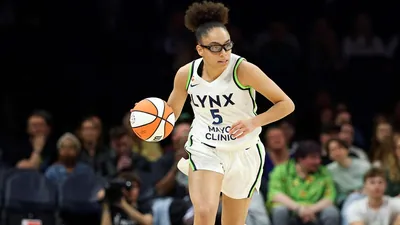
The Caitlin Clark-Olivia Miles controversy has become one of the biggest talking points surrounding the WNBA after an incident during the Minnesota Lynx’s meeting with the Indiana Fever in Minneapolis. What initially appeared to be a physical sequence near the basket quickly became controversial after replay footage showed contact between Miles and Clark during a second-quarter drive.
No foul was called on the play, but the decision immediately triggered debate among fans on social media. Some questioned whether the contact was simply part of an aggressive basketball play, while others argued that the officials should have taken a closer look at the incident. The controversy became even more prominent because Clark remains one of the league’s biggest stars and every physical confrontation involving her tends to attract intense scrutiny.
What Happened Between Olivia Miles and Caitlin Clark?
The incident occurred early in the second quarter when Olivia Miles attacked the basket after finding a route through the Indiana defense.
As Miles turned the corner, she appeared to make contact with Fever guard Kelsey Mitchell before continuing toward the rim. Clark then rotated across the lane in an attempt to contest the shot.
The two players collided while Clark was challenging the attempt. Replay footage appeared to show Miles extending her leg during the sequence, with Clark subsequently falling to the floor.
Officials did not call a foul on the play, which immediately became the central point of discussion.
Why Did the Play Become So Controversial?
The controversy largely stems from how the contact was interpreted.
Basketball is an inherently physical sport, particularly around the basket, and offensive players frequently extend their bodies while attempting to create space or maintain balance. That makes determining intent difficult from a single replay angle.
However, some viewers believed Miles’ leg movement went beyond a normal basketball motion and questioned whether additional officiating review was warranted.
There has been no established finding that Miles deliberately attempted to injure Clark or Mitchell. Those accusations came from sections of the online fanbase rather than from an official ruling about the play.
Was Olivia Miles Penalized?
No foul was called on the sequence involving Miles, Clark and Mitchell.
That decision became particularly important because fans who believed the contact was excessive expected officials to intervene. Others viewed the play as part of the normal physicality of a competitive WNBA game.
The absence of an official foul means the controversy should be understood primarily as a disagreement over the interpretation of the play rather than evidence that a deliberate act of foul play was established.
Olivia Miles Produced a Big Performance Despite the Controversy
The controversy did not prevent Miles from making a major impact on the scoreboard.
The Lynx rookie finished the game with 25 points and connected on three of six attempts from three-point range, while also contributing several assists.
Her offensive production was one of the defining aspects of Minnesota’s performance, but the physical sequence involving Clark quickly overshadowed much of the conversation surrounding her individual display.
| Olivia Miles’ Performance | Result |
|---|---|
| Points | 25 |
| Three-pointers | 3-of-6 |
| Assists | Several |
| Main Talking Point | Second-quarter collision involving Caitlin Clark |
Did Olivia Miles Intentionally Try to Injure Caitlin Clark?
There is currently no confirmed evidence establishing that Miles intentionally tried to injure Clark.
Some social media users interpreted the replay as deliberate, particularly because of the apparent extension of Miles’ leg during the shooting motion. Other viewers considered it an accidental consequence of a fast-moving play in a crowded area around the basket.
That distinction is important. A player’s movement can look unusual or dangerous in slow motion without proving intent. Determining whether contact was deliberate requires more than a single replay sequence, and the official decision on the court did not result in a foul being assessed against Miles for the incident.
Kelsey Mitchell Was Also Involved in the Sequence
The controversy was not limited to Clark.
Before Clark arrived to challenge the shot, Miles appeared to make contact with Kelsey Mitchell while driving toward the basket. Some fans subsequently highlighted both incidents when criticizing the rookie’s approach to the play.
However, social media commentary should not be confused with an official disciplinary finding. The sequence remains a matter of interpretation among viewers rather than a confirmed case of intentional misconduct.
Olivia Miles Avoids Direct Question About Caitlin Clark
Following the game, ESPN reporter Holly Rowe approached Miles during a sideline interaction and asked her about Caitlin Clark.
Miles did not directly address the question. Instead, she shifted the conversation toward Kelsey Mitchell and praised her as a talented player.
Her decision not to engage directly with the controversy added another layer to the online discussion, although it does not establish anything about her intentions during the original play.
Why Caitlin Clark’s Involvement Amplified the Story
The incident attracted significant attention because Clark is one of the WNBA’s most recognizable players and has an enormous fan following.
Physical plays involving the Indiana star routinely receive substantial attention online, particularly when replay angles produce disagreement about whether a foul should have been called.
That creates a difficult environment for both players and officials. A routine basketball collision can become a major social-media debate within minutes, with supporters of opposing teams interpreting the same sequence very differently.
Social Media Reactions Intensify the Debate
Fans quickly flooded social media with competing interpretations of the incident.
Some accused the WNBA of allowing overly physical play, while others defended Miles and argued that the sequence was being exaggerated because Clark was involved.
Several posts alleged that Miles deliberately struck Mitchell and extended her leg toward Clark. Other fans criticized the officiating and questioned why the play was not reviewed.
These reactions demonstrate how quickly a disputed basketball play can become a larger debate about officiating, player safety and competitive intensity.
The Bigger WNBA Issue: Physicality vs Player Safety
The Miles-Clark incident highlights a broader challenge for professional basketball: where should officials draw the line between legitimate physical defense and dangerous contact?
Basketball requires players to attack narrow spaces at high speed, meaning collisions are unavoidable. Offensive players also use their arms and legs to maintain balance, protect the ball and create separation.
At the same time, defenders must be protected from unnecessary contact, particularly around the head, neck and lower body.
The difficulty for officials is determining whether an unusual movement is intentional, incidental or simply a natural part of the player’s attempt to complete a difficult play.
Why Replay Angles Can Change the Conversation
One reason the controversy grew so quickly was the availability of replay footage.
Live television gives officials only a fraction of a second to interpret a rapidly developing play. Fans, however, can watch the same moment repeatedly from multiple angles and in slow motion.
That creates an important distinction between what appears suspicious in replay and what an official can reasonably determine in real time.
A more detailed review system can improve accuracy in certain situations, but it can also create difficult questions about how much physical contact should trigger intervention during normal basketball action.
What Happens Next for Olivia Miles and Caitlin Clark?
The immediate expectation is that both players will move forward with their respective seasons rather than allow one disputed sequence to define their campaigns.
For Miles, the bigger challenge will be maintaining the form that produced her 25-point performance while continuing to adjust to the physical demands of professional basketball.
For Clark and the Fever, the focus will remain on winning games and navigating a highly competitive WNBA season.
The controversy may continue to generate discussion online, but unless the league announces additional disciplinary action, the incident is unlikely to have consequences beyond the debate surrounding the game itself.
Key Takeaways From the Caitlin Clark-Olivia Miles Controversy
- The incident occurred during the second quarter of the Minnesota Lynx vs Indiana Fever game.
- Olivia Miles drove toward the basket and made contact with Kelsey Mitchell before colliding with Caitlin Clark.
- Replay footage appeared to show Miles extending her leg during the shooting sequence.
- No foul was called on the play.
- Some fans accused Miles of intentional contact, but there is no confirmed evidence establishing that she deliberately attempted to injure either player.
- Miles finished with 25 points and shot 3-of-6 from three-point range.
- The incident has renewed debate about physicality, officiating and player safety in the WNBA.
Conclusion
The Caitlin Clark-Olivia Miles controversy has become a major talking point because it combines three ingredients that consistently generate intense WNBA discussion: a physical play, disputed officiating and two highly visible players.
While the replay has led to strong opinions from fans, it is important to separate interpretation from established fact. The officials did not call a foul on Miles, and there has been no confirmed determination that she intentionally attempted to injure Clark or Mitchell.
For Miles, the most meaningful response will ultimately come on the court. Her 25-point performance demonstrated her ability to influence a game, and her continued development will be far more important to her WNBA career than one controversial sequence that has dominated social media.
For breaking news and live news updates, like us on Facebook or follow us on Twitter and Instagram. Read more on Latest Basketball on thefoxdaily.com.


COMMENTS 0