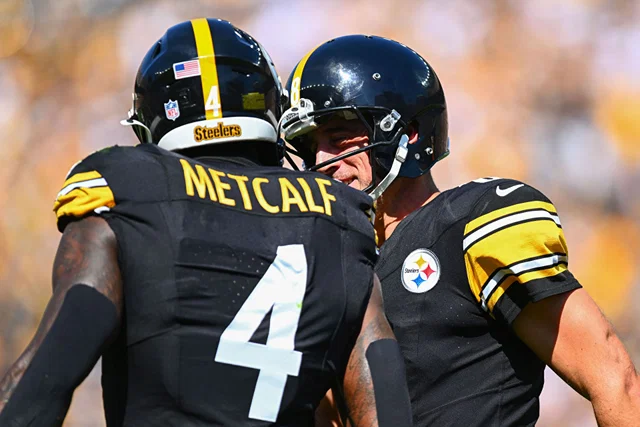
Colin Cowherd has questioned the Pittsburgh Steelers‘ decision to invest heavily in wide receiver DK Metcalf, arguing that the team’s offensive struggles should not be blamed entirely on quarterback Aaron Rodgers. Following Pittsburgh’s 19-16 defeat to the Philadelphia Eagles, the NFL analyst pointed to Metcalf’s performances and contract as major concerns for the franchise.
Metcalf’s difficult afternoon in Philadelphia ended in the third quarter after he was ejected. The wide receiver recorded just one reception for two yards and was involved in an incident with Eagles cornerback Cooper DeJean that led to his dismissal. He was assessed two personal fouls, with the ejection reportedly stemming from an alleged attempt to poke DeJean in the eye.
The defeat dropped Pittsburgh to 6-4 for the season. The Steelers lost to an Eagles team that had entered the game following seven consecutive defeats, adding further pressure on an offense that has struggled to produce consistently.
Although Cowherd previously described Rodgers as “moody,” he resisted making the 42-year-old quarterback the central explanation for Pittsburgh’s problems. Instead, he questioned whether the Steelers were receiving sufficient value from their major investment in Metcalf.
“In 2026 it’s so easy to blame Aaron Rodgers but do people understand how bad the DK Metcalf deal is? He can’t get open, can’t catch, he’s imploding,” Cowherd said.
Metcalf’s Production Raises Concerns
Metcalf’s statistical production has become a major part of the discussion surrounding Pittsburgh’s offense. He has recorded 36 receptions for 434 yards and two touchdowns on 74 targets.
His catch rate is below 50%, ranking as the second-worst among 133 qualified players, according to ESPN Research. The numbers have raised questions about his consistency and ability to turn opportunities into completed receptions.
His drops have also become a concern. According to Pro Football Focus, Metcalf has six drops, the second-highest total among wide receivers. For a player who arrived in Pittsburgh with expectations associated with a major contract and significant trade compensation, the production has attracted scrutiny.
The Philadelphia game added another difficult moment to his season. Metcalf finished with only one catch for two yards before being ejected in the third quarter. His involvement in the incident with DeJean meant he could not contribute during the remainder of the contest.
The ejection also shifted attention away from Pittsburgh’s broader offensive problems and toward Metcalf’s individual performance. Cowherd’s criticism suggests that he believes the Steelers’ investment in the receiver deserves greater attention when evaluating the team’s disappointing offensive output.
Rodgers Has Also Faced Offensive Difficulties
Rodgers’ performance against Philadelphia was not without problems. The veteran quarterback completed 30 of 44 passes for 227 yards, threw one touchdown and did not record an interception.
However, he was sacked five times during the game and finished as Pittsburgh’s leading rusher. The combination of limited passing production and pressure from the Eagles’ defense reflected the difficulties the Steelers experienced throughout the afternoon.
Pittsburgh’s passing offense entered Sunday ranked 24th in the NFL in passing yards. The team had also averaged only 158.7 passing yards per game across its previous three contests.
Those numbers illustrate that the offensive struggles extend beyond one player. Rodgers has not consistently produced the passing numbers Pittsburgh needs, while the team’s overall passing output has remained limited.
Nevertheless, Cowherd argued that focusing exclusively on the quarterback would overlook Metcalf’s contribution to the problem. His comments shift part of the discussion toward the receiver’s ability to get open, secure passes and deliver the production expected from a player acquired through a significant trade and contract extension.
The Contract Math Behind Cowherd’s Criticism
The financial commitment to Metcalf is central to Cowherd’s argument. Pittsburgh acquired the receiver from Seattle by sending the Seahawks a 2025 second-round pick and a seventh-round selection. The Steelers also received a sixth-round pick in the transaction.
After completing the trade, Pittsburgh signed Metcalf to a four-year contract extension worth $132 million. The agreement represented a substantial investment in the wide receiver and placed expectations on him to become a major part of the team’s passing offense.
Seattle subsequently packaged the second-round selection it received from Pittsburgh to move up in the draft and select safety Nick Emmanwori. That detail adds another dimension to the trade, as the Seahawks used the compensation from the Metcalf deal to strengthen their roster through the draft.
The Steelers also restructured Metcalf’s contract before the current season. The team converted approximately $23.6 million of his base salary into a signing bonus, changing the way the financial commitment is distributed across the remaining years of the agreement.
According to OverTheCap, the restructuring leaves Pittsburgh facing significant future salary-cap charges:
- 2027: $38.4 million
- 2028: $39.9 million
- 2029: $47.4 million
The contract also includes roster bonuses due each March. These payments create important decision points for the Steelers as they evaluate the receiver’s future and the financial consequences of keeping him.
The potential cost of moving on from Metcalf is another major concern. Releasing him before next season would leave Pittsburgh with approximately $35.8 million in dead money, according to OverTheCap.
Dead money represents salary-cap charges that remain with a team even after a player is no longer on its roster. In this situation, the reported figure would make a release financially difficult, particularly if the Steelers wanted to redirect their resources toward other areas of the offense.
Cowherd Calls It a Historic Contract Mistake
Cowherd’s criticism went beyond Metcalf’s recent performances. He questioned the overall value of the agreement and suggested that Seattle benefited significantly from the transaction.
“It’s the worst deal for a wide receiver, I think ever,” Cowherd said. “John Schneider worked Omar Khan, this is a bad deal.”
The comments reflected Cowherd’s view that Seattle general manager John Schneider secured a favorable return from Pittsburgh general manager Omar Khan. His argument combines the draft compensation Seattle received with the financial commitment Pittsburgh made to Metcalf.
However, the full evaluation of the trade and contract will depend on Metcalf’s performances over the remaining years of the agreement. His production, availability and role in the Steelers’ offense will all influence how the deal is ultimately viewed.
For Pittsburgh, the immediate concern is finding a way to improve an offense that has struggled to generate passing yards. The Steelers need better production from their receiving group, more consistent execution and improved protection for Rodgers.
What Happens Next for Metcalf and the Steelers?
Metcalf is not expected to receive a suspension for the alleged eye-poking incident involving DeJean, although a fine is considered likely. The incident could still attract attention from the NFL as the league reviews the conduct that resulted in his ejection.
Pittsburgh’s next game is against Denver on Friday. The matchup will give the Steelers an opportunity to respond after the disappointing loss in Philadelphia and attempt to improve their offensive performance.
The next major contractual decision point arrives in March, when the roster bonuses are due. That timing could become important as the Steelers assess their salary-cap position and determine how to approach Metcalf’s future.
For now, the team must balance the financial implications of the contract with its need to improve on the field. The reported dead-money figure makes an immediate release difficult, while the scheduled future cap charges increase the importance of receiving stronger production from the receiver.
The Bigger Question for Pittsburgh
The Steelers’ 19-16 loss to Philadelphia exposed several problems that cannot be explained by one player alone. Rodgers completed 30 passes and avoided interceptions, but the offense struggled to create enough production. Five sacks and a limited passing total further complicated Pittsburgh’s afternoon.
Metcalf’s low catch rate, six drops and early ejection have nevertheless made him a central focus of the criticism. His contract adds another layer to the situation because Pittsburgh committed substantial draft capital and $132 million over four years to acquire and retain him.
Cowherd’s argument is that the conversation around Rodgers should also account for the performance and financial cost of the team’s receiving investment. Whether Metcalf can respond with more consistent production will be important to Pittsburgh’s efforts to improve its offense and make the most of the contract.
With Denver approaching and a significant contractual decision point scheduled for March, the Steelers face pressure to find answers both on the field and in their long-term roster planning.
For breaking news and live news updates, like us on Facebook or follow us on Twitter and Instagram. Read more on Latest NFL on thefoxdaily.com.





COMMENTS 0