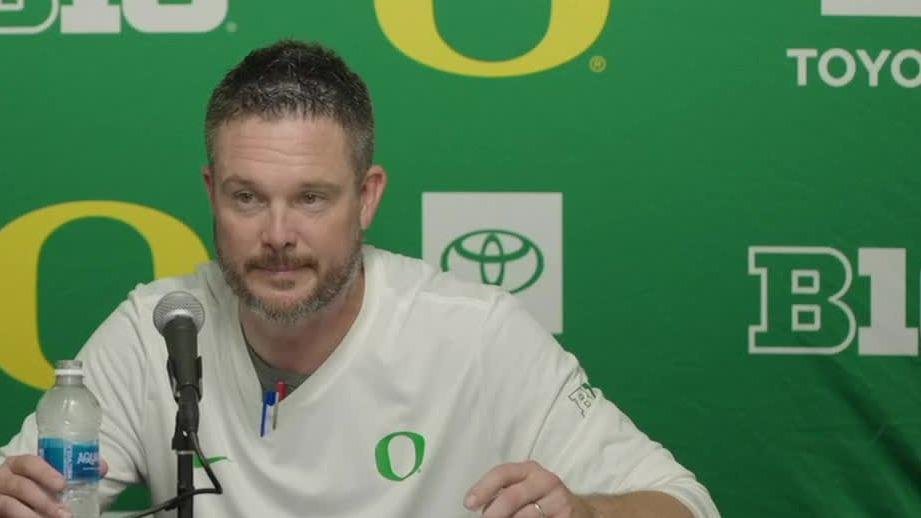
Oregon quarterback Dante Moore is not expected to return for the remainder of the season after missing the Ducks’ past three games with a concussion, head coach Dan Lanning announced Monday. The decision represents a significant setback for a team that entered the campaign with national championship ambitions and Moore among its leading Heisman Trophy contenders.
Moore suffered the concussion during Oregon’s September 26 game against USC after taking a late hit while attempting to slide following a scramble. He was subsequently transported by ambulance to Los Angeles General Medical Center for evaluation. Although his MRI and CT scans came back clean, he has not been medically cleared to resume playing.
The quarterback’s absence has coincided with a difficult stretch for the Ducks. Oregon has scored fewer than 20 points in each of the three games Moore has missed, losing two of them. Backup Dylan Raiola and third-string quarterback Brock Thomas have both started during that period, but the offense has struggled to establish consistency.
Lanning emphasized that the decision was based on Moore’s recovery rather than the team’s recent results. The coach said the quarterback would want to return if he could, but stressed that his health must come first. Oregon now faces the challenge of finishing the season without its established starter while attempting to stabilize an offense that has lost momentum.
The announcement also arrives amid wider changes to the Ducks’ coaching staff. Following a 21-10 loss to Illinois, Lanning dismissed offensive coordinator Drew Mehringer and subsequently named quarterbacks coach and offensive analyst Jay Johnson as the team’s new playcaller.
Dan Lanning Confirms Dante Moore Is Not Expected Back This Season
Lanning announced Monday that Moore was not expected to return to the field this season, ending hopes that the quarterback might recover in time to help Oregon during the closing weeks of its campaign.
Although Moore had returned to practice and thrown the football in recent weeks, the coaching staff had not provided a firm timetable for his return. According to Lanning, the Ducks received greater clarity about the situation during the week leading up to Monday’s announcement.
The coach made clear that Moore’s absence should not be interpreted as a lack of commitment to his teammates or the program. Instead, the decision reflects the medical considerations surrounding his recovery and the need to avoid putting him back into a competitive environment before he is ready.
“If it was up to Dante in any shape, way, he would be out there playing for the guys,” Lanning said.
Lanning also rejected the suggestion that Moore might be choosing to sit out because the season had not unfolded as expected.
“This isn’t a selfish decision on Dante’s part, saying, ‘I don’t want to come back, the season doesn’t look the way I want it to look.’ That’s not at all what this is.”
The distinction matters because Moore entered the season with substantial expectations. After helping Oregon achieve a 13-2 record in 2025, he returned to college rather than entering the 2026 NFL draft. His decision positioned him as one of the most closely watched quarterbacks in College Football.
However, individual ambitions and team goals cannot override medical considerations. A player’s return from a concussion requires appropriate evaluation, and a return to practice does not automatically mean that the player is ready for the demands of a competitive game.
Lanning said Oregon would continue to support Moore even though he would not return as the team’s starting quarterback this season. The coach described the situation as a serious medical matter but expressed confidence that Moore would make a full recovery.
“We said before that this is a serious deal that he’ll 100% be able to fully recover from, that hasn’t changed,” Lanning said. “But for him to be out there on the field for us, that’s not going to happen. We’d love to have Dante out there, he’s still going to be a big part of this team.”
For Oregon, the immediate priority is now to prepare the offense for the remainder of the campaign without its leading quarterback. For Moore, the focus shifts away from the team’s short-term results and toward recovery, with his longer-term football future remaining an important consideration.
How Dante Moore Suffered His Concussion Against USC
Moore’s injury occurred during Oregon’s September 26 matchup against USC. In the second quarter, the quarterback scrambled upfield and attempted to slide before being hit late by linebacker Desman Stephens II.
Moore remained down on the field for an extended period, prompting concern from players, coaches and medical personnel. He was eventually transported by ambulance to Los Angeles General Medical Center for further evaluation.
Oregon later announced that Moore had sustained a concussion. His MRI and CT scans came back clean, but those results did not establish that he was ready to resume playing football.
Concussion recovery is not determined solely by the results of imaging tests. Medical professionals must also consider symptoms, clinical assessments and how a player responds as activity gradually increases. Clearance to return to competition requires more than the absence of an obvious structural abnormality on a scan.
That context helps explain why Moore’s return to practice did not lead to an immediate return to the lineup. According to Lanning, the quarterback had thrown the ball in recent weeks, but the team had not established a specific date for his comeback.
The coach also explained that Oregon could control the environment in which Moore participated in practice, including situations involving the scout team. A live game presents a different level of uncertainty because contact and unexpected plays can occur at any moment.
Lanning said the final decision about Moore’s availability was outside the team’s control in the sense that the quarterback had not been medically cleared to play. The coaching staff could continue to manage his practice environment, but it could not treat his return to throwing as permission to place him in a competitive game.
The announcement that Moore was not expected back this season therefore provides greater clarity after several weeks of uncertainty. Rather than continuing to speculate about a possible return date, Oregon can now plan its remaining games around the quarterbacks who are available.
It is important, however, not to confuse the end of Moore’s playing season with the end of his recovery. Lanning said the injury was expected to be fully recoverable, while making clear that Moore would not return to the field for the Ducks this season.
Dante Moore’s Injury Has Changed Oregon’s Season
Oregon began the season with high expectations, entering the campaign ranked No. 2 in the Associated Press preseason poll. The Ducks were viewed as national championship contenders, and Moore was among the quarterbacks expected to compete for the Heisman Trophy.
His early performances appeared to support those expectations. In four games before his injury, Moore completed 69.7% of his passes for 926 yards, nine touchdowns and zero interceptions.
Those numbers reflected an efficient start to the season. Moore was completing passes at a high rate, producing touchdowns and avoiding interceptions, giving Oregon a reliable foundation for its offensive approach.
His absence has exposed how difficult it can be for a team to replace its established starter in the middle of a campaign. Oregon has failed to reach 20 points in any of the three games he has missed, and two of those contests ended in defeat.
The scoring decline does not necessarily reflect one isolated problem. A quarterback change can affect timing between receivers and passers, decision-making under pressure, the rhythm of the passing game and the way an offense handles critical situations.
Moore’s familiarity with Oregon’s offense was especially valuable after he spent the previous season developing into the team’s starter. Replacing that experience requires more than simply selecting another player to take snaps. The offense must also adjust its play-calling, execution and expectations to fit the quarterback on the field.
Both Raiola and Thomas have had opportunities to lead the Ducks, but neither has been able to establish a consistent offensive rhythm during Moore’s absence. That challenge has contributed to the pressure on Lanning and the coaching staff to find a workable solution.
Oregon’s difficulties also illustrate how quickly the outlook of a promising season can change. The Ducks began with championship ambitions, but the combination of Moore’s injury and consecutive offensive struggles has placed those goals in serious doubt.
With Moore no longer expected to return, Oregon must focus on improving its execution with the available personnel. The coaching staff’s challenge is to establish a dependable offensive identity rather than attempting to reproduce every aspect of the system built around its injured starter.
Oregon Fires Offensive Coordinator Drew Mehringer After Illinois Defeat
Oregon’s offensive problems have prompted a significant coaching change. On Sunday, Lanning fired offensive coordinator Drew Mehringer following the Ducks’ 21-10 loss to Illinois.
The defeat added to the team’s struggles during Moore’s absence and effectively ended Oregon’s chances of reaching the College Football Playoff for a third consecutive year, according to the supplied report.
While the quarterback injury has been a major factor in the offense’s recent difficulties, the coaching staff must also find ways to improve production with the players available. The decision to remove Mehringer indicates that Lanning wanted a different approach as the season moved toward its conclusion.
Oregon’s inability to score 20 points in three straight games created a clear need for improvement. A team with championship aspirations cannot afford prolonged offensive stagnation, particularly when the margin for error becomes smaller late in the season.
However, changing the offensive coordinator does not automatically solve the underlying issues. The next playcaller must assess the strengths of the available quarterbacks, establish realistic expectations and find ways to produce consistent results without Moore.
The timing of the change also presents a challenge. A midseason coaching adjustment leaves limited time to implement new ideas, while players must adapt to changes in communication, responsibilities and game-day decisions.
For Lanning, the objective is to give the offense a spark and improve consistency during the remaining games. The coaching decision represents an attempt to change the team’s direction at a difficult point in the season.
Jay Johnson Takes Over Oregon’s Offensive Playcalling
Lanning announced Monday night that Jay Johnson would assume playcalling responsibilities following Mehringer’s dismissal. Johnson is Oregon’s offensive analyst and quarterbacks coach, and he brings extensive college coaching experience to the role.
Johnson is in his first year with the Ducks but has coached at the college level since 1994. His previous positions include offensive coordinator roles at Wyoming and Michigan State.
That experience will be important as Oregon attempts to stabilize an offense that has struggled without Moore. Johnson must work with the quarterbacks available, identify the most reliable offensive combinations and make decisions that help the team avoid the problems that have affected its recent performances.
Lanning explained that the change was intended to improve the offense’s consistency rather than simply respond to one disappointing result.
“Ultimately, I felt like we needed to be able to develop more consistency there, and this gave us a spark and an opportunity to be able to do that,” Lanning said.
Johnson’s background as a quarterbacks coach could prove useful as Oregon adjusts to life without Moore. He will need to help the available signal-callers make decisions efficiently, build confidence in the passing game and communicate a clear approach to the rest of the offense.
The immediate task is not to reproduce Moore’s statistical output exactly. Instead, Oregon must identify the combinations and strategies that give its current players the best chance of executing consistently.
That may require adjustments to the balance between passing and running, the types of throws requested from the quarterbacks and the way the offense approaches high-pressure situations. The effectiveness of those changes will become clearer as the Ducks play under Johnson’s direction.
Johnson also inherits a difficult situation in which the team has little room for error. The Ducks’ recent losses have weakened their postseason outlook, meaning that improving offensive performance is essential even if a return to the College Football Playoff is no longer realistic.
How Dylan Raiola and Brock Thomas Fit Into Oregon’s Plans
With Moore ruled out for the remainder of the season, Oregon will have to rely on the quarterbacks who remain available. Raiola and Thomas have both taken turns starting during the injured quarterback’s absence, but the offense has struggled to find a consistent rhythm.
The change in playcalling gives Johnson an opportunity to evaluate how each quarterback fits the team’s current needs. A successful approach will depend on execution, decision-making and the ability to sustain drives rather than simply on individual passing totals.
Oregon must also support its quarterbacks through better overall offensive execution. Reliable protection, effective route-running and a balanced approach can help reduce the pressure on players who are adjusting to larger responsibilities.
The transition will not be straightforward. Moore had established himself as the starter after spending the previous season behind Dillon Gabriel, and his familiarity with the system gave Oregon a level of continuity that is difficult to recreate quickly.
Raiola and Thomas now have an opportunity to demonstrate that they can lead the offense under Johnson. Their performances will help determine how competitive Oregon can remain in its remaining games and provide the coaching staff with useful information for future roster decisions.
Nevertheless, Moore’s injury means the Ducks must avoid treating his potential return as a solution to their immediate problems. Lanning has made clear that the quarterback is not expected to play again this season, so the team’s plans must be built around the available options.
Dante Moore’s Journey From UCLA to Oregon Stardom
Moore’s rise to national prominence followed an uneven start to his college career at UCLA. He began as a freshman starter in 2023, throwing for 1,610 yards and nine touchdowns with 11 interceptions during his first six games.
After those six games, Moore was replaced by backup quarterback Ethan Garbers. The change marked an early setback in his development, but it did not end his prospects as a leading college quarterback.
Moore transferred to Oregon during the offseason. The Ducks had already added Oklahoma transfer Dillon Gabriel ahead of the 2024 season, and Gabriel became the team’s starter. Moore spent that season behind him, gaining time to develop before taking over as Oregon’s starting quarterback the following year.
The opportunity to learn behind an experienced starter helped set the stage for Moore’s breakthrough in 2025. He led Oregon to a 13-2 record and completed 71% of his passes for 3,565 yards and 30 touchdowns.
Those numbers elevated his standing among college quarterbacks and attracted attention from opposing coaches and NFL scouts. His accuracy, passing production and role in Oregon’s successful season helped establish him as a leading professional prospect.
Moore’s development also demonstrated the value of his transfer to Oregon. After an inconsistent beginning at UCLA, he found a path to becoming a starter, improving his production and positioning himself among the most highly regarded players at his position.
His decision to return for the 2026 season was therefore significant. Rather than immediately entering the NFL draft, he chose to continue his college career with the Ducks, creating expectations that he could lead another championship challenge while strengthening his professional prospects.
The concussion has interrupted that plan. Although the injury is expected to be fully recoverable, the loss of the remaining season means Moore will have fewer opportunities to add to his college record before the next NFL draft.
What Moore’s Injury Means for His NFL Draft Prospects
Before deciding to return to Oregon, Moore was widely projected to be among the top selections in the 2026 NFL draft. His decision to remain in college was followed by a strong 2025 campaign, during which he led the Ducks to a 13-2 record and recorded 30 touchdown passes.
His performance attracted praise from opposing coaches and NFL scouts, and ESPN’s draft analysts had projected him to be among the top three picks had he entered the 2026 draft, according to the supplied report.
However, Moore is now ranked 25th among prospects for the upcoming NFL draft by ESPN analyst Mel Kiper Jr. The change in his standing comes as his college season has been cut short by the concussion and Oregon’s overall results have deteriorated.
Draft projections are not final decisions, and rankings can change as analysts assess players’ performances, physical condition and professional potential. Moore’s injury adds uncertainty, but the available information does not establish how NFL teams will ultimately evaluate him.
His earlier production remains an important part of his record. In 2025, he completed 71% of his passes for 3,565 yards and 30 touchdowns while helping Oregon achieve a 13-2 record. Before his injury this season, he had completed 69.7% of his passes for 926 yards and nine touchdowns without throwing an interception.
Those figures provide evidence of his ability to perform at a high level over an extended period. At the same time, teams considering a quarterback prospect will want to understand the circumstances of his concussion, his recovery and his readiness for the demands of professional football.
The most immediate priority is for Moore to recover fully. Lanning has said the injury is expected to be completely recoverable, and the coach’s comments indicate that the decision to rule Moore out is intended to protect his longer-term well-being rather than reflect a loss of confidence in his abilities.
For Moore, the next stage will involve completing his recovery and preparing for the next phase of his football career when medically appropriate. His precise draft position remains uncertain, and it would be premature to conclude that the injury alone will determine his professional future.
Oregon Must Move Forward Without Its Starting Quarterback
The announcement that Moore is not expected to return this season forces Oregon to reconsider its immediate priorities. The Ducks entered the campaign with national championship ambitions, but his injury and the offense’s struggles have made the remainder of the season a different challenge.
The team’s inability to score 20 points in any of the three games Moore has missed illustrates the size of the problem. With the quarterback now ruled out for the season, Oregon must find a way to improve production without relying on a possible return from its established starter.
Johnson’s appointment as playcaller gives the coaching staff a chance to establish a more consistent approach. The new playcaller will need to work closely with Raiola, Thomas and the rest of the offense to identify reliable options and improve execution.
Defensively and across the broader team, Oregon must also avoid allowing the offensive difficulties to dictate every aspect of its performance. A more controlled offensive approach, fewer costly mistakes and better management of possessions could help the Ducks become more competitive in their remaining games.
The coaching staff will have to balance the need for immediate improvement with the realities of a midseason transition. Players are adapting to a new playcaller, the quarterback depth chart has changed, and the team’s original championship expectations have been undermined by recent results.
For Lanning, the focus is now on managing those challenges while supporting Moore’s recovery. The coach has made clear that the quarterback will remain part of the team even though he will not play again this season.
Conclusion: Dante Moore’s Focus Turns to Recovery as Oregon Resets Its Offense
Dante Moore is not expected to return for Oregon this season after suffering a concussion against USC on September 26. Head coach Dan Lanning confirmed Monday that the quarterback has not been medically cleared and will not return to the field for the Ducks during the remainder of the campaign.
The loss is significant for a team that began the season ranked No. 2 nationally and hoped to compete for a championship. Oregon has scored fewer than 20 points in each of the three games Moore has missed, losing twice, and the offense has struggled to establish consistency with Raiola and Thomas sharing the starting responsibilities.
The situation has also prompted a coaching change. Following the loss to Illinois, Lanning dismissed offensive coordinator Drew Mehringer and appointed Jay Johnson to take over playcalling duties. Johnson will now be responsible for helping the Ducks find a more effective offensive approach without their established starter.
Moore’s longer-term future remains important. His strong 2025 season and efficient start to 2026 established him as a highly regarded quarterback prospect, although his current draft ranking has fallen compared with earlier projections. The final impact on his professional prospects remains uncertain.
For now, the priority is clear: Moore needs to complete his recovery, and Oregon must learn to operate without him. Lanning has emphasized that the injury is expected to be fully recoverable, while making it equally clear that the quarterback will not return this season.
For breaking news and live news updates, like us on Facebook or follow us on Twitter and Instagram. Read more on Latest Sports on thefoxdaily.com.



COMMENTS 0