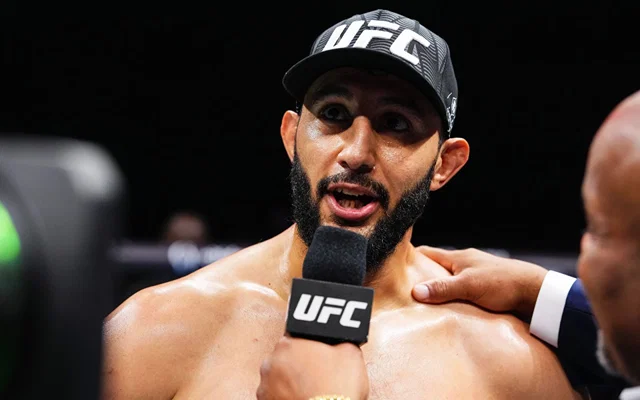
Dominick Reyes has openly criticized Daniel Cormier‘s commentary following his reported first-round knockout victory over Azamat Murzakanov at UFC 333, questioning the former two-division champion’s preparation, analysis, and perceived bias during the broadcast.
The light heavyweight contender explained that he watched the fight again while at the airport and became increasingly frustrated with several of Cormier’s observations. According to Reyes, the commentary failed to accurately capture what was happening inside the Octagon, raising concerns about the responsibility commentators have when analyzing professional fighters and their performances.
Reyes believes UFC commentators play an important role in shaping how audiences understand a fight. He argued that their assessments should be based on proper preparation, accurate observations, and a fair understanding of the competitors involved. For Reyes, the issue extends beyond one broadcast and raises a broader question about accountability within UFC commentary.
During an appearance on The Ariel Helwani Show, Reyes delivered a pointed assessment of Cormier’s performance behind the microphone. While acknowledging the former champion’s communication skills and popularity, Reyes insisted that commentators must be more careful when discussing the careers and performances of active fighters.
Dominick Reyes Questions Daniel Cormier’s Commentary After UFC 333
Reyes’ frustration reportedly came after he reviewed his fight against Murzakanov at the airport. Watching the contest again gave him an opportunity to evaluate the broadcast commentary alongside the action inside the cage. He felt that several of Cormier’s remarks did not accurately represent the exchanges or the circumstances of the fight.
Rather than treating the criticism as a minor disagreement over interpretation, Reyes questioned whether Cormier had adequately prepared for the broadcast. He suggested that commentators should conduct enough research to understand the fighters, their approaches, and the details that influence a contest.
Reyes expressed his frustration during his conversation with Ariel Helwani, saying:
“I watched the fight at the airport, and I was like, dude, what are you talking about, man? He was so off base on so many different things. You didn’t do any research, and now you’re just kind of talking, man. It’s just the fact that you’re ill-prepared, and you have a tendency to be a little biased. It’s color commentary. It’s not just talking about meat pies during the fight. The only people in the whole UFC that are never held accountable are the announcers. So it’s time.”
The comments reflect Reyes’ belief that live fight analysis should involve more than entertaining conversation. For him, commentary should help viewers understand what is happening technically and strategically rather than distract from the action or leave important details unexplained.
His remarks also raise questions about how fighters perceive commentary after a contest. While audiences may primarily experience a fight through the broadcast, competitors have a different perspective because they are directly involved in the exchanges being described. Reyes believes that difference makes preparation and accuracy particularly important.
Why Reyes Believes UFC Commentators Should Be Held Accountable
One of the strongest elements of Reyes’ criticism was his argument that UFC commentators are rarely held accountable for their analysis. Fighters, coaches, and other members of the sport are routinely judged on their performances, but Reyes believes broadcasters should also face scrutiny when their observations are inaccurate or unfair.
Commentary can influence how viewers interpret a contest, especially when a fight involves complicated exchanges, tactical adjustments, or moments that are difficult to understand at full speed. A commentator’s description can help explain why a fighter is succeeding, identify a defensive adjustment, or clarify the significance of a particular sequence.
However, an inaccurate assessment can also create a disconnect between what a fighter believes happened and what the audience hears. Reyes suggested that this responsibility deserves greater attention because commentary can affect the public perception of athletes whose careers depend on their performances inside the Octagon.
His argument is not simply that commentators should agree with fighters. Different observers can reasonably interpret the same exchange in different ways, and disagreement is a natural part of combat sports analysis. Reyes’ concern, as expressed in his interview, was that commentary should be informed, fair, and grounded in what actually happens during a fight.
That distinction matters in a sport where individual moments can determine the outcome of a contest. A missed defensive movement, a successful counter, or an adjustment in distance can change the direction of a round. Effective commentary should help viewers recognize those details and understand their significance.
Reyes also suggested that perceived bias can undermine the credibility of a broadcast. Even when a commentator does not intend to favor one competitor, repeated observations that appear one-sided can influence how audiences interpret the action. In Reyes’ view, commentators should remain conscious of that possibility and make an effort to provide balanced analysis.
Dominick Reyes Praises Dominick Cruz, Jon Anik, Paul Felder and Laura Sanko
Although Reyes was particularly critical of Cormier’s commentary during UFC 333, he did not dismiss the UFC’s broadcasting team as a whole. Instead, he highlighted several commentators whose work he appreciates, including Dominick Cruz, Jon Anik, Paul Felder, and Laura Sanko.
Reyes singled out Cruz as the commentator he considers the best in the UFC. Cruz is known for discussing technical details, including movement, distance management, defensive positioning, and the tactical decisions that shape mixed martial arts contests. Reyes’ praise suggests that he values commentary that helps viewers understand the finer points of a fight.
He also praised Anik, whose role includes providing play-by-play narration and maintaining the flow of a broadcast. Reyes expressed appreciation for Felder’s analysis and Sanko’s work as well, making clear that his criticism of Cormier did not reflect a general dissatisfaction with every UFC commentator.
Explaining his views on the broadcast team, Reyes said:
“I think Dom Cruz is the best. I think Anik is really, really good. I like Paul Felder a lot. Laura Sanko is amazing. I like DC too. I think he’s extremely well-spoken, man. He’s got a silver tongue. He gets fans in there. I think he’s really good at what he does. He just needs to do better. That’s it. They’re all really good, but you could do better. Just don’t be biased, man, and be real. Realize these are our lives. You can’t just say things willy-nilly about us out here.”
The statement provides important context for Reyes’ dispute with Cormier. He acknowledged Cormier’s strengths as a broadcaster, including his ability to communicate clearly and connect with viewers. His objection was that those strengths do not remove the need for preparation and balanced analysis.
By praising several other commentators, Reyes also illustrated the standards he wants to see from the broadcasting team. His preferred approach appears to involve detailed fight knowledge, clear explanations, and a commitment to describing the action fairly.
Why Dominick Cruz Stands Out to Reyes
Reyes’ selection of Cruz as his preferred UFC commentator highlights the importance he places on technical insight. Mixed martial arts is a complex sport in which small changes in positioning, timing, and distance can have significant consequences. A commentator who can identify those details can provide viewers with a deeper understanding of a fight.
Technical commentary can be especially valuable when the action moves quickly. Fighters often make adjustments that are not immediately obvious to casual viewers, such as changing their stance, controlling the range, disguising a strike, or using movement to limit an opponent’s opportunities.
By pointing to Cruz, Reyes emphasized the kind of analysis he appreciates. His praise does not mean that every commentator must adopt the same style, but it reinforces his view that the broadcast should provide meaningful information about the contest rather than rely entirely on general observations.
Play-by-play narration, technical analysis, and entertainment all serve different purposes during a UFC broadcast. Anik helps guide viewers through the action, while analysts such as Cruz and Felder can explain the tactical developments. Sanko also brings her own perspective to the broadcast team. Reyes’ comments suggest that he values the different contributions these commentators make when their analysis remains grounded in the fight.
His criticism of Cormier, therefore, is not necessarily a demand for a particular commentary style. Instead, Reyes is asking for a higher standard of preparation and accuracy, regardless of the personality or approach of the person speaking.
Daniel Cormier’s Reputation as a UFC Commentator
Cormier occupies a prominent position in UFC broadcasting, bringing the perspective of a former elite competitor to his commentary. As a former two-division champion, he has extensive experience with the demands of high-level mixed martial arts and the technical decisions fighters must make under pressure.
His ability to explain the sport from a competitor’s perspective is one of the qualities Reyes acknowledged during his interview. Reyes described Cormier as well-spoken and capable of engaging fans, indicating that he recognizes the broadcaster’s strengths even while questioning aspects of his work.
That acknowledgment makes Reyes’ criticism more specific. Rather than arguing that Cormier lacks the ability to commentate, Reyes believes the former champion should bring greater preparation and consistency to his broadcasts.
For an experienced fighter, commentary can carry a different significance than it does for a casual viewer. An observation about a fighter’s strategy, decision-making, or execution may influence how an audience evaluates that athlete’s abilities. Reyes argued that commentators should remember that their words concern real competitors and careers, not merely entertainment.
At the same time, commentary remains an interpretive role. Analysts must make quick judgments while watching live action, and not every observation will be universally accepted. The central issue raised by Reyes is whether those judgments are supported by careful preparation and whether commentators recognize the responsibility that comes with their platform.
UFC 333 Victory Over Azamat Murzakanov Adds Context to the Dispute
The disagreement followed Reyes’ reported first-round knockout victory over Murzakanov at UFC 333. The result placed additional attention on Reyes and gave the fighter an opportunity to discuss how the bout was presented during the broadcast.
A knockout can end a contest in an instant, but the action leading up to the finish may involve a series of tactical choices. Positioning, timing, defensive reactions, and the ability to capitalize on an opening all contribute to the final outcome. For that reason, the commentary surrounding a fight can play an important role in explaining how a decisive moment developed.
Reyes’ frustration suggests that he believed the broadcast did not adequately capture certain aspects of his performance. His remarks focused on what he considered inaccurate observations and insufficient preparation, rather than simply expressing displeasure with criticism directed at him.
That distinction is important because fighters and commentators may view the same sequence differently. A commentator has to assess the action in real time, while a fighter can review the bout afterward with a more detailed understanding of what he was attempting to accomplish. Reyes said his airport rewatch reinforced his concerns about the broadcast.
His comments do not establish that every disputed observation was objectively wrong, but they make clear that he wants greater care when commentators evaluate a fighter’s performance. The disagreement also illustrates the tension that can emerge when athletes publicly challenge the people responsible for explaining their sport to a global audience.
How Commentary Can Shape the Perception of MMA Fighters
UFC commentary does more than describe punches, kicks, takedowns, and defensive movements. It provides context for viewers who may not have the technical knowledge to recognize every tactical development. A well-explained exchange can help an audience understand why a fighter is controlling the pace or why an opponent is struggling to find an opening.
That influence can become particularly significant when a bout is closely contested or when a fighter’s performance does not match the audience’s expectations. Commentary can draw attention to effective defense, explain why a strategy is working, or identify areas where a competitor needs to adjust.
Reyes’ concern is that commentators should exercise this influence responsibly. He argued that broadcasters need to understand the fighters they are discussing and avoid making statements that appear careless or biased. His position reflects the belief that professional analysis should be held to standards comparable to those expected in other parts of the sport.
However, accountability does not necessarily mean that commentators should avoid criticism or offer only positive assessments. Honest analysis sometimes requires pointing out mistakes, identifying tactical weaknesses, or explaining why a fighter is losing an exchange. The challenge is to make those assessments accurately and explain the reasoning behind them.
A credible broadcast should also allow room for uncertainty. When an exchange is difficult to interpret, acknowledging that complexity can be more informative than presenting a rushed conclusion as unquestionable fact. For Reyes, the larger principle is that commentators should be real with their audience and recognize the consequences their words may have for the athletes involved.
Could Reyes’ Comments Renew the Debate Over UFC Broadcast Standards?
Reyes’ criticism adds to the broader discussion about the role of commentary in professional combat sports. UFC broadcasts must balance technical information, entertainment, storytelling, and the fast pace of live competition. Commentators are expected to explain the action while keeping viewers engaged, often with limited time to process complicated exchanges.
That environment makes preparation especially important. Familiarity with a fighter’s style, strengths, weaknesses, and recent performances can help commentators provide context instead of relying on generic descriptions. It can also help them identify when a fighter is deliberately changing tactics or responding to an opponent’s adjustments.
Reyes’ comments suggest that he wants broadcasters to be more accountable for how they perform that role. He believes their assessments should be fair and informed, particularly because public commentary can influence how a fighter’s performance is understood after the event.
His praise for Cormier’s communication skills also leaves room for improvement rather than presenting the disagreement as an entirely negative judgment. Reyes maintained that Cormier is talented at his job but argued that talent should be accompanied by preparation and impartiality.
Whether the criticism leads to any broader changes in broadcasting standards remains uncertain. Nevertheless, the dispute highlights an ongoing challenge for sports media: how to combine engaging personalities with accurate, technically informed analysis that respects the athletes being discussed.
What Happens Next After Dominick Reyes’ Criticism?
Reyes’ remarks have put the spotlight on the relationship between fighters and the commentators who cover their careers. His comments could prompt further discussion about how broadcasters prepare for events and how they respond when athletes challenge their analysis publicly.
For Cormier, the criticism centers on specific concerns raised by Reyes about the UFC 333 broadcast. Reyes acknowledged Cormier’s strengths while arguing that he should be more careful in his preparation and avoid commentary that could be perceived as biased. The disagreement therefore leaves room for a response or clarification from the former champion, although no response is established in the supplied material.
For Reyes, the larger issue is the standard applied to commentary across the UFC. He wants analysts to recognize that the athletes they discuss are professionals whose careers are shaped by their performances and public reputations. In his view, the broadcasting role comes with a responsibility to be accurate, prepared, and fair.
The dispute also underscores how much importance fighters place on the way their performances are described. A contest may last only minutes, but the commentary surrounding it can influence the way fans remember the action. That makes accuracy and context important elements of a broadcast, alongside entertainment and personality.
Conclusion
Dominick Reyes has challenged Daniel Cormier’s commentary following his reported UFC 333 victory over Azamat Murzakanov, accusing the former two-division champion of being unprepared and at times biased. Reyes said his review of the fight at the airport left him frustrated with several observations and renewed his concerns about the accountability of UFC commentators.
Despite the pointed criticism, Reyes acknowledged Cormier’s communication skills and ability to connect with fans. He also praised Dominick Cruz, Jon Anik, Paul Felder, and Laura Sanko, with Cruz emerging as his preferred commentator for technical analysis.
Ultimately, Reyes’ message was that commentary should be both engaging and responsible. He believes broadcasters must understand the fighters they discuss, accurately explain what happens inside the Octagon, and recognize that their words can influence public perceptions of professional athletes. Whether the disagreement develops further, it has brought renewed attention to the standards fighters expect from the voices covering their sport.
For breaking news and live news updates, like us on Facebook or follow us on Twitter and Instagram. Read more on Latest MMA on thefoxdaily.com.






COMMENTS 0