A Contract Star Turned NFL Drama Headline
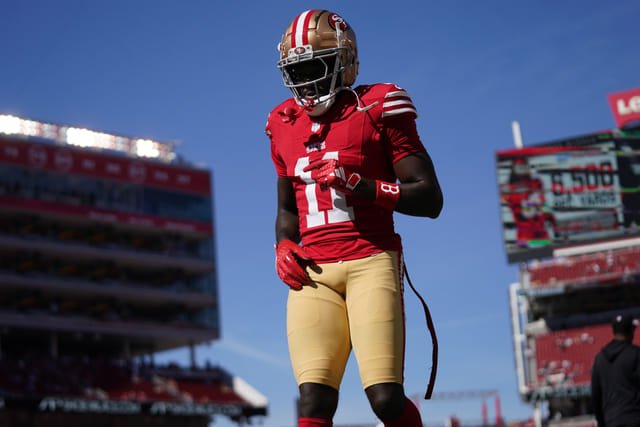
The ongoing dispute between wide receiver Brandon Aiyuk and the San Francisco 49ers has escalated far beyond a typical contract disagreement. What began as frustration over guarantees and team decisions has now turned into a full-blown public controversy involving social media rants, former player criticism, and growing questions about his NFL future.
The situation intensified after Aiyuk posted a video calling the 49ers “stupid” and “dumb” in response to what he described as unfair handling of his contract structure. His comments immediately drew backlash from analysts, including former NFL linebacker and media personality Emmanuel Acho, who offered one of the most direct responses yet.
Acho didn’t just criticize the situation—he reframed it entirely, suggesting that the real damage may not be to the franchise, but to Aiyuk himself.
Background: How the Brandon Aiyuk Contract Situation Escalated
Brandon Aiyuk’s rise in San Francisco was built on production, consistency, and his role as a key weapon in one of the NFL’s most structured offensive systems. After a breakout season that established him as one of the league’s most productive receivers, he secured a massive contract extension reportedly worth around $120 million.
On paper, the deal positioned Aiyuk among the elite tier of NFL wide receivers. However, behind the scenes, complications involving guaranteed money, roster decisions, and contractual conditions created tension between player and franchise.
Things reached a breaking point when Aiyuk publicly accused the organization of mishandling guarantees and expressed frustration over his future with the team. That frustration eventually spilled into social media, where he launched a direct verbal attack on the franchise.
This marked a turning point: what was once a business negotiation became a public perception battle.
The Viral Rant: Why Aiyuk’s Comments Sparked Backlash
Aiyuk’s recent video included strong language directed at the organization, where he accused the franchise of making poor financial decisions and suggested he would soon be playing elsewhere.
While emotional player responses are not unusual in the NFL, the tone and public nature of this statement elevated the controversy. In modern professional sports, public criticism of a team often shifts attention from contract disputes to professionalism and reputation management.
The reaction was immediate across media platforms, with analysts, fans, and former players debating whether Aiyuk had crossed a line.
Emmanuel Acho’s Response: “He Is the Loser in This Situation”
The most notable response came from Emmanuel Acho, who broke down the situation on a sports podcast appearance. His argument was direct and unapologetic.
“I feel bad because BA is the loser here… not that he is a loser, but he is losing in this situation.”
Acho’s perspective centered on financial scale and long-term career positioning. He emphasized that organizations like the 49ers operate within billion-dollar frameworks and are unlikely to be emotionally affected by contractual disputes at the individual level.
Instead, he suggested that Aiyuk’s real challenge is not with the franchise—but with how the situation affects his long-term earning potential and professional reputation.
Why Acho Believes the 49ers Are Not “Losing”
A key part of Acho’s argument is rooted in NFL business economics. The San Francisco 49ers operate as a high-value organization with extensive financial flexibility and roster depth.
From that perspective, even large contract disputes rarely create meaningful financial strain for ownership groups. Instead, teams often recover value through cap management strategies, trades, or contract restructuring.
Acho’s broader point is that while players may view disputes emotionally, franchises typically operate with long-term asset management logic rather than short-term frustration.
Comparing Perspectives: Player Emotion vs Franchise Business Logic
The Aiyuk situation highlights a recurring tension in the NFL: emotional investment versus structural control.
| Factor | Brandon Aiyuk Perspective | 49ers / NFL Business Perspective |
|---|---|---|
| Contract View | Focus on guarantees and perceived fairness | Focus on cap flexibility and performance value |
| Public Communication | Social media expression of frustration | Controlled or limited public response |
| Financial Interpretation | Personal income and career security | Organizational asset management |
| Outcome Goal | Stability and respect in negotiations | Maximize return on investment or trade value |
| Risk Factor | Reputation and future contract leverage | Locker room stability and roster efficiency |
Why This Controversy Matters Beyond One Player
While this situation centers on Brandon Aiyuk, it reflects a larger NFL trend: the growing visibility of contract disputes in the social media era.
In earlier generations, disagreements between players and teams were handled privately. Today, players can directly influence public opinion, while teams often respond with silence or minimal statements.
This shift has created a new dynamic where perception can influence negotiation leverage—but rarely changes contractual control.
The result is a constant tension between expression and structure, emotion and economics.
The Contract Reality: Why These Disputes Are So Common
NFL contracts are often misunderstood by fans. While headline figures like $120 million appear fully guaranteed, the actual structure typically includes:
- Signing bonuses
- Injury guarantees
- Performance incentives
- Conditional future earnings
This structure gives teams long-term flexibility while still offering players significant earning potential. However, it also creates friction when expectations differ from execution.
In Aiyuk’s case, disputes over guarantees and roster decisions appear to be the core source of frustration.
What Happens Next: Trade Possibilities and NFL Reality
Despite the public tension, the most likely resolution in situations like this is a trade rather than a release. The San Francisco 49ers would almost certainly prefer to recover value rather than lose a high-caliber receiver without compensation.
While teams like the Washington Commanders have been loosely linked in speculation, no confirmed move has materialized.
Until a trade or reconciliation occurs, Aiyuk’s situation remains one of the most closely watched contract storylines in the NFL.
Big Picture: Emmanuel Acho’s Warning and the Player Reality Check
Acho’s criticism ultimately reflects a broader message to players across the league: talent alone is not enough to control contract outcomes.
Even elite production does not override structural contract systems, and public frustration can sometimes weaken leverage rather than strengthen it.
His stance reframes the debate—not as “who is right,” but as “who has long-term control over the outcome.”
Conclusion: A Defining Moment in Player-Team Power Dynamics
The Brandon Aiyuk 49ers controversy Emmanuel Acho reaction is more than a viral sports debate—it is a modern NFL case study in contract structure, public narrative, and power imbalance.
While Aiyuk’s frustration reflects the emotional reality of professional sports, the franchise’s position reflects the structural reality of the league.
As the situation develops, it will likely influence how future players approach contract disputes, public statements, and negotiation strategy in an increasingly media-driven NFL environment.
In the end, the lesson is clear: in today’s NFL, leverage is not just about talent—it is about timing, control, and narrative power.
For breaking news and live news updates, like us on Facebook or follow us on Twitter and Instagram. Read more on Latest Sports on thefoxdaily.com.





COMMENTS 0