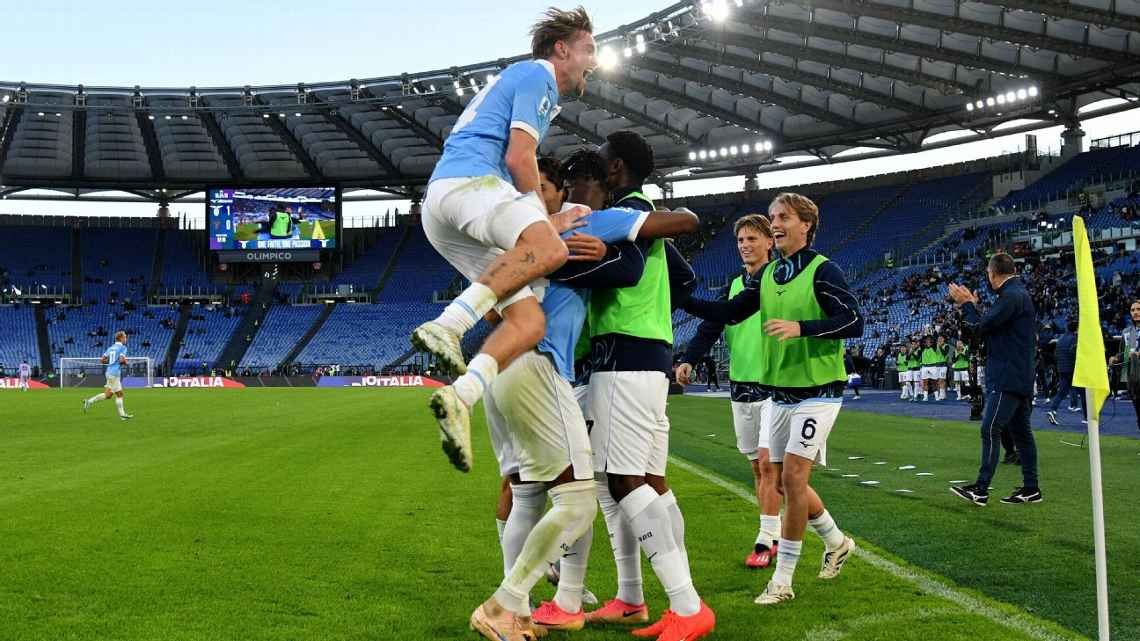
Lazio have reached the top of Serie A with 32 points from their opening 12 matches, achieving a position the club had not occupied at this stage of a season for more than 25 years. Their impressive start has attracted attention not only because of their results but also because they are performing without meaningful home support, as a widespread fan boycott continues to keep thousands of supporters away from the Stadio Olimpico.
The situation is particularly striking when compared with Lazio’s previous title-winning era. The team that won Serie A in 1999-2000 was an expensively assembled collection of international stars. The current side, by contrast, has been built on a much smaller budget under an owner who has faced years of criticism over investment and the club’s direction.
Despite a relatively unremarkable recent record and a squad without the star power of some of their rivals, Lazio have emerged as one of the most surprising stories of the 2026-27 campaign. Their success has also given fresh attention to the dispute between supporters and long-time owner Claudio Lotito.
How Lazio returned to the top of Serie A
Lazio’s position at the top of the table is a reminder of how dramatically the club has changed since its last comparable start more than two decades ago. The side that eventually won the 1999-2000 Serie A title featured several internationally recognised players, including Siniša Mihajlović and Alessandro Nesta in defence, Juan Sebastián Verón, Diego Simeone and Pavel Nedvěd in midfield, and Marcelo Salas, Alen Bokšić and Simone Inzaghi in attack.
That team was managed by Sven-Göran Eriksson, who later became England’s first foreign manager. His appointment with the national side followed his successful period at Lazio, where he had worked with a squad assembled at considerable expense.
The financial scale of that project eventually became a problem. Lazio’s expensive approach was followed by serious financial difficulties, and the club would go bankrupt a few seasons later.
The current team represents a very different model. Lazio have been operating on a shoestring compared with the spending associated with their former title-winning side. Their recruitment has been shaped by financial limitations and criticism of Lotito, who has been accused by supporters of failing to invest sufficiently in the club.
Nevertheless, the 2026-27 squad has found a way to produce results. Several players who had previously occupied limited roles or attracted little attention are now contributing to a team that has collected 32 points from 12 league matches.
A squad full of unexpected stories
Lazio’s current success has been built around a group of players whose individual backgrounds make the team’s rise particularly unusual. Goalkeeper Christos Mandas is enjoying his first full season as a starter after playing only 90 minutes of cup football during the previous campaign. His performances have become an important part of the club’s strong start.
Right-back Romano Floriani also has an unusual family connection. His great-grandfather was Benito Mussolini, while his great-aunt is the famous Italian actress Sophia Loren. Those connections have added an unexpected personal detail to the profile of a player now involved in Lazio’s push at the top of the table.
The club’s biggest summer signing, Davide Frattesi, arrived after spending time as a super-sub at Inter Milan. He had made only 18 league starts across three seasons there, but Lazio have brought him into a different environment as they attempt to strengthen their squad.
Frattesi also attracted attention through his family connections. His sister is an influencer who previously dated US footballer Weston McKennie, adding another off-field detail to the story surrounding Lazio’s summer recruitment.
Playmaker Reda Belahyane has also experienced a significant change in fortunes. Before this season, he had started only six matches in 18 months at the club and was widely regarded as a disappointing signing. His performances this campaign have changed that perception, with his contribution becoming one of the more notable developments in Lazio’s season.
Centre-back Oliver Provstgaard brings another unusual detail to the squad. He has a Champions League winner’s medal from 2021, although the achievement came in the esports Champions League rather than the traditional football competition.
These stories reflect the unusual character of a Lazio side that does not have the obvious collection of established superstars associated with some previous title contenders. Instead, the team has benefited from players finding form, unexpected contributions and a collective effort that has produced results beyond many expectations.
Gattuso faces another challenge in his managerial career
Gennaro Gattuso is another major part of Lazio’s unexpected position. The former Italy international is now managing the club after a difficult period with the national team. His last role in charge of Italy ended in April, when the Azzurri lost a decisive playoff against Bosnia-Herzegovina and missed out on a chance to qualify for the World Cup.
That disappointment was significant for a country with a long history of success in international football. Italy have won the World Cup four times, a total surpassed only by Brazil, which has five titles.
Lazio is Gattuso’s 11th managerial job. None of his previous positions lasted longer than two seasons, and his average time in charge has been approximately 41 weeks. His appointment therefore represents another opportunity to establish greater stability and demonstrate his ability to build a successful team over a longer period.
His direct communication style has been evident during the ongoing dispute between Lazio’s supporters and the club’s ownership. Gattuso has made clear that he misses the fans while also recognising their reasons for staying away from home matches.
His ability to acknowledge both sides has helped him navigate a difficult situation involving people who remain essential to the club’s identity and the players who must continue performing despite the atmosphere inside the stadium.
Lazio’s supporters are staying away from home matches
The most remarkable part of Lazio’s current campaign is the absence of their usual home support. Average attendance across the club’s first five home matches has been around 10,000 spectators per game, an extremely low figure for the Stadio Olimpico, which has a capacity of approximately 70,000.
Even that attendance figure does not fully represent the number of Lazio supporters inside the stadium. Visiting fans have frequently made up a substantial portion of the crowd and have sometimes outnumbered the home supporters. That was particularly evident during AC Milan’s visit in September, when the total attendance was approximately 21,000.
The contrast with previous seasons is considerable. Lazio averaged around 44,000 spectators per match across the two full seasons before the boycott. Season-ticket sales have also fallen sharply, dropping from 29,918 in 2025-26 to fewer than 3,000 this season.
The boycott began in January after years of tension between Lotito and the club’s hardcore supporters, known as ultras. However, the protest quickly spread beyond the ultras, attracting supporters from different sections of the fanbase.
The central complaints concern what fans describe as a lack of respect towards supporters, insufficient ambition and a general feeling that the club has lost direction. Their main demand is for Lotito to put Lazio up for sale, but the owner has refused to do so.
For supporters, the decision to stay away is not an indication that they have stopped caring about the team. They describe the boycott as an act of love intended to pressure the ownership into addressing their concerns.
Fans continue supporting the team outside the stadium
Although Lazio supporters are not entering the Stadio Olimpico for home matches, many continue to show their commitment in other ways. Before each home fixture, groups gather outside the stadium to welcome the team bus and encourage the players with flares, songs and banners.
The gatherings have taken on the atmosphere of a pre-match rally. Supporters attempt to create the energy and encouragement that would normally come from the stands before leaving to watch the match elsewhere, often together in groups.
Away matches have presented a different picture. Lazio’s travelling support has remained strong, with away tickets selling out and supporters sometimes managing to obtain additional allocations from opposing clubs.
The contrast between empty home stands and packed away sections has become one of the defining features of the club’s season. It also demonstrates that the boycott is specifically aimed at the ownership dispute rather than being a withdrawal of support for the players.
Gattuso admits the empty stadium is affecting the atmosphere
Gattuso has openly discussed the impact of playing in front of a largely empty stadium. Rather than dismissing the boycott, he has recognised the emotional difficulty for both the players and the supporters.
He described the atmosphere as similar to the experience of playing during the COVID-19 pandemic, when football matches took place without ordinary crowds.
“We miss the fans, playing in a stadium that’s 20% full sucks: it’s like COVID all over again,” Gattuso said. “For me, football without fans isn’t football, it’s another sport, you might as well go and take your dog for a walk.”
However, the Lazio manager also said he understood the supporters’ decision and respected their commitment to their position.
“The fans are suffering too; it’s killing them inside not coming to see us. But I have to respect their decision, because they’re showing integrity. And I thank them for the tremendous support they are showing us in other ways.”
His comments reflect the difficult position facing the squad. The players benefit from the encouragement of supporters, particularly at home, but they are also aware that the dispute is about issues beyond the results on the pitch.
Lotito refuses to consider selling Lazio
Claudio Lotito has remained firm in his response to the boycott. He has said that he will not be pressured into selling the club and has rejected the idea of offering free or heavily discounted tickets simply to increase attendance.
His position is that the team’s results should be enough to encourage supporters to return. Lotito has pointed to Lazio’s place at the top of Serie A as evidence that the club is performing well, arguing that supporters should be inside the stadium rather than leaving the players without home backing.
“We’re top of the table. If you love Lazio, you should be in the stadium instead of leaving the players to fend for themselves,” Lotito said.
Lotito has owned Lazio since 2004 and has repeatedly faced criticism from sections of the fanbase. The relationship has become increasingly difficult as supporters continue to demand a change in ownership and a clearer sporting direction.
The boycott is expected to be suspended for the Rome derby against Roma next month. Staying away from such a significant fixture would be a particularly difficult decision for Lazio supporters, even amid the ongoing dispute. Beyond the derby, however, the boycott is expected to continue.
Can Lazio maintain their position at the top?
Despite their impressive start, there are reasons to question whether Lazio can remain at the top of Serie A until the end of the season. Their schedule has been relatively favourable so far, and several underlying performance figures suggest that their current results could become harder to maintain.
Lazio have scored 25 goals from an expected goals figure of 17.3. At the other end of the pitch, they have conceded only nine goals despite an expected goals-against figure of 13.6. These numbers indicate that the team has significantly outperformed its expected figures in both attack and defence.
Such overperformance can be difficult to sustain across an entire campaign. If their finishing becomes less efficient or their opponents convert more of their chances, Lazio’s results could become less impressive even if their overall performances remain similar.
The squad also lacks an obvious equivalent of the standout attacking and midfield stars who have driven some of football’s most memorable underdog title victories. Frattesi, Mattia Zaccagni and Kenneth Taylor are capable players, while Belahyane and Provstgaard have emerged as important contributors. Mandas is also enjoying an outstanding season.
However, there is no clear equivalent of Jamie Vardy, N’Golo Kanté or Riyad Mahrez from Leicester City’s historic 2015-16 Premier League title-winning team. That comparison has been raised because both sides have challenged expectations, but Lazio’s squad profile is different.
For now, their position at the top is a significant achievement. Whether it develops into a sustained title challenge will depend on their ability to maintain their form as the schedule becomes more demanding.
Could the boycott force a change in ownership?
The question of whether the supporters can persuade Lotito to sell the club is more complicated than Lazio’s results on the pitch. The boycott is clearly affecting attendance and has the potential to reduce matchday revenue, but Lotito has shown little public indication that financial pressure or negative publicity will change his position.
His history with Lazio helps explain that stance. He took control of the club when it was facing bankruptcy and has previously described his role as one of rescuing the institution. In a memorable comment from around 20 years ago, he said: “I resuscitated Lazio … now we’re in a coma and on life support, hopefully I’ll be able to reverse that.”
Lotito has appeared willing to respond to financial pressure by cutting costs rather than changing his approach. He has also shown that negative publicity does not necessarily persuade him to alter his decisions, despite the criticism that he and the club have faced over the years.
The scale and duration of the current boycott may nevertheless be difficult to ignore. The protest has continued for months and has involved a much broader section of the fanbase than the hardcore ultras alone. Lazio’s strong performances have also brought additional attention to the dispute.
A particularly significant possibility would be the club qualifying for the Champions League while the boycott remains in place. A successful Lazio side competing in Europe’s leading club competition without substantial home support would create an unusual and highly visible situation for the club and its ownership.
Whether that pressure will eventually persuade Lotito to consider a sale remains uncertain. The owner has not indicated that he intends to leave, and supporters have not shown signs of abandoning their campaign.
A rare example of supporter power in football
Lazio’s current position has created an unusual combination of sporting success and an ongoing conflict between supporters and ownership. The team is collecting points and leading Serie A, while the stands at its home stadium remain largely empty because of a protest that began over dissatisfaction with the club’s direction.
The situation also raises questions for supporters of other clubs dealing with unpopular owners, including Manchester United and Valencia. It demonstrates how organised fan action can affect attendance, revenue and the public image of a football club, even when the team is performing well.
For Lazio, the immediate challenge is to maintain their results while the boycott continues. Gattuso must keep his players focused, the supporters must decide how long they are willing to stay away, and Lotito faces continued pressure to address their demands.
Whether Lazio can remain at the top of Serie A is still uncertain, particularly given their underlying performance figures and the challenges ahead. But their remarkable start has already demonstrated that a club can enjoy sporting success even when its relationship with its own supporters is deeply strained. The bigger question is whether that success can help bring the two sides back together or make the ongoing dispute even more significant.
For breaking news and live news updates, like us on Facebook or follow us on Twitter and Instagram. Read more on Latest Football on thefoxdaily.com.






COMMENTS 0