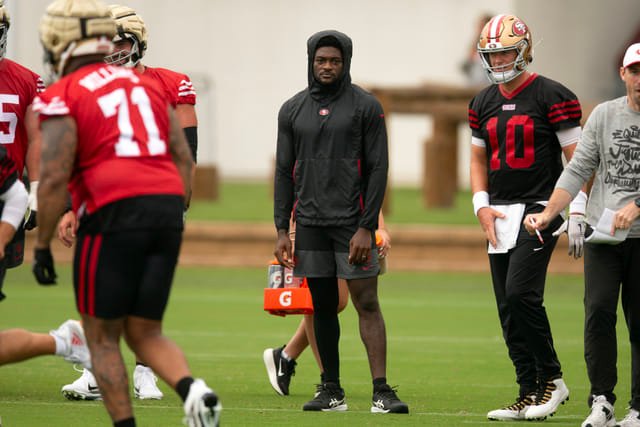
A Star Receiver, a Fractured Relationship, and a Franchise Refusing to Blink
The ongoing situation involving wide receiver Brandon Aiyuk and the San Francisco 49ers has quickly evolved into one of the most complex roster disputes of the NFL offseason.
What began as frustration on social media has now turned into a full-scale contract and roster-control standoff, with the franchise refusing to release the Pro Bowl receiver despite growing public tension. Adding further weight to the discussion, three-time Super Bowl champion Mark Schlereth publicly defended the 49ers’ decision to hold firm, framing it as a matter of business logic rather than emotion.
At the same time, Aiyuk’s outspoken criticism of the organization—combined with speculation linking him to the Washington Commanders—has intensified debate about player empowerment, contract guarantees, and the limits of franchise control in modern NFL economics.
This is not just a headline feud. It is a case study in how NFL contracts, guaranteed money structures, and trade leverage collide in real time.
Background: How the Brandon Aiyuk Situation Reached This Point
Brandon Aiyuk’s rise with San Francisco was built on consistency, explosiveness, and a growing role in one of the NFL’s most structured offensive systems. After a breakout season in 2023 where he surpassed 1,300 receiving yards, Aiyuk established himself as a core piece of the 49ers’ offensive identity.
That performance led to a major contract extension reportedly worth over $100 million, positioning him among the higher-paid receivers in the league. On paper, it was a long-term partnership between a rising star and a Super Bowl-contending franchise.
However, NFL relationships often shift quickly when performance expectations, financial guarantees, and organizational direction begin to misalign. According to the ongoing narrative, tensions escalated after disputes involving contract guarantees and roster decisions, eventually spilling into public criticism from Aiyuk.
The result: a situation where the player has expressed frustration, the team has restricted his status, and trade speculation has become unavoidable.
The Core Issue: Why the 49ers Refuse to Release Brandon Aiyuk
At the heart of the controversy is a simple but powerful NFL principle: teams control contract rights unless they choose otherwise.
Despite Aiyuk’s dissatisfaction, the 49ers are under no obligation to release him. Instead, they retain leverage through contract structure and potential trade value.
From a front-office perspective, releasing a player of Aiyuk’s caliber would mean losing both athletic production and financial return. In modern NFL roster construction, that is rarely considered a viable option unless unavoidable.
This is where Mark Schlereth’s defense becomes significant—he framed the situation as a matter of asset management rather than emotional reaction.
“The NFL is a business. They invested money in him. They want compensation in return.” – Mark Schlereth
His argument reflects a long-standing NFL reality: teams prioritize return on investment, especially when significant guaranteed money is involved.
Understanding the Business Logic: Why Teams Hold Onto Disgruntled Players
The NFL is often described as a player-driven league, but contract structures still heavily favor organizations. When a franchise invests millions into a player, it expects either performance value or trade compensation in return.
Releasing a high-value player like Aiyuk would typically result in:
- Loss of potential draft capital
- Increased dead cap implications
- Reduced roster strength in a competitive division
- Setting a precedent for future contract disputes
Instead, teams often prefer to explore trade markets, even if relationships have deteriorated. That approach allows franchises to recoup value rather than absorbing financial loss.
Contract Pressure and the Guaranteed Money Problem
Modern NFL contracts are often structured with a mix of guaranteed money and conditional future earnings. While headline numbers appear massive, only portions are fully guaranteed at signing.
In Aiyuk’s case, the controversy revolves around how guaranteed money was handled and whether certain protections were voided due to roster or disciplinary designations.
This is a critical point in understanding why disputes escalate. Once guaranteed protections are altered or voided, players often feel their security has been undermined, even if teams argue they are operating within contractual rights.
This tension has become increasingly common in the NFL era where:
- Contracts are long-term but not fully guaranteed
- Teams maintain escape mechanisms through roster designations
- Players rely heavily on performance-based leverage
Comparing Player vs Franchise Power in Modern NFL Deals
The Brandon Aiyuk situation highlights a broader power imbalance that continues to define the league. While players have more voice than ever before, franchises still control contractual outcomes.
| Factor | Player Position (Aiyuk) | Team Position (49ers) |
|---|---|---|
| Contract Control | Limited after signing extension | Strong due to guaranteed structure |
| Public Influence | Social media pressure and narrative control | Organizational messaging and silence strategy |
| Financial Leverage | Dependent on guarantees and bonuses | Cap management flexibility |
| Trade Outcome | Desires clarity or exit path | Seeks compensation (draft picks/players) |
| Long-term Impact | Career stability concern | Roster optimization and cap efficiency |
Why Social Media Escalated the Situation
One of the defining features of modern NFL disputes is the role of social media. In previous eras, disagreements remained internal. Today, players can directly communicate frustrations to millions of fans instantly.
Aiyuk’s public criticism of the organization significantly changed how the situation is perceived. Once statements enter the public domain, they transform private contract disputes into public narratives involving loyalty, respect, and organizational culture.
For teams, this creates a challenge: respond publicly and escalate tension, or remain silent and allow speculation to grow.
The 49ers have largely chosen the latter approach, relying on organizational control rather than media engagement.
Trade Market Reality: Why the Washington Commanders Are Mentioned
Speculation linking Aiyuk to the Washington Commanders has gained attention due to their ongoing need for elite receiving talent and offensive restructuring.
In a theoretical trade scenario, Aiyuk would represent an immediate upgrade for any receiver-needy franchise, particularly one looking to stabilize quarterback development and offensive identity.
However, trade feasibility depends on multiple factors:
- Contract absorption capability
- Draft capital availability
- Willingness of San Francisco to negotiate
- Player willingness to restructure or accept new terms
At this stage, speculation remains just that—speculation. But in the NFL, where roster movement can shift rapidly, such links often gain momentum when internal relationships deteriorate.
Strategic Impact on the San Francisco 49ers
For the 49ers, this situation is not just about one player—it is about maintaining competitive stability. San Francisco is consistently viewed as a Super Bowl contender, meaning every roster decision is evaluated through a championship lens.
Allowing a key offensive weapon to leave without compensation would weaken depth and reduce flexibility in an already competitive NFC landscape.
However, keeping a disgruntled player also carries risks:
- Locker room distraction potential
- Reduced morale or engagement
- Public perception issues
This creates a delicate balancing act between long-term planning and short-term cohesion.
Big Picture: What This Means for the NFL Contract Era
The Brandon Aiyuk 49ers controversy trade release situation reflects a broader NFL evolution where player empowerment and organizational control continue to collide.
While players have gained influence through branding, social media, and negotiation leverage, franchises still hold structural power through contracts and cap management.
This duality ensures that disputes like this will remain common, especially in high-value positions like wide receiver, where production is critical but contracts are complex.
If anything, this situation reinforces a growing NFL trend: the most important battles are no longer just on the field—they are in contract rooms and negotiation tables.
Conclusion: A Standoff That Could Shape Future NFL Negotiations
The ongoing situation involving Brandon Aiyuk and the San Francisco 49ers is more than a temporary dispute—it is a reflection of how modern NFL economics function under pressure.
With strong contract leverage on one side and public frustration on the other, both player and franchise are locked in a strategic waiting game.
Whether this ends in reconciliation, a trade, or continued tension, the outcome will likely influence how future contracts are negotiated across the league.
One thing is certain: in today’s NFL, talent alone does not determine control—structure, timing, and leverage do.
For breaking news and live news updates, like us on Facebook or follow us on Twitter and Instagram. Read more on Latest Sports on thefoxdaily.com.






COMMENTS 0