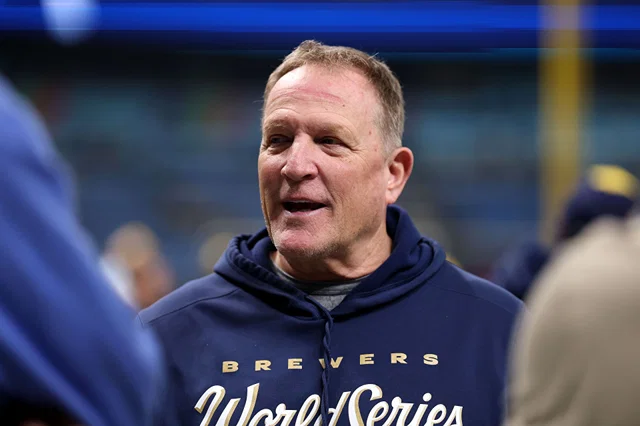
Milwaukee Brewers manager Pat Murphy has received public support from former Kansas City Royals star Eric Hosmer after facing criticism for comments directed at the New York Yankees following Milwaukee’s World Series triumph. Hosmer defended the 67-year-old manager, arguing that Murphy played a major role in rebuilding Jake Bauers’ confidence and helping the first baseman rediscover his value at the highest level.
The controversy followed Milwaukee’s 4-1 victory over Tampa Bay in Game 5 at Tropicana Field. After the final out, Bauers handed the ball to Murphy, creating an emotional moment as the Brewers celebrated the franchise’s first World Series championship. Murphy used the occasion to make a pointed comparison between Milwaukee’s team culture and the environment he said Bauers experienced with the 2023 Yankees.
His remarks quickly attracted attention, particularly among New York supporters. Some critics questioned why Murphy chose to bring up the Yankees during the celebrations. However, Hosmer offered a different perspective, suggesting that the manager’s comments reflected a relationship built on trust, opportunity and personal development.
The debate has also brought renewed attention to the culture Murphy has established in Milwaukee. Former Brewers outfielder Geoff Jenkins has previously praised the manager for creating an organisation-wide identity that encourages players to understand and embrace the team’s expectations.
Eric Hosmer defends Pat Murphy after Yankees criticism
Hosmer, a four-time Gold Glove first baseman who helped the Kansas City Royals win the 2015 World Series, publicly backed Murphy in a post on X. The former MLB player, now a host of the Diggin Deep Podcast, argued that criticism of the manager overlooked the support he had provided to Bauers throughout his time in Milwaukee.
Hosmer’s defence focused on the relationship between a manager and a player who may need opportunities and encouragement to rebuild his confidence. He suggested that Murphy continued to challenge Bauers by giving him more playing time in important situations, even when the first baseman’s future in professional baseball was uncertain.
“Come on now ‼️ That “old man” believed in Jake (probably when Jake didn’t even believe in himself) and continued challenging Jake with more and more playing time on the game’s biggest stages. Now Bauers is back to being a dawg, NLCS mvp, World Champion and as confident as ever.”
Hosmer’s message presented Murphy’s approach as more than a routine managerial decision. In his view, the Brewers skipper recognised something in Bauers and continued giving him opportunities to prove himself when confidence and playing time could have made a significant difference.
The former Royals star also addressed the financial and professional consequences of Bauers’ resurgence. With the first baseman approaching free agency, Hosmer suggested that the player’s improved reputation could lead to opportunities beyond Milwaukee.
“He has an opportunity to continue his career when he was ready to pack it in and take it to the house. Everybody knows the reality, Jake’s set himself and his family up for generational wealth and there’s a good chance it’s not going to be with Milwaukee. That “old man” changed his life forever!”
Hosmer’s comments shifted the discussion towards the long-term impact of managerial support. While Murphy’s remarks about the Yankees attracted attention, Hosmer wanted people to consider what the Brewers manager had contributed to Bauers’ career.
What Pat Murphy said about Jake Bauers and the Yankees
The incident occurred after Milwaukee completed its 4-1 victory over Tampa Bay in Game 5. Bauers handed Murphy the ball from the final out, and the manager used the moment to remind the player of the standards he believed defined the Brewers organisation.
Murphy reportedly contrasted Milwaukee’s approach with the environment he associated with the 2023 Yankees, suggesting that players on that team were more focused on individual interests than collective success.
The comments were particularly notable because Bauers had previously played for New York. His experience with the Yankees therefore became part of Murphy’s message about the importance of team-first baseball.
For Murphy, the comparison appeared to underline a broader point about the difference between individual performance and collective responsibility. A successful baseball team requires players to accept different roles, support teammates and remain committed to a shared objective throughout a long season.
However, the timing and wording of the remarks created a separate controversy. Milwaukee had just celebrated a historic championship, and some observers felt the manager could have focused entirely on his own team’s achievement rather than criticising another franchise.
The criticism did not necessarily challenge Murphy’s accomplishments in Milwaukee. Instead, it focused on whether the Yankees comparison was appropriate during a championship celebration. That distinction became central to the debate surrounding the manager’s comments.
Mark Titus criticises Murphy’s comments
One of the critics was podcast host Mark Titus of Mostly Sports. Titus questioned Murphy’s remarks and suggested that Bauers should have responded by telling the manager to stop speaking in that manner.
His reaction reflected the view that Bauers should not have been placed in the middle of a public comparison involving his former team. The comments also highlighted how quickly a celebratory moment can become a wider discussion when a manager makes remarks about another organisation.
For Yankees supporters, the criticism was understandable because Murphy’s comments portrayed the 2023 team in an unfavourable light. The franchise has a long history and a demanding fan base, making criticism from a rival manager particularly likely to attract attention.
However, Hosmer’s response suggested that the controversy could not be understood simply by examining the words Murphy used. The former first baseman emphasised the personal connection between the manager and Bauers, arguing that the opportunities Murphy provided had helped change the player’s career trajectory.
The disagreement therefore became a discussion about two different aspects of baseball leadership: public comments about rival teams and the private or professional support managers provide to their own players.
Jake Bauers’ resurgence gives context to Hosmer’s defence
Bauers’ role in Milwaukee’s championship run helps explain why Hosmer reacted so strongly to the criticism. A player’s career is rarely defined by a single season, and opportunities can become especially important when an individual has struggled to establish a consistent place in the major leagues.
Hosmer portrayed Bauers as someone who had reached a point where he was considering stepping away from professional baseball. In his account, Murphy’s willingness to continue giving him opportunities helped restore his confidence and gave him another chance to demonstrate his ability.
That support became particularly valuable as Milwaukee progressed through the postseason. Playing meaningful baseball in high-pressure situations can help a player build confidence, but it also requires a manager to trust that the individual can handle the responsibility.
Hosmer described Bauers as having returned to his best competitive form, highlighting his contribution to the Brewers’ run and his recognition as NLCS MVP. He also pointed to the player’s World Series championship as evidence of how far his career had progressed.
His argument was that Murphy should receive credit for helping Bauers reach this stage, regardless of whether the first baseman ultimately remains with Milwaukee. A strong postseason performance can improve a player’s standing around the league and create opportunities that might not have been available earlier in his career.
For a player approaching free agency, that change can have major consequences. Teams evaluate not only a player’s statistics but also his ability to contribute in different roles, perform under pressure and remain productive during important games.
Geoff Jenkins explains the winning culture Murphy built in Milwaukee
Hosmer was not the only former MLB player to highlight Murphy’s influence on the Brewers. Former Milwaukee outfielder Geoff Jenkins previously discussed the manager’s approach during an October 23 episode of Foul Territory.
Jenkins explained that Murphy had helped establish a consistent culture throughout the organisation. According to the former outfielder, the philosophy was not limited to the major-league clubhouse but extended into the Brewers’ minor-league system.
“I think Murphy has created a culture here,” Jenkins said. “I think all the guys have bought into it and they’ve created that culture in the minor league. So now, if you bring a guy up, they already know what the culture’s like, how you have to buy in, and how you have to be a part of it. And if you want to play, that’s the way we play baseball.”
Jenkins’ comments highlighted an important part of building a successful baseball organisation. When players are promoted from the minor leagues, they already understand the expectations, responsibilities and playing style required at the major-league level.
That continuity can make the transition easier for younger players. Instead of entering an unfamiliar environment and learning an entirely new set of expectations, they arrive with an understanding of the organisation’s approach.
Jenkins also explained that he had experienced different clubhouse environments during his playing career. He referred to Philadelphia as an organisation where a strong culture existed, while acknowledging that he had also been part of Milwaukee clubhouses where that sense of unity was not present.
“So, I really appreciate that. It’s hard to create and produce that. I’ve been in Philly where it was like that, and I’ve been in some Milwaukee clubhouses, where it wasn’t like that. So, for Murph to pull this off and for it to be, this is the standard and guys buy in. It’s pretty special.”
The comments offered an additional explanation for why Murphy’s leadership has received recognition beyond the results on the field. Creating a winning culture involves establishing standards that players understand and follow, regardless of their individual status within the squad.
Why a consistent clubhouse culture matters in Major League Baseball
Baseball seasons place enormous demands on players. Major League Baseball teams compete across a long regular season, with repeated travel, frequent games and constant adjustments to lineups and pitching plans. Maintaining unity throughout that schedule can be difficult.
Managers must handle different personalities, playing-time expectations and individual ambitions while keeping the team’s objectives in focus. A player who starts regularly may have different priorities from someone who spends time on the bench or moves between positions.
That is why organisational culture can influence performance. When players understand their responsibilities and accept the team’s expectations, managers have more flexibility to make decisions based on matchups and circumstances rather than worrying about how every change will affect the clubhouse.
Jenkins’ explanation suggests that Murphy’s influence extends beyond individual conversations with established players. By reinforcing the same standards throughout the minor-league system, Milwaukee can prepare prospects for the expectations they will face after promotion.
Such an approach also helps create accountability. Players are expected to contribute to the group, prepare properly and remain ready when their opportunities arrive. Those principles become particularly important during the postseason, when injuries, tactical adjustments and difficult matchups can change a team’s plans quickly.
Bauers’ experience, as described by Hosmer, provides an individual example of how a manager’s trust can fit into that broader culture. Giving a player another opportunity does not guarantee success, but it can create the conditions in which a player has a chance to rebuild confidence and contribute.
Pat Murphy’s managerial achievements strengthen his reputation
Murphy’s growing reputation in Milwaukee is also supported by his managerial record. The supplied report notes that he had already won the National League Manager of the Year award in 2024 and 2025, placing him among the most recognised managers in the league during that period.
His work with the Brewers has been associated with consistent regular-season performance and the development of a team identity. The reported 103-win campaign and championship success further strengthened the case for recognising his leadership.
Manager of the Year recognition generally reflects more than the final position in the standings. Voters often consider how a manager handles injuries, develops younger players, manages difficult stretches and gets contributions from different parts of the roster.
Milwaukee’s reported success therefore provides important context for the praise from Hosmer and Jenkins. Both former players focused on different aspects of Murphy’s leadership: Hosmer highlighted his personal investment in Bauers, while Jenkins discussed the wider culture established across the organisation.
Those perspectives suggest that the manager’s influence is not limited to tactical decisions during games. His approach to player development, communication and expectations has become part of the wider conversation about Milwaukee’s success.
Could Jake Bauers leave Milwaukee after the championship?
Bauers’ pending free-agent status is another important part of the story. Hosmer suggested that the first baseman’s improved position could lead to a future outside Milwaukee, although his next destination has not been established by the supplied report.
Free agency can create difficult decisions for both players and organisations. A player who has performed well during a championship run may attract interest from other clubs, while his current team must consider roster requirements, financial flexibility and the value of retaining him.
For Bauers, the postseason experience could become an important part of his professional profile. Performing on baseball’s biggest stages can demonstrate that a player is capable of handling pressure, particularly when the opportunities arrive in high-stakes situations.
Hosmer’s comments focused on the possibility that Bauers had gained a renewed opportunity to continue his career and provide long-term financial security for himself and his family. The former Royals star’s point was that Murphy’s belief in the player could have consequences extending well beyond one championship season.
Whether Bauers remains in Milwaukee or signs elsewhere, his next contract will depend on several factors, including team needs, his overall performance and the interest of other clubs. His future should not be treated as settled simply because he is approaching free agency.
Murphy’s Yankees remarks have created a wider debate about leadership
The reaction to Murphy’s comments demonstrates how a manager’s public words can become part of a team’s championship story. For some observers, the Yankees comparison was unnecessary. For Hosmer, however, the focus should remain on the manager’s support for a player who benefited from receiving opportunities in Milwaukee.
Both perspectives reflect different expectations of leadership. Managers are often judged on how they represent their teams publicly, but they are also evaluated by players and former professionals on the relationships they build inside the clubhouse.
Murphy’s supporters have pointed to the Brewers’ culture as evidence of his impact. Jenkins’ comments about organisational standards and Hosmer’s defence of the Bauers relationship provide two examples of that support.
The controversy is unlikely to change the significance of Milwaukee’s championship achievement. However, it has added another layer to the discussion surrounding the manager, his communication style and the environment he has helped establish.
Conclusion: Hosmer says Murphy’s belief changed Bauers’ career
Eric Hosmer’s defence of Pat Murphy has shifted attention from the manager’s criticism of the Yankees towards the support he reportedly provided Jake Bauers. The former Royals champion argued that Murphy continued to believe in the first baseman, giving him opportunities that helped restore his confidence and strengthen his professional future.
Geoff Jenkins’ praise for Milwaukee’s clubhouse culture offers a broader explanation of Murphy’s influence. His comments suggest that the manager has helped establish shared expectations throughout the organisation, making it easier for players to understand what is required when they reach the major-league team.
Although Murphy’s remarks about the 2023 Yankees attracted criticism, Hosmer believes the manager deserves recognition for his role in Bauers’ resurgence. With the first baseman approaching free agency, the next stage of his career remains open.
For Milwaukee, the championship and the culture behind it remain the central achievements. The debate over Murphy’s comments may continue, but the support from Hosmer and Jenkins has reinforced the argument that the Brewers manager’s impact goes beyond the final score.
For breaking news and live news updates, like us on Facebook or follow us on Twitter and Instagram. Read more on Latest MLB on thefoxdaily.com.





COMMENTS 0