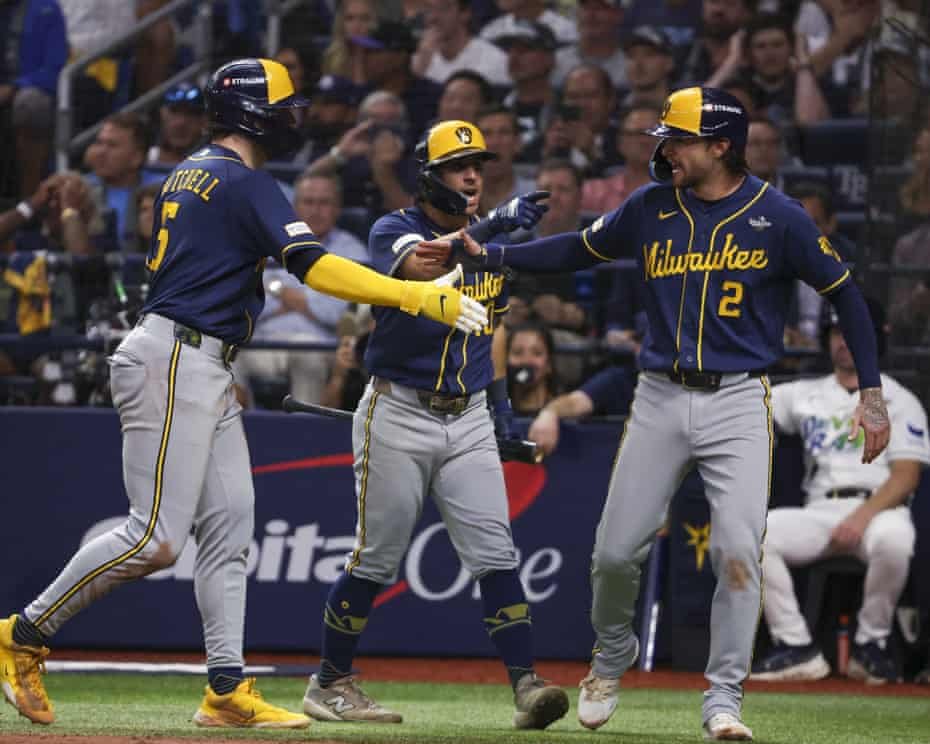
The Milwaukee Brewers moved to the edge of baseball history on Monday night, October 26, delivering a commanding 10-1 victory over the Tampa Bay Rays in Game 3 of the 2026 World Series at Tropicana Field. Powered by an explosive offensive outburst and an exceptional performance from rookie left-hander Robert Gasser, Milwaukee seized a 3-0 lead in the best-of-seven championship series.
Jackson Chourio and Brice Turang helped spark an eight-run fifth inning that transformed a competitive game into a one-sided contest. Chourio finished with four hits in five at-bats, while catcher William Contreras contributed three hits as the Brewers collected 16 hits against Tampa Bay starter Freddy Peralta and five relievers.
Gasser supplied the other half of Milwaukee’s winning formula. The left-hander allowed just one hit and faced the minimum 18 batters through six innings, giving the Rays almost no opportunity to build momentum. His performance placed him alongside a remarkable piece of World Series pitching history associated with Dodgers legend Sandy Koufax.
With the victory, Milwaukee extended its postseason winning streak to eight games and its road winning streak to four. The Brewers now need just one more win to secure their first World Series championship, with Game 4 scheduled for Tuesday night at Tropicana Field.
For Tampa Bay, the challenge is considerably more complicated. The Rays must find a way to contain an offense that has repeatedly produced under pressure while improving their own ability to generate runs against Milwaukee’s pitching staff.
How Milwaukee turned Game 3 into a statement victory
The final score suggests a comfortable evening for Milwaukee, but the decisive moment came when the Brewers converted their offensive opportunities into an overwhelming fifth-inning rally.
Before that explosion, the game had not yet reached the stage of a runaway victory. Milwaukee’s ability to produce eight runs in a single inning changed the contest’s character, creating a substantial advantage that Tampa Bay could not overcome.
Chourio and Turang provide the offensive spark
Chourio and Turang were central to the inning that broke the game open. Their contributions helped Milwaukee string together the kind of sustained offensive pressure that can quickly overwhelm an opposing pitching staff.
An eight-run inning is significant for more than the number of runs scored. It forces the opposing manager to reconsider pitching decisions, places additional pressure on the bullpen and changes how the remaining innings are managed. Hitters can approach subsequent at-bats with a more comfortable margin, while the trailing team must balance the urgency of scoring with the need to avoid further damage.
For Milwaukee, the fifth inning demonstrated how quickly its lineup can capitalize when multiple hitters contribute. Rather than relying on a single home run or an isolated standout performance, the Brewers assembled a rally large enough to determine the outcome.
The inning also reduced the importance of late-game heroics. With a substantial lead established early enough in the second half of the contest, Milwaukee could concentrate on protecting its advantage instead of depending on a narrow finish.
Chourio and Contreras lead a 16-hit attack
Chourio finished the night 4-for-5, an outstanding contribution in a game defined by Milwaukee’s ability to keep the offense moving. Four hits gave the Brewers repeated opportunities to apply pressure and made him one of the central figures in the victory.
Contreras went 3-for-5, providing another productive performance from a lineup that consistently found ways to reach base and generate scoring opportunities.
Together, Chourio and Contreras accounted for seven of Milwaukee’s 16 hits. Their production illustrates the importance of having multiple reliable contributors in a championship lineup. When several hitters are producing, opposing pitchers have fewer opportunities to work around a single dangerous batter.
The Brewers collected their 16 hits against Peralta and five Tampa Bay relievers. That detail matters because the offensive performance was not limited to one matchup. Milwaukee continued to produce despite the Rays turning to additional pitchers in an effort to manage the damage.
For Tampa Bay, the difficulty was not simply allowing one big inning. The larger problem was the combination of Milwaukee’s sustained hitting and its ability to turn that production into a decisive advantage.
Robert Gasser delivers a remarkable World Series pitching performance
While Milwaukee’s offense attracted attention with its eight-run fifth inning, Gasser gave the Brewers the pitching stability needed to control the game.
The rookie left-hander allowed a line-drive single to Yandy Díaz to begin the bottom of the first inning. He then retired 14 consecutive batters before Victor Mesa Jr. opened the sixth with a walk.
Despite allowing those two baserunners, Gasser faced the minimum 18 batters through six innings. The sequence is notable because the Rays did not get a second opportunity to put a runner on base during that stretch of consecutive outs.
Gasser’s outing limited Tampa Bay’s ability to build a response. Even as Milwaukee’s offense established a large lead, the pitcher continued to prevent the Rays from generating the sustained traffic on the bases that can produce multi-run innings.
Why facing the minimum 18 batters matters
In baseball, a pitcher faces the minimum number of batters when every batter is retired without a runner remaining on base. A single does not necessarily increase the total number of batters faced beyond the inning’s normal requirement if the runner is subsequently erased before additional batters come to the plate.
Gasser’s performance was particularly unusual because Díaz’s first-inning single and Mesa’s sixth-inning walk could have disrupted the sequence. Instead, the Brewers left-hander recorded enough outs between those events to complete six innings while facing only 18 hitters.
The achievement highlights a combination of command, defensive execution and the ability to prevent baserunners from turning into scoring threats. It is also a reminder that pitching effectiveness cannot be measured by strikeouts alone. Preventing hits, limiting walks and avoiding extended innings can be equally important when a team is trying to protect a lead.
A connection to Sandy Koufax’s World Series history
Gasser became the first left-handed pitcher to face the minimum 18 batters through six innings of a World Series game since Sandy Koufax accomplished the feat for the Los Angeles Dodgers in 1965.
The comparison places Gasser’s outing within a notable historical context. Koufax is remembered as one of the defining pitchers of his era, making the connection a meaningful measure of how unusual Gasser’s performance was.
It is important, however, to distinguish the specific accomplishment from a broader claim about pitching dominance. Gasser’s six-inning sequence was exceptional, but it does not by itself establish that his outing was identical to Koufax’s in every respect. The historical parallel concerns the minimum number of batters faced through six innings of a World Series game.
For Milwaukee, the immediate significance is straightforward: Gasser provided six innings of highly effective work in a game where the offense supplied more than enough support. His contribution helped prevent Tampa Bay from mounting the kind of comeback that might have made the final innings more difficult.
How the Brewers reached a 3-0 World Series advantage
Milwaukee’s victory in Game 3 was not an isolated success. It followed two closely contested wins at home that established the Brewers’ early control of the series.
The Brewers won Game 1 by a score of 3-2 on Friday, October 23, before securing a 5-4 victory in Game 2 on Saturday, October 24. Those results gave Milwaukee a 2-0 series advantage before the teams traveled to Tampa Bay.
Game 2 was especially important because the Rays had taken a four-run lead in the first inning. Milwaukee gradually recovered, with Sal Frelick tying the game through a leadoff home run in the sixth and Cooper Pratt driving in Turang with the go-ahead run in the seventh.
The Brewers’ ability to recover from that early deficit demonstrated that their offensive threat extended beyond games in which they scored first. They could remain competitive after a difficult start and find opportunities to take control later in the contest.
Game 3 presented a different challenge. Rather than relying on a narrow late advantage, Milwaukee built a decisive lead through its explosive fifth inning and supported it with Gasser’s exceptional outing.
That contrast is important. The first two victories showed the Brewers could win tight games, while the third demonstrated their ability to turn a contest into a rout when the offense catches fire.
| World Series game | Result | Series situation |
|---|---|---|
| Game 1, October 23 | Brewers 3, Rays 2 | Milwaukee led 1-0 |
| Game 2, October 24 | Brewers 5, Rays 4 | Milwaukee led 2-0 |
| Game 3, October 26 | Brewers 10, Rays 1 | Milwaukee leads 3-0 |
| Game 4, October 27 | Scheduled at Tropicana Field | Milwaukee can clinch the championship |
Why the 2026 World Series matters to Milwaukee
The Brewers entered the championship series seeking the first World Series title in franchise history. Their current position therefore represents more than an opportunity to win another postseason series. One additional victory would complete a championship run that has already included several major postseason accomplishments.
Milwaukee finished the 2026 regular season with a franchise-record 103 wins and secured the National League’s place in the World Series. The club then swept the San Diego Padres in the National League Division Series before sweeping the Los Angeles Dodgers in the National League Championship Series.
The four-game sweep of the Dodgers was particularly significant because Los Angeles had defeated Milwaukee in the previous year’s postseason run toward a second consecutive World Series title. The Brewers reversed that outcome in 2026, winning all four games of the National League Championship Series.
That postseason performance established Milwaukee as a team capable of winning consistently against high-level opposition. Its World Series results have continued the same pattern, although the first two games against Tampa Bay showed that the Brewers were capable of winning even when the margin was small.
The franchise’s championship history adds another layer of significance. Milwaukee’s previous World Series appearance came in 1982, when the Brewers lost to the St. Louis Cardinals in seven games. At that time, the Brewers competed in the American League.
The 2026 series therefore gives Milwaukee an opportunity to achieve something the franchise has not accomplished in its previous World Series appearance. A victory in Game 4 would convert the club’s strong regular season and postseason results into its first championship.
Regular-season success has carried into October
The Brewers’ 103-59 regular-season record gave them home-field advantage in the World Series against Tampa Bay, which finished 98-64. Milwaukee’s regular-season advantage was meaningful because it allowed the team to host the opening two games and, if necessary, Games 6 and 7.
The Rays, meanwhile, entered the series after winning the American League Championship Series against the Cleveland Guardians. Their route to the championship round demonstrated that they were capable of surviving a difficult postseason schedule.
However, the difference between regular-season success and championship success is the ability to reproduce results under changing conditions. Milwaukee has now won three consecutive games against Tampa Bay, including two one-run contests and a nine-run victory.
That range of results offers a stronger indication of the Brewers’ current position than any single statistic. They have shown that they can manage tight finishes, recover from deficits and exploit opportunities when an opponent’s pitching begins to struggle.
What went wrong for the Tampa Bay Rays?
For Tampa Bay, the 10-1 defeat creates an immediate problem: the Rays must respond to a substantial loss while facing elimination in the next game.
The opening two games offered little separation between the teams on the scoreboard. Milwaukee won each by a single run, leaving Tampa Bay with reasons to believe that a reversal was possible. Game 3 changed that calculation by exposing how quickly the series can move away from the Rays when Milwaukee’s offense begins producing in bunches.
The pitching staff faces a difficult challenge
Peralta started Game 3 for Tampa Bay, but the Brewers finished with 16 hits against him and five relievers. The result placed additional pressure on the Rays’ pitching staff after Milwaukee repeatedly found ways to reach base and score.
The challenge for Tampa Bay is not simply to prevent another eight-run inning. The Rays must limit the number of opportunities Milwaukee creates across the entire game, especially when Chourio, Contreras and other productive hitters are involved.
That could require better execution in critical situations, although the exact adjustments will depend on the pitching options available and the matchups in Game 4. A team cannot assume that changing pitchers alone will solve an offensive problem when the opposing lineup is producing against multiple arms.
The Rays need a more productive offensive response
Milwaukee’s pitching has also made it difficult for Tampa Bay to remain competitive. Gasser’s one-hit performance through six innings limited the Rays’ ability to establish a rhythm, while his sequence of consecutive outs prevented them from building sustained pressure.
For Game 4, Tampa Bay’s hitters will need to create more opportunities to reach base and convert those opportunities into runs. A quick start could help reduce the pressure on the pitching staff, but the Rays would also need to maintain that production rather than relying on one early scoring burst.
The broader issue is that Tampa Bay now has little room for error. Another defeat would end its championship hopes, so each missed scoring opportunity or poorly managed inning could have immediate consequences.
Game 4 preview: Can Milwaukee complete the sweep?
Game 4 is scheduled for Tuesday, October 27, at Tropicana Field. Milwaukee enters with a 3-0 lead and the opportunity to secure its first World Series championship with another victory on the road.
The Brewers will have a clear objective: continue the offensive production that powered Game 3 while maintaining the pitching discipline that has helped them win the first three contests. They do not need to reproduce a 10-run performance to clinch the series, but they must remain effective against a Tampa Bay team that will be fighting to extend its season.
For the Rays, the immediate priority is to win Game 4. That would reduce Milwaukee’s advantage to 3-1 and force the series back to Tampa Bay for a potential fifth game before the teams return to Milwaukee, if necessary.
A comeback from a 3-0 deficit would require Tampa Bay to win four consecutive games. That is the central challenge facing the Rays, and the Brewers’ latest victory has made the task even more difficult by demonstrating the scale of Milwaukee’s offensive potential.
Three factors that could decide Game 4
- Early scoring opportunities: Tampa Bay needs to turn baserunners into runs and avoid allowing Milwaukee to establish another comfortable lead.
- Pitching efficiency: The Rays must limit extended innings and reduce the pressure placed on their bullpen, while Milwaukee will look to maintain its recent effectiveness.
- Offensive depth: The Brewers have received major contributions from Chourio, Contreras, Turang and other hitters. Tampa Bay must find a way to contain the lineup rather than concentrating exclusively on one player.
These factors do not guarantee a particular outcome, but they identify the areas most likely to shape the contest. The Brewers have demonstrated that they can win close games and dominate when their offense gains momentum. The Rays must disrupt that pattern if they want to extend the series.
What the Brewers’ Game 3 victory tells us about the championship race
Milwaukee’s 10-1 win offers a clear illustration of how complementary strengths can produce a decisive postseason result. The offense supplied 16 hits and an eight-run inning, while Gasser prevented Tampa Bay from mounting a meaningful response during his six-inning stretch of exceptional pitching.
The result also shows why the Brewers’ championship position cannot be attributed to one player alone. Chourio’s four-hit performance was outstanding, and Contreras added three hits, but Milwaukee’s advantage emerged from a broader offensive effort supported by effective pitching.
That balance is especially valuable in a World Series, where the opposition has already demonstrated the ability to defeat other strong postseason teams. The Brewers have now won three games in different circumstances, strengthening their position without needing every contest to follow the same script.
Still, a 3-0 lead is not the same as a completed championship. Milwaukee must win one more game, and Tampa Bay will have the opportunity to respond in front of its home crowd. Until the final out of a clinching game, the outcome remains unresolved.
The next contest will therefore test the Brewers’ ability to maintain their focus when the championship is within reach. For Tampa Bay, it will test whether the team can recover quickly from its most damaging defeat of the series.
Final outlook: One victory separates Milwaukee from its first World Series title
The Milwaukee Brewers have placed themselves in an extraordinary position after defeating the Tampa Bay Rays 10-1 in Game 3 of the 2026 World Series. Chourio and Turang helped trigger an eight-run fifth inning, Contreras added three hits, and Gasser delivered a remarkable six-inning performance that recalled Koufax’s World Series pitching history.
The victory extended Milwaukee’s postseason winning streak to eight games and gave the club a 3-0 advantage in the championship series. After winning the first two games by narrow margins, the Brewers demonstrated their ability to turn a competitive matchup into a decisive victory.
Game 4 now represents the most important opportunity of Milwaukee’s season. A win would deliver the franchise’s first World Series championship and complete a postseason run built on regular-season consistency, strong pitching and increasingly productive offense.
The Rays, meanwhile, must win to keep their championship hopes alive. They face a formidable task against a Milwaukee team that has shown few weaknesses over the first three games, but the series will not be officially decided until one team secures the necessary fourth victory.
For now, the Brewers have earned the advantage every team wants in October: control of the series and a chance to finish the job in their next game. Their 10-1 victory was not the championship itself, but it brought Milwaukee within one win of a historic achievement.
For breaking news and live news updates, like us on Facebook or follow us on Twitter and Instagram. Read more on Latest Sports on thefoxdaily.com.






COMMENTS 0