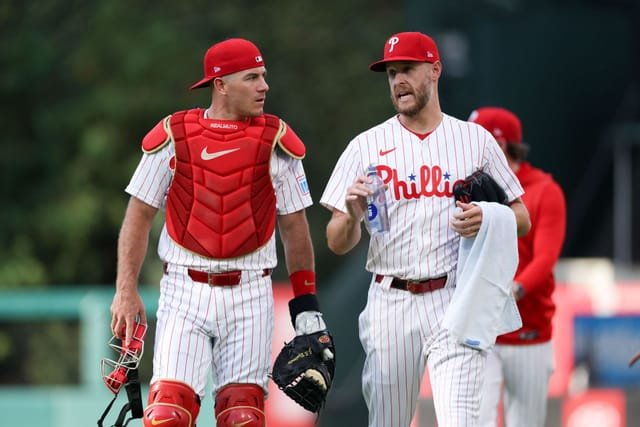
Zack Wheeler delivered an important pitching performance for the Philadelphia Phillies against the Atlanta Braves, but his reaction to Ronald Acuña Jr.’s home run celebration became a major talking point after the game.
The Phillies defeated the Braves 4-2 on Saturday, with Wheeler limiting Atlanta to one run over six innings while striking out nine batters. The veteran right-hander also escaped an early bases-loaded situation and eventually got Acuña out to end the fifth inning.
However, the game included a moment that added extra emotion to an already important National League East matchup. Acuña hit a home run off Wheeler in the third inning and celebrated as he made his way around the bases. Wheeler later insisted that the celebration did not bother him, although his comments about how Phillies players approach home runs were interpreted by many fans as a subtle criticism.
The response was immediate. Some MLB fans mocked Wheeler online, arguing that his comments sounded more irritated than indifferent, while others viewed the exchange as nothing more than normal competitive tension between two accomplished players.
Ronald Acuña Jr. hits Zack Wheeler for a home run
The central moment occurred in the top of the third inning when Ronald Acuña Jr. connected against Wheeler and launched his 15th home run of the season.
The Braves star’s reaction attracted attention as he danced while rounding the bases. Home-run celebrations have become an increasingly visible part of modern baseball, particularly as players express more personality during games.
For Atlanta, Acuña’s blast provided an important offensive moment against one of Philadelphia’s most experienced pitchers. Wheeler, however, eventually regained control and finished the outing strongly.
The home run also created a contrast between the two sides. Acuña celebrated his individual achievement in an expressive manner, while Wheeler later referenced the more understated approach typically associated with some Phillies players.
What Zack Wheeler said about Acuña’s celebration
After the game, Wheeler was asked about Acuña’s home-run celebration. He said that it did not bother him particularly much and emphasized that the Braves slugger could celebrate however he wanted after hitting a home run.
However, Wheeler then compared Acuña’s celebration with the way a Phillies player would typically react after hitting a major home run at Citizens Bank Park.
That comparison became the key part of the discussion because it appeared to suggest that Wheeler preferred a more traditional approach to celebrating home runs.
Although his initial response sounded dismissive of the issue, the follow-up comment gave fans something to debate. Supporters of Acuña interpreted it as unnecessary criticism, while Phillies supporters could see it as part of the competitive edge that naturally exists between division rivals.
Why MLB fans reacted so strongly to Wheeler
Social media reactions quickly turned the postgame comments into a debate about baseball etiquette and player celebrations.
Some fans accused Wheeler of complaining about Acuña’s behavior, while others questioned why he would bring up the celebration if it genuinely did not bother him.
Several reactions focused on the apparent contradiction between saying the celebration was not an issue and then discussing it at length. That perceived contradiction made Wheeler an easy target for jokes and criticism.
Other fans took a more measured view. From that perspective, Wheeler’s comments could simply reflect a difference in baseball culture and personal preference rather than genuine hostility toward Acuña.
Baseball has traditionally had unwritten expectations about how players should behave after home runs, particularly regarding excessive celebration. Modern MLB, however, has increasingly embraced individual expression, creating occasional disagreements between players and fans about what constitutes acceptable emotion.
Wheeler gets his response against Acuña
While Acuña won the individual battle by hitting the home run, Wheeler eventually had an opportunity to answer on the mound.
He struck out Acuña to end the fifth inning, a moment Wheeler later acknowledged carried extra significance for him.
Wheeler admitted that he particularly wanted the strikeout because of the earlier home run. His comments suggested that the sequence had become a personal competitive challenge during the game.
That kind of response is not unusual in professional baseball. Pitchers and hitters face each other repeatedly, and individual encounters can create their own narratives within a larger game.
For Wheeler, striking out Acuña did not erase the home run, but it provided a satisfying response before he completed his outing.
Zack Wheeler’s pitching performance was more important than the controversy
Despite the attention surrounding his comments, Wheeler’s actual performance was one of the biggest reasons Philadelphia secured the victory.
The Phillies ace allowed one run on three hits and two walks while recording nine strikeouts across six innings.
His performance was particularly impressive because he faced significant trouble immediately. Wheeler found himself in a bases-loaded situation with no outs in the first inning, creating an early opportunity for Atlanta to take control of the game.
Instead of allowing the situation to unravel, he managed to escape the inning and limit the damage.
That recovery became an important part of his overall performance. Pitchers often face situations where one difficult inning can completely change a game, and Wheeler’s ability to work through the pressure helped Philadelphia maintain control.
Wheeler explains how he handled the early bases-loaded jam
Following the game, Wheeler explained that he did not approach the difficult first inning with a negative mindset.
Rather than thinking that another problem was about to develop, he focused on responding to the immediate situation and making the necessary pitches.
Wheeler said he was feeling good despite putting himself into the difficult position. His explanation offered insight into the mentality required from an experienced starting pitcher.
The ability to reset quickly is especially valuable for pitchers. A bases-loaded situation can create enormous pressure, but dwelling on what has already happened can make the next pitch even more difficult.
Wheeler’s response showed why experience matters. Instead of allowing the early trouble to define his outing, he continued attacking hitters and eventually completed six solid innings.
Phillies beat Braves 4-2 in an important NL East matchup
The Phillies’ 4-2 victory had significance beyond the individual exchange between Wheeler and Acuña.
The result reduced Atlanta’s lead to four games in the race for the National League East title, making the win particularly valuable for Philadelphia.
Division games carry additional importance because the teams compete directly for the same postseason objective. A victory against a division rival can simultaneously improve one team’s position while preventing the other from creating additional separation.
That context helps explain why the game contained so much competitive intensity. Wheeler was not simply facing an ordinary opponent. He was pitching against a Braves lineup standing between Philadelphia and its divisional ambitions.
Wheeler’s $126 million contract adds another layer
Wheeler’s comments also attracted attention because he is one of the most important and highly compensated players on Philadelphia’s roster.
He is playing under a $126 million contract with the Phillies, reflecting the organization’s long-term confidence in his ability to lead the pitching staff.
With that level of responsibility comes heightened expectations. Every start is examined closely, particularly when Wheeler faces a division rival and one of baseball’s most recognizable offensive players.
His contract itself was not directly related to the Acuña celebration, but it helps explain why Wheeler remains such a central figure whenever the Phillies face significant opponents.
For Philadelphia, his value is ultimately measured by performances like Saturday’s outing: navigating difficult innings, limiting scoring opportunities and giving the offense a chance to win.
Ronald Acuña Jr. and the changing culture of MLB celebrations
The disagreement also reflects a broader change in professional baseball.
Players today are increasingly comfortable showing emotion after major moments. Home runs can involve gestures, dances, reactions toward teammates and other forms of celebration that were less common in earlier eras.
Acuña has long been associated with an energetic style of play, making his reaction after hitting a home run unsurprising to many fans.
At the same time, some players still prefer a more understated approach. That difference does not necessarily mean one side is right and the other is wrong. It reflects the tension between baseball’s traditional culture and its evolving personality.
Division rivalry can amplify that difference. A celebration against a pitcher from a competing team is more likely to generate a reaction than the same celebration during a less consequential game.
Is Zack Wheeler really upset with Ronald Acuña Jr.?
There is no clear evidence that Wheeler has a serious personal issue with Acuña.
His comments indicated that he did not consider the celebration a major problem, while his later admission about wanting to strike Acuña out showed the competitive significance of the earlier encounter.
That distinction matters. Wanting to defeat an opponent after giving up a home run is a normal competitive reaction. It does not automatically mean there is a personal feud between the players.
The strongest interpretation is therefore that Wheeler was frustrated by giving up the home run and enjoyed getting the strikeout later in the game. Fans, however, were free to interpret his comments through the larger debate surrounding MLB celebrations.
Wheeler’s response could become part of the Phillies-Braves rivalry
Games between Philadelphia and Atlanta already carry significant divisional importance, and moments involving star players can add another layer to the rivalry.
Acuña’s home run against Wheeler, followed by the strikeout later in the game, created a small individual storyline within the larger contest.
Neither moment determined the entire game. Philadelphia ultimately won 4-2, and Wheeler’s six-inning performance was more significant to the final result than the exchange itself.
Still, baseball rivalries are often built from exactly these kinds of moments. A home run, a strikeout, a celebration and a postgame comment can become recurring references whenever the players meet again.
What the game means for Philadelphia
For the Phillies, the most important takeaway was the victory and the improved position in the NL East race.
Wheeler demonstrated that he could overcome an uncomfortable start, surrender a home run to one of Atlanta’s biggest stars and still provide six effective innings.
That resilience could be particularly important as the season moves toward its decisive stages. Teams competing for a division title need reliable starting pitching, especially in games against direct rivals.
The Phillies therefore received more than a win on Saturday. They also saw their ace respond well to adversity against a dangerous Atlanta lineup.
Key numbers from Zack Wheeler’s start
| Category | Result |
|---|---|
| Team | Philadelphia Phillies |
| Opponent | Atlanta Braves |
| Final score | Phillies 4, Braves 2 |
| Innings pitched | 6 |
| Runs allowed | 1 |
| Hits allowed | 3 |
| Walks allowed | 2 |
| Strikeouts | 9 |
| Ronald Acuña Jr. home runs | 1 against Wheeler |
| NL East gap after game | Braves lead reduced to four games |
The bigger story: competition versus celebration
The Wheeler-Acuña moment ultimately represents a familiar question in professional sports: how should players balance competitive intensity with personal expression?
There is no universal answer. Some athletes prefer to celebrate openly, while others believe the game is best played with a quieter style. Fans naturally develop their own preferences as well.
What makes the discussion particularly interesting is that both sides can coexist within the same sport. MLB has room for players who show considerable emotion and players who prefer traditional restraint.
For Wheeler, the practical response was to keep pitching. He recovered from the early bases-loaded jam, limited Atlanta’s offense and eventually struck out Acuña. Philadelphia won the game, which made the result more important than the online debate.
Conclusion: Wheeler answers Acuña with a strong outing
Zack Wheeler’s performance against the Atlanta Braves ultimately gave Philadelphia exactly what it needed from its ace. He allowed one run across six innings, struck out nine and helped the Phillies secure a 4-2 victory in an important NL East matchup.
Ronald Acuña Jr.’s home run and celebration created the game’s most discussed moment, while Wheeler’s postgame comments sparked criticism from sections of the MLB fanbase.
Yet the most telling response came on the field. Wheeler later struck out Acuña and helped Philadelphia close out the victory.
Whether fans view Wheeler’s remarks as harmless competitive banter or unnecessary complaining, the game itself demonstrated why the veteran remains such an important part of the Phillies. With the NL East race tightening, performances under pressure will matter far more than a single postgame exchange.
For breaking news and live news updates, like us on Facebook or follow us on Twitter and Instagram. Read more on Latest MLB on thefoxdaily.com.





COMMENTS 0