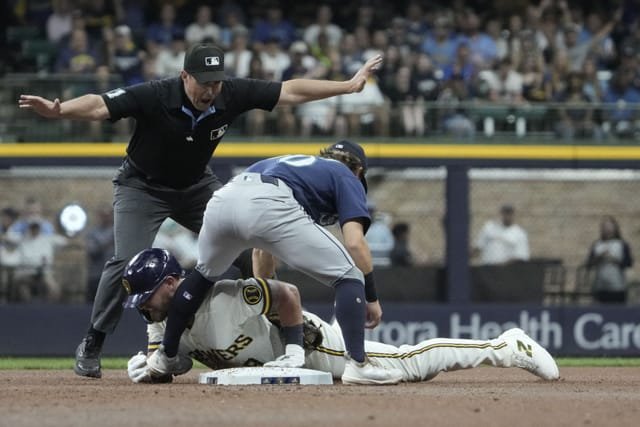
Jake Bauers became the center of attention during the Milwaukee Brewers’ series opener against the Seattle Mariners after a controversial collision with catcher Cal Raleigh at home plate. The play sparked immediate debate among MLB fans over aggressive baserunning, catcher interference and whether the runner should have been called out.
The incident happened in the first inning after William Contreras hit a line drive through left field. Bauers, who was at second base, raced toward home as Seattle attempted to prevent him from scoring. Raleigh prepared to make the tag, but the two players collided and the baseball came loose from the Mariners catcher’s glove.
Bauers crossed home plate before Raleigh could regain possession and make another tagging attempt. The unusual sequence quickly spread across social media, with fans offering sharply different opinions about whether the contact was legal or whether Bauers intentionally knocked the ball loose.
However, what initially looked like the biggest talking point of the game eventually became only one part of a remarkable night for Milwaukee. The Brewers’ offense exploded for 22 runs and 22 hits, while their pitching staff completed a shutout to defeat Seattle 22-0.
What happened between Jake Bauers and Cal Raleigh?
The controversial play began when William Contreras put the ball into play toward left field. Bauers was already in scoring position and immediately attempted to advance home.
Raleigh positioned himself at the plate to receive the ball and make the tag. As Bauers arrived, Raleigh attempted to tag him, but contact occurred between the runner and catcher.
The collision caused Raleigh to lose control of the baseball. Bauers then touched home plate before Raleigh could recover the ball and attempt another tag.
That sequence created the central question surrounding the play: was the contact simply part of an aggressive attempt to score, or did Bauers intentionally interfere with Raleigh’s ability to complete the tag?
That distinction matters because MLB rules place limits on how runners can interfere with fielders. At the same time, contact during a play at home plate can occur naturally when a runner and catcher are competing for the same piece of real estate.
Why MLB fans questioned the decision
The reaction from fans demonstrated just how controversial the play appeared from different perspectives.
Some supporters believed Bauers had simply taken advantage of the situation and continued running after the catcher failed to secure the baseball. Others argued that the ball appeared to have been knocked loose by Bauers and questioned why the play did not result in an out.
One fan brought Josh Naylor into the discussion, arguing that a similar play involving the Cleveland Guardians star would have generated an even stronger reaction.
Another fan questioned why runners would not use similar tactics more frequently if such contact is allowed. Others described the play as intentional and suggested that runner interference should have been called.
The wide range of reactions shows why controversial plays at home plate continue to generate some of baseball’s most heated arguments. The debate is rarely limited to the official ruling. Fans also consider intent, previous incidents, player reputation and whether similar plays have received consistent treatment.
The Josh Naylor comparison
The Josh Naylor comparison added another dimension to the discussion. It suggested that fans sometimes judge the same type of aggressive play differently depending on which player is involved.
That is a recurring feature of sports debates. A play considered clever when made by one team’s player can be described as unsportsmanlike when performed by an opponent.
In this case, the Naylor reference helped turn a single play involving Bauers and Raleigh into a larger conversation about consistency in MLB officiating and fan perception.
Runner interference is the key question
The biggest technical issue surrounding the Bauers play is the distinction between legal baserunning and interference.
A runner is naturally expected to do everything legally possible to reach the next base. A catcher, meanwhile, must maintain control of the ball while attempting to complete the tag.
When those responsibilities collide, the interpretation can become complicated.
A physical collision does not automatically mean the runner committed interference. Likewise, a catcher dropping the ball does not automatically mean the runner was entitled to advance. The specific circumstances of the play matter.
This is why plays involving contact at home plate can create such strong disagreements among fans. Television viewers may see the same sequence but reach completely different conclusions about whether the runner caused the defensive failure.
Milwaukee’s offense turned controversy into an afterthought
While the first-inning collision dominated the early conversation, Milwaukee’s offense eventually became the defining story of the game.
The Brewers erupted for 22 runs, producing their season-high total of 22 hits against Seattle pitching.
The offensive explosion did not happen all at once. Milwaukee gradually built momentum before turning the game into a complete rout.
The Brewers scored five runs in the fifth inning, added another five in the sixth and then delivered an extraordinary nine-run final inning.
By the time the final inning was underway, Seattle had no realistic path back into the contest. Milwaukee’s relentless offensive pressure transformed the game from a series opener into one of the most one-sided results of the season.
Jake Bauers continued his career-best offensive season
Bauers’ involvement in the controversial play was only part of his contribution. He also played a meaningful role in Milwaukee’s offensive production.
According to the supplied game report, Bauers entered the contest batting a career-high .275 with 21 home runs.
That production represents an important development in his career. A player capable of contributing both with power and in situational opportunities gives a lineup additional depth, particularly during a long MLB season.
Bauers had also recently delivered a strong performance against the Los Angeles Dodgers, going 4-for-4 in Milwaukee’s series finale.
Against Seattle, he followed that performance with two hits in three plate appearances.
Bauers’ two-run homer made the rout even bigger
Bauers’ most significant offensive moment came in the sixth inning when he hit a two-run home run.
The homer extended Milwaukee’s advantage to 11-0 and added another major moment to a game in which the Brewers’ offense was already overwhelming Seattle.
For Bauers, the performance was especially notable because it showed that his impact was not limited to the controversial baserunning sequence. He contributed directly to the scoreboard and helped Milwaukee maintain its enormous advantage.
Twenty-two hits explain Milwaukee’s dominance
The 22-0 scoreline naturally attracts attention, but Milwaukee’s 22-hit performance provides a better explanation of how the game became so lopsided.
Scoring 22 runs requires sustained offensive pressure. One big inning can create a large lead, but maintaining that level of production across multiple innings requires numerous hitters to contribute.
Milwaukee’s five-run fifth, five-run sixth and nine-run final inning demonstrate how quickly the Brewers repeatedly capitalized on opportunities.
The final nine-run inning was particularly devastating because it showed that the offense did not slow down even after the game had effectively been decided.
Milwaukee’s pitching completed the perfect response
The Brewers’ offensive performance received most of the attention, but their pitching was equally important in completing the shutout.
Milwaukee starter Kyle Harrison delivered five scoreless innings and struck out eight Mariners hitters.
That performance gave the Brewers a strong foundation while their offense began building its enormous lead.
After Harrison’s outing ended, Milwaukee’s bullpen continued the job. The relievers combined to keep Seattle scoreless over the final four innings.
The result was not simply an offensive victory. Milwaukee produced a complete team performance in which the starting pitcher, bullpen and lineup all contributed to a dominant shutout.
Brewers vs Mariners: The numbers behind the 22-0 rout
| Category | Milwaukee Brewers | Seattle Mariners |
|---|---|---|
| Final Score | 22 | 0 |
| Hits | 22 | 0 runs scored |
| Fifth Inning Runs | 5 | 0 |
| Sixth Inning Runs | 5 | 0 |
| Final Inning Runs | 9 | 0 |
| Jake Bauers | 2-for-3, 2-run HR | – |
| Kyle Harrison | 5 scoreless innings, 8 strikeouts | – |
Why the 22-0 result matters more than one controversial play
The Bauers-Raleigh collision may dominate social media discussion, but Milwaukee’s overall performance provides a much broader takeaway.
A controversial play can define the conversation around a game for a few hours. A 22-run offensive performance and a shutout, however, demonstrate something much more significant about how completely one team controlled the contest.
Milwaukee did not depend on a single lucky sequence. The Brewers produced runs in multiple innings, recorded 22 hits and received five scoreless innings from Harrison before the bullpen closed the game.
That combination makes the victory particularly convincing.
Comparison: controversy versus complete team dominance
The first-inning incident was a moment. Milwaukee’s 22-0 victory was a performance.
The distinction is important. The Bauers play can be debated endlessly because reasonable viewers may disagree about the contact. The scoreboard, however, tells a much simpler story: Milwaukee dominated Seattle in virtually every meaningful phase of the game.
That contrast is one of the most interesting aspects of the contest. The most controversial moment came when the Brewers had scored only one run, yet the final result showed an offense that eventually produced 22 runs.
What this could mean for Jake Bauers
Bauers’ career-best offensive numbers make his current form particularly noteworthy.
When a player combines consistent production with the ability to contribute in different ways, his value to a lineup can increase significantly. Bauers demonstrated that versatility during this game by contributing on the bases and at the plate.
The home-run contribution also reinforced his ability to provide power in the middle of an offensive outburst.
For Milwaukee, the bigger question will be whether this level of production can continue. A single 22-run game is extraordinary, but sustained offensive success depends on consistency over a much larger sample.
What to watch after the Brewers’ 22-0 victory
The immediate focus will shift to whether Milwaukee can carry the offensive momentum into the remainder of the series.
Seattle, meanwhile, will need to move beyond one of its most difficult results and prevent the defeat from becoming a larger problem.
For Bauers, the spotlight will remain particularly intense. The controversial collision has made him a talking point among MLB fans, while his offensive performance gives Milwaukee another reason to keep him in the conversation.
The most interesting development may be how fans respond if a similar play happens again. If another runner makes contact with a catcher during a tag attempt, comparisons with the Bauers-Raleigh incident are almost inevitable.
Conclusion: Jake Bauers leaves a lasting mark on a remarkable Brewers win
Jake Bauers ended the night as one of the most discussed players from Milwaukee’s extraordinary victory, but for two very different reasons.
His collision with Cal Raleigh during the first inning created a fierce debate about aggressive baserunning and potential runner interference. Fans disagreed over whether Bauers simply completed a hard run to the plate or deliberately caused the ball to come loose.
Later, however, Bauers helped Milwaukee’s offense make the controversy seem almost insignificant. His two-run homer contributed to an offensive performance in which the Brewers collected 22 hits and scored 22 runs.
With Kyle Harrison throwing five scoreless innings and the bullpen completing the shutout, Milwaukee produced a remarkably complete performance.
The controversial first-inning play will continue to generate arguments, especially among fans who believe similar incidents should be judged consistently. But the clearest takeaway from the game is far simpler: Milwaukee overwhelmed Seattle from the middle innings onward and finished with a 22-0 statement victory.
For breaking news and live news updates, like us on Facebook or follow us on Twitter and Instagram. Read more on Latest MLB on thefoxdaily.com.






COMMENTS 0