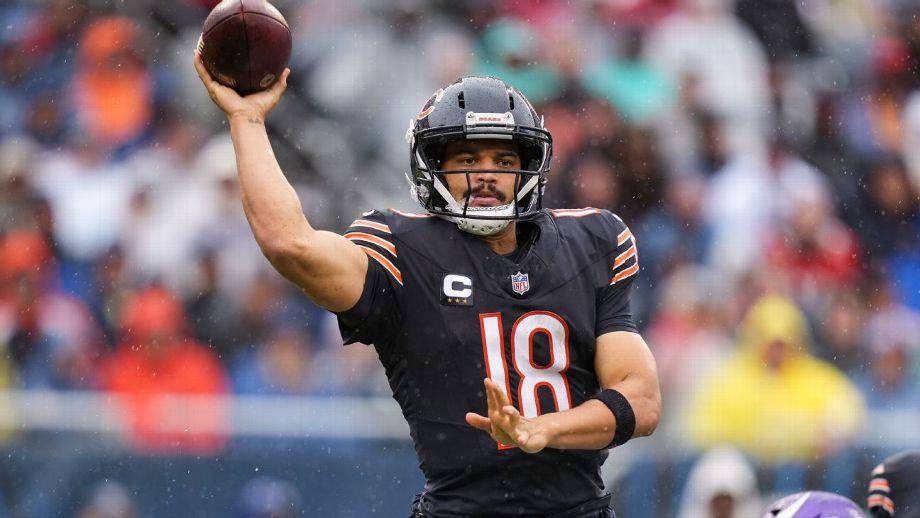
Fantasy Football managers faced several important lineup decisions heading into NFL Week 6, with injuries affecting key quarterbacks, running backs, wide receivers, and tight ends. Chicago Bears quarterback Caleb Williams was cleared to play despite a hamstring concern, while Philadelphia Eagles quarterback Jalen Hurts and Baltimore Ravens quarterback Lamar Jackson were ruled out, forcing fantasy managers to reconsider their starting lineups.
Several other players also received important status updates before Sunday’s games. Zay Flowers, Chris Olave, DK Metcalf, and DeVonta Smith were among the offensive players listed as active, while injuries to players such as Rashee Rice, David Montgomery, and Will Shipley created opportunities for potential replacements.
These updates were particularly important for managers dealing with injuries, bye weeks, and uncertain player workloads. Knowing which players were active was only part of the decision-making process, as fantasy managers also needed to consider matchup quality, expected touches, quarterback changes, and the possibility of limited playing time.
Here is a detailed breakdown of the key Week 6 fantasy football inactives, injury updates, replacement options, and lineup recommendations based on the supplied report.
Fantasy Football Week 6: The Biggest Injury Updates
The most significant developments involved quarterbacks Jalen Hurts and Lamar Jackson, both of whom were ruled out. Their absences affected not only their own fantasy value but also the outlook for their teams’ receivers and tight ends.
Meanwhile, Caleb Williams was active for Chicago despite a hamstring issue. His availability gave fantasy managers the option to keep him in their lineups, although some caution remained because of the possibility that he could limit his rushing activity.
Several running backs also faced uncertain situations. Quinshon Judkins, Jeremiyah Love, David Montgomery, and Jacory Croskey-Merritt were among those ruled out, creating opportunities for replacement players to receive additional touches.
At wide receiver, the return of several active players offered some relief, while absences involving Rashee Rice and Deebo Samuel Sr. required managers to explore alternative options. The overall lesson for Week 6 was clear: checking availability alone was not enough. Fantasy managers also needed to understand how each absence could change a team’s offensive approach.
Quarterback Updates: Caleb Williams Active, Hurts and Jackson Out
Caleb Williams, Chicago Bears: Active
Williams was active for Week 6 despite dealing with a hamstring concern. His availability kept him in consideration as a QB1, although fantasy managers were advised to monitor the potential impact of the injury on his mobility.
Williams had yet to throw multiple touchdown passes or score at least 15 fantasy points in a game that season, according to the supplied report. Those numbers made him a less reliable option than quarterbacks producing consistently strong results.
Nevertheless, his availability was positive news for the Bears’ offense. Bijan Robinson and Drake London were also identified in the supplied analysis as players who could benefit from their quarterback being available, although their team affiliations and the related player details should be independently verified before publication.
For fantasy managers choosing between Williams and other quarterbacks, the original analysis recommended Williams over Trevor Lawrence, Jameis Winston, and Jacoby Brissett, while preferring Kirk Cousins and Jordan Love over him.
Jalen Hurts, Philadelphia Eagles: Ruled Out
Hurts was ruled out after the supplied report stated that he had been placed on injured reserve because of a blood clot. His absence represented a major change for fantasy managers who normally relied on his passing production and rushing ability.
Tanner McKee was identified as the Eagles’ replacement starter. However, his fantasy appeal was considered limited, particularly in traditional one-quarterback leagues. He was viewed primarily as a possible emergency option in superflex formats, where teams can start two quarterbacks.
Fantasy managers looking for replacements were advised to consider alternatives such as Kirk Cousins, Jordan Love, Tyler Shough, Jameis Winston, or Aaron Rodgers, depending on availability and league settings.
The quarterback change also affected Philadelphia’s receiving options. Dallas Goedert was identified as the Eagles pass-catcher most worth trusting, largely because tight ends can remain involved through short passes and red-zone opportunities. However, the uncertainty surrounding McKee made the team’s other receiving options riskier than usual.
Lamar Jackson, Baltimore Ravens: Ruled Out
Jackson was ruled out after missing practice during the week because of an ankle issue. Tyler Huntley was expected to start in his place, creating an important adjustment for fantasy managers who normally rely on Jackson’s combination of passing and rushing production.
Huntley had produced 201 passing yards, two passing touchdowns, 20 rushing yards, and a rushing touchdown in the previous game, according to the supplied report. That performance suggested he could provide some fantasy value, particularly in superflex leagues.
However, Huntley was not considered an automatic replacement for Jackson in standard one-quarterback formats. Managers were encouraged to compare him with available streaming options before making a decision.
Jackson’s absence also affected Zay Flowers. Although Flowers was active for Week 6, his production had taken a hit without Jackson at quarterback. He remained a potential WR2 because of his target volume, but managers needed to account for the less certain offensive environment.
Wide Receiver Injury Updates and Fantasy Football Advice
Zay Flowers, Baltimore Ravens: Active
Flowers was active despite dealing with a toe concern. He remained a viable fantasy starter because of his involvement in the passing game, even though Jackson’s absence created some uncertainty about his production.
The supplied report noted that Flowers received nine targets from Huntley in the previous game. That level of involvement supported his consideration as a WR2, particularly in leagues where managers needed reliable receiving volume.
Rashod Bateman was also active, but he was viewed as a deeper-league option rather than a preferred starter. Rookie receiver Ja’Kobi Lane was identified as a potential bench stash for managers with room to develop a longer-term option.
A.J. Brown, New England Patriots: Active
Brown was activated and expected to play after dealing with an ankle injury. His availability gave fantasy managers another potential starting receiver, particularly during a week when injuries and bye weeks reduced the number of dependable options.
However, the supplied analysis cautioned that Brown could carry more risk than usual. Returning from a significant ankle injury can affect a player’s movement and explosiveness, and a return to the lineup does not necessarily mean an immediate return to peak performance.
Brown remained a potential option because of his upside and expected involvement, but managers were advised to moderate their expectations rather than automatically treating him as a fully healthy, elite starter.
DeVonta Smith, Philadelphia Eagles: Active
Smith returned to practice during the week and was active for Week 6 after dealing with hamstring and toe concerns. His availability offered a boost to fantasy managers, although the Eagles’ quarterback situation made him a less predictable option.
With Hurts ruled out and McKee expected to start, Smith faced additional uncertainty. His big-play ability kept him in the WR3 conversation, but managers needed to consider whether the backup quarterback could consistently deliver catchable passes.
The situation illustrated why a receiver’s health status should never be the only factor in a fantasy decision. Quarterback quality, target share, and the expected offensive environment can all influence a player’s value.
DK Metcalf, Pittsburgh Steelers: Active
Metcalf was removed from the injury report and was expected to play after dealing with an illness. The update allowed fantasy managers to retain him in their starting plans without the same immediate uncertainty surrounding his availability.
The supplied analysis considered Metcalf a viable WR2 option. His ability to produce on downfield passes and generate substantial gains made him an attractive starter for managers looking for receiving upside.
Chris Olave, New Orleans Saints: Active
Olave was active after missing practice at the beginning of the week because of an illness. His availability was positive news for fantasy managers seeking a dependable receiving option.
The supplied report recommended starting Olave if he was available to play. Even when an illness affects practice participation, a confirmed active status can allow managers to retain a player with a meaningful role in the passing game.
Rashee Rice, Kansas City Chiefs: Ruled Out
Rice was ruled out for Week 6 after not practising following the Chiefs’ bye. His absence created an opportunity for other Kansas City receivers to receive additional targets.
Xavier Worthy was identified as the primary receiver expected to benefit. The supplied analysis recommended Worthy over Ladd McConkey, Germie Bernard, Romeo Doubs, and Jakobi Meyers.
The absence of Rice and Tyquan Thornton also increased the importance of Travis Kelce in the passing game. Kelce was considered a must-start tight end because of his established role and the potential for additional targets.
Cyrus Allen was mentioned as a speculative addition for managers in deeper leagues. Such options can be useful when injuries create opportunities, although fantasy managers should avoid assuming that an increased opportunity automatically guarantees production.
Deebo Samuel Sr., San Francisco 49ers: Ruled Out
Samuel was ruled out with a hamstring injury. Although he had avoided injured reserve at the time of the supplied report, his absence removed an important offensive option from San Francisco’s lineup.
Brandin Cooks was identified as the most direct in-house replacement. However, managers were encouraged to consider other available receivers if stronger streaming options were available on the waiver wire.
The supplied report also noted that San Francisco had opened Christian Kirk’s 21-day window to return, suggesting that a comeback was approaching. His availability and eventual role would need to be monitored before making longer-term fantasy decisions.
Running Back Inactives: Who Benefits From the Absences?
Quinshon Judkins, Cleveland Browns: Ruled Out
Judkins was ruled out after dealing with an ankle injury during the week. His absence left Cleveland with Jaleel McLaughlin and Audric Estime as the available running backs identified in the supplied report.
McLaughlin was considered the preferred fantasy option because he was expected to handle passing-game work and potentially split rushing attempts. Although his floor remained low, additional opportunities made him a possible flex play.
The report also noted that Dylan Sampson’s 21-day return window had opened, but he was unavailable for Week 6. Fantasy managers therefore needed to focus on the players expected to handle the immediate workload.
Jeremiyah Love, Arizona Cardinals: Ruled Out
Love was ruled out after missing practice throughout the week because of an ankle injury. His absence increased the expected workload for Tyler Allgeier, who was identified as a potential RB2 based on volume alone.
Allgeier was expected to handle a substantial portion of the rushing work and could receive goal-line opportunities. He might also see additional targets if Arizona fell behind and needed to rely more heavily on the passing game.
The supplied analysis recommended Allgeier over Woody Marks, Alvin Kamara, Omarion Hampton, and Jacory Croskey-Merritt. Fantasy managers should nevertheless consider their league’s scoring format and the latest confirmed depth-chart information before finalising their lineups.
David Montgomery, Houston Texans: Ruled Out
Montgomery was ruled out for Houston’s London matchup against Jacksonville because of a groin injury. Woody Marks was expected to start in his place, making Marks a possible waiver-wire or flex option for managers needing running-back depth.
However, the matchup was considered difficult. Jacksonville had allowed just 42 rushing yards per game to running backs, according to the supplied report, and had limited explosive rushing plays effectively.
Marks’ potential value came partly from the receiving game. Jacksonville had allowed the fifth-most receiving yards to running backs, giving Marks a possible path to fantasy production even if his rushing efficiency was limited.
The supplied analysis preferred several other running backs over Marks, including Braelon Allen, Emanuel Wilson, Tony Pollard, Cam Skattebo, and MarShawn Lloyd. Managers should weigh projected touches and receiving involvement against the difficulty of the matchup.
Will Shipley, Philadelphia Eagles: Ruled Out
Shipley was expected to miss multiple weeks after suffering a foot injury. His absence created an opportunity for Dameon Pierce to take on a larger role while Saquon Barkley remained unavailable.
Pierce was described as a volume-based RB2 or flex option in a favourable matchup against Carolina. The supplied analysis highlighted Carolina’s struggles against running backs, including rushing yardage, rushing touchdowns, yards after contact, and fantasy points allowed per game.
For fantasy managers dealing with multiple running-back injuries, Pierce represented a potential short-term option because playing time can be especially valuable when several established starters are unavailable.
Jacory Croskey-Merritt, Washington Commanders: Ruled Out
Croskey-Merritt was ruled out because of a groin injury, leaving Rachaad White as Washington’s expected lead back in the supplied report.
White was considered a possible RB3 or flex option, with additional upside because of his projected workload, particularly in the passing game. However, the matchup against San Francisco was challenging.
The 49ers had limited explosive rushing plays and had allowed only two rushing touchdowns to running backs entering Week 6, according to the supplied report. That reduced the appeal of relying on White for rushing production alone.
His receiving opportunities could nevertheless provide a path to fantasy points, especially in point-per-reception leagues. Managers should consider the balance between workload and matchup difficulty before deciding whether to start him.
Additional Running Back Updates
TreVeyon Henderson, New England Patriots: Active
Henderson was active despite an ankle injury after initially being expected to miss multiple weeks. His return gave fantasy managers another option, but uncertainty remained about how much work he would receive.
Because Henderson’s explosiveness was an important part of his fantasy appeal, the possibility of limited mobility made him a high-risk, high-reward flex option.
Rhamondre Stevenson was considered the preferred Patriots running back in the supplied analysis. Stevenson had recorded at least 16 touches, 74 yards, and a touchdown in each of the previous two games, giving him a more established workload.
Alvin Kamara, New Orleans Saints: Active
Kamara was active despite a back issue. However, his efficiency had been inconsistent, limiting the confidence fantasy managers could place in him as a high-end starter.
His receiving involvement remained a source of potential value, keeping him in the flex conversation. The supplied report also identified the Giants as a favourable matchup because of the rate at which they had allowed explosive runs to running backs.
Rico Dowdle, Pittsburgh Steelers: Active
Dowdle was active after recording his first full practice since injuring his toe. Nevertheless, Jaylen Warren had performed well during Dowdle’s absence, averaging 163 yards per game over the previous three weeks according to the supplied report.
Warren was expected to remain the lead back, making him a strong starting option across fantasy formats. Dowdle was still worth keeping on rosters, but the report viewed him primarily as an insurance option until his role became clearer.
Tyjae Spears, Tennessee Titans: Active
Spears was active after progressing from limited practice participation to a full session on Friday. He was coming off a season-high nine targets, which offered some encouragement for managers searching for flex help.
However, his usage had been inconsistent, making him difficult to trust as a regular starter. He was best viewed as a deeper-league option rather than a player who should automatically enter every lineup.
Tight End Updates: Streaming Options for Week 6
Tyler Warren, Indianapolis Colts: Ruled Out
Warren was ruled out after appearing on the injury report with a groin issue. His absence forced fantasy managers to consider alternative tight ends, particularly those who relied on him as their regular starter.
The supplied analysis identified Tyler Higbee, Pat Freiermuth, Darren Waller, and Michael Mayer as possible streaming replacements. Dalton Kincaid was another name worth checking on the waiver wire if he was available in a manager’s league.
When replacing an injured tight end, managers should consider expected targets, red-zone involvement, and the likelihood that the player will remain on the field for passing situations.
Pat Freiermuth, Pittsburgh Steelers: Active
Freiermuth was active after being added to the injury report on Saturday with a calf issue. He remained a potential streaming option for managers who needed help at tight end.
The supplied report suggested he could see more targets because Pittsburgh was short-handed at wide receiver. However, his injury introduced some risk, meaning managers needed to weigh the possibility of increased involvement against uncertainty about his condition.
Kenyon Sadiq, New York Jets: Active
Sadiq was active after dealing with a concussion. Nevertheless, he was not considered the preferred streaming option for Week 6.
The supplied analysis recommended alternatives such as Tyler Higbee, Juwan Johnson, and Pat Freiermuth. Fantasy managers should prioritise players with clearer expected roles and stronger opportunities when choosing a short-term tight end replacement.
Late-Game Players: Important Updates to Monitor
Players scheduled for late-afternoon or Monday-night games presented additional challenges because managers had to make decisions before all injury information was available. Leaving a questionable player in a lineup without a backup could result in an unexpected zero if that player was eventually ruled out.
DJ Moore, Buffalo Bills: Questionable
Moore was questionable with a shoulder injury after returning to practice on Friday while wearing a red non-contact jersey. His status required monitoring because the Bills had a bye in Week 7 and could potentially choose to give him additional recovery time.
Khalil Shakir was identified as the preferred alternative among Buffalo’s other receivers. Keon Coleman was considered an upside flex option, while Dalton Kincaid was highlighted as an attractive option because of the Raiders’ reported struggles against tight ends.
Fantasy managers should confirm Moore’s final status before kickoff and prepare a replacement if they cannot afford to wait for late news.
Ladd McConkey, Los Angeles Chargers: Expected to Play
McConkey was not listed on the practice report for Week 6, indicating that he was expected to play. However, uncertainty remained about his workload after he was active in Week 5 without playing a single snap.
The supplied analysis classified McConkey as a high-risk option with some upside. Managers were advised to consider alternative receivers such as Tre Tucker, Xavier Worthy, Germie Bernard, or Khalil Shakir if they wanted a clearer starting option.
Quentin Johnston, Los Angeles Chargers: Expected to Play
Johnston practised on a limited basis during the week and was not listed on the final injury report. He was therefore expected to play, but his fantasy outlook remained uncertain.
According to the supplied report, Johnston had not exceeded 40 receiving yards in any game that season. Concerns about the Chargers’ offensive line and overall offensive production further reduced confidence in his immediate fantasy value.
Managers searching for a streaming receiver were advised to consider the alternatives mentioned in the McConkey section instead.
Monday Night Football: Mike Evans, Stefon Diggs and Terry McLaurin
Mike Evans, San Francisco 49ers: Questionable
Evans was listed as questionable with rib and Achilles concerns heading into Monday night. The supplied report noted that he had played through the same rib issue the previous week, suggesting that another appearance was possible.
However, fantasy managers were advised to have a backup ready. Brandin Cooks was identified as a possible waiver-wire replacement, with Antonio Williams another option to consider.
Stefon Diggs, Washington Commanders: Status Uncertain
Diggs missed Week 5 and did not practise at the beginning of the following week, but he returned to practice on Friday. That development gave him a chance to play on Monday night, although his final status remained important.
Terry McLaurin was identified as the leading option in the Commanders’ passing attack. Managers considering Diggs needed a backup to avoid the risk of receiving no fantasy points if he was ruled out after their other options had already played.
Brandin Cooks, Antonio Williams, and Chig Okonkwo were listed as potential waiver-wire alternatives. Okonkwo was noted as having led the Commanders with six targets in the previous game, according to the supplied report.
Terry McLaurin, Washington Commanders: Injury Monitoring Required
McLaurin was limited on Thursday before missing Friday’s practice. The absence was listed as rest, so the supplied analysis advised managers not to panic immediately.
Nevertheless, the Monday-night schedule made it important to prepare a backup plan. Managers should monitor official updates and ensure they have another viable receiver available if McLaurin’s status changes before kickoff.
Fantasy Football Week 6: Players Ruled Out Before Sunday
Several players had already been ruled out before Sunday’s games, allowing fantasy managers to make early adjustments. Their absences also created potential opportunities for teammates who were expected to receive more touches or targets.
| Player | Position | Team Listed in Source | Status | Potential Fantasy Impact |
|---|---|---|---|---|
| Jalen Hurts | QB | Eagles | Out | Tanner McKee becomes the starting quarterback; receiving options carry additional uncertainty. |
| Lamar Jackson | QB | Ravens | Out | Tyler Huntley starts; Zay Flowers remains relevant because of target volume. |
| Rashee Rice | WR | Chiefs | Out | Xavier Worthy and Travis Kelce could receive additional opportunities. |
| Deebo Samuel Sr. | WR | 49ers | Out | Brandin Cooks is a potential replacement option. |
| Will Shipley | RB | Eagles | Out | Dameon Pierce could receive additional work. |
| David Montgomery | RB | Texans | Out | Woody Marks is expected to start in his place. |
| Quinshon Judkins | RB | Browns | Out | Jaleel McLaughlin is a potential flex option. |
| Jeremiyah Love | RB | Cardinals | Out | Tyler Allgeier could benefit from additional volume. |
| Jacory Croskey-Merritt | RB | Commanders | Out | Rachaad White is expected to handle more work. |
| Tyler Warren | TE | Colts | Out | Managers need a replacement tight end. |
Important: The supplied source contains several player-team combinations and injury details that may be inconsistent. Verify the official NFL inactive lists, team affiliations, injury reports, and final player statuses before using this table as live fantasy advice.
How to Adjust Your Fantasy Football Lineup for Week 6
Fantasy managers should use a structured approach when making last-minute lineup changes. A player being active does not necessarily mean that he will receive a normal workload, and a teammate’s absence does not automatically guarantee a replacement will produce strong fantasy numbers.
1. Confirm Official Inactive Lists
Check official team announcements before kickoff. The supplied report indicated that Sunday inactive lists were expected approximately 90 minutes before games began, with early-game announcements around 11:30 a.m. ET and late-afternoon announcements around 2:30 p.m. ET.
These times are general scheduling guidance from the supplied material. Managers should confirm the actual kickoff time and official announcement for each game.
2. Identify Players Who Gain Volume
When a starting running back or receiver is unavailable, another player may inherit additional opportunities. Examples in the supplied report include Tyler Allgeier following Jeremiyah Love’s absence, Woody Marks following David Montgomery’s absence, and Xavier Worthy following Rashee Rice’s absence.
Before starting a replacement, consider whether the player is expected to receive a meaningful workload, whether the team has other alternatives, and whether the matchup supports a productive performance.
3. Account for Quarterback Changes
The absence of a starting quarterback can affect an entire passing attack. Receivers may see fewer accurate targets, while tight ends and running backs may become more involved in short passing situations.
Flowers, Smith, and Goedert were among the pass-catchers whose fantasy outlook required additional consideration because of quarterback changes described in the supplied report.
4. Keep a Backup for Questionable Late-Game Players
Players scheduled for Monday night create a particular challenge because many alternative options will have already played by the time their final status becomes clear. Managers should identify an available replacement before their earlier games begin.
That strategy is especially important when deciding whether to start questionable players such as Mike Evans, Stefon Diggs, or Terry McLaurin. An appropriate backup can reduce the risk of losing a starting lineup spot to an unexpected inactive designation.
Conclusion
Fantasy football Week 6 featured several major injury developments, including Caleb Williams being active despite a hamstring concern and Jalen Hurts and Lamar Jackson being ruled out. Their availability and absence affected quarterback decisions and created additional uncertainty for their respective receiving groups.
Other important updates involved Zay Flowers, A.J. Brown, DeVonta Smith, Chris Olave, and DK Metcalf, who were listed as active in the supplied report. Meanwhile, the absences of players such as Rashee Rice, David Montgomery, Will Shipley, and Jeremiyah Love created potential opportunities for teammates to receive more touches or targets.
The best fantasy decisions depend on more than injury status. Managers should consider projected workload, matchup quality, quarterback changes, scoring format, and late-game uncertainty before finalising their lineups. Most importantly, official team reports should be checked before kickoff because player availability and roles can change.
Editorial note: This article reorganises the supplied fantasy-football report. Because several player-team pairings and injury details in the source may be inconsistent, verify the information against official NFL team announcements and current fantasy resources before publication or lineup decisions.
For breaking news and live news updates, like us on Facebook or follow us on Twitter and Instagram. Read more on Latest Football on thefoxdaily.com.


COMMENTS 0