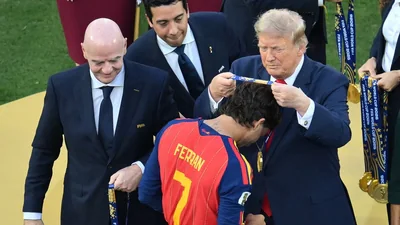
Ferran Torres should have been enjoying a straightforward celebration of one of the greatest moments in Spanish football history. After scoring the decisive goal in Spain’s FIFA World Cup final victory over Argentina and earning Player of the Match honors, the forward appeared destined to dominate headlines for purely sporting reasons.
Instead, a cap worn during Spain’s World Cup victory parade has generated a controversy that extends far beyond football.
The phrase “Make Spain Great Again,” displayed prominently on Torres’ cap during celebrations in Madrid, immediately triggered intense discussion across social media, television panels, and political circles. While some interpreted it as a harmless joke connected to World Cup festivities, others viewed it as a political statement linked to the slogan that became synonymous with Donald Trump’s political campaigns in the United States.
The debate intensified further when Trump publicly defended the Spanish forward, turning what began as a football-related talking point into an international political conversation.
How Ferran Torres Became the Hero of Spain’s World Cup Triumph
Before examining the controversy, it is important to understand why Ferran Torres occupied such a prominent position during Spain’s celebrations.
Torres delivered the defining moment of the World Cup final by scoring the winning goal in Spain’s 1-0 victory over Argentina after extra time. The strike secured Spain’s second FIFA World Cup title and completed one of the most successful international campaigns in the country’s football history.
The goal carried particular significance because Torres entered the tournament under considerable pressure. Throughout the competition, he faced criticism regarding his performances, consistency, and role within Spain’s attacking setup.
By scoring in the sport’s biggest match, he transformed his narrative from questioned performer to national hero.
His emotional reaction after the final reflected the magnitude of the moment, emphasizing perseverance and resilience after weeks of scrutiny.
Why the Cap Created Such a Strong Reaction
In modern football, symbolism often travels faster than goals.
Images from victory celebrations are instantly shared across global platforms, meaning every gesture, slogan, and accessory can become a subject of interpretation.
The phrase “Make Spain Great Again” immediately drew attention because of its similarity to the globally recognized “Make America Great Again” slogan associated with Donald Trump.
The reactions largely fell into three categories:
- Those who viewed it as a political statement.
- Those who saw it as a humorous reference.
- Those who considered it simply a patriotic celebration of Spain’s success.
The absence of an immediate explanation from Torres allowed these competing interpretations to flourish.
Without clarification, public debate became driven largely by assumptions rather than confirmed intentions.
Donald Trump’s Response and Why It Matters
The controversy gained an international dimension when Donald Trump was asked about the incident during a press conference.
Trump praised Torres and suggested the gesture was made in good faith, describing it positively and expressing appreciation for the apparent reference.
His comments ensured the story would receive attention beyond sports media.
What may have remained a domestic debate in Spain suddenly became part of a broader international conversation involving politics, culture, and sport.
This demonstrates how football’s biggest stars increasingly operate within a global environment where actions on and off the field can attract worldwide scrutiny.
The Growing Intersection Between Football and Politics
The Ferran Torres situation highlights a broader trend that has become increasingly common in international sport.
Historically, athletes were often encouraged to avoid political discussions entirely. Today, however, the relationship between sports and politics is far more complex.
Football has become intertwined with issues such as:
- National identity.
- Social movements.
- Political symbolism.
- Cultural representation.
- International relations.
- Public discourse.
As a result, seemingly simple gestures can generate reactions far beyond their original context.
Whether intended or not, public figures often find their actions interpreted through political lenses.
Why Intent Matters in Public Controversies
One of the central questions surrounding the debate is whether Torres intended to make a political statement at all.
Intent frequently becomes the most contested aspect of controversies involving public figures.
Supporters argue that victory celebrations are often spontaneous and emotional, making it dangerous to attach deeper meanings without clear evidence.
Critics counter that highly visible public appearances inevitably carry symbolic weight, regardless of intent.
The challenge is that only Torres himself can fully explain his reasoning, and until he does, the discussion is likely to remain speculative.
How Social Media Amplifies Modern Sports Controversies
Twenty years ago, a player wearing a controversial cap during a celebration might have generated a few newspaper headlines.
Today, the dynamics are entirely different.
Social media platforms enable millions of people to analyze, debate, and reinterpret events in real time.
This creates several effects:
- Rapid spread of images and videos.
- Multiple competing narratives.
- Increased international attention.
- Political polarization.
- Extended news cycles.
In many cases, the online reaction becomes a bigger story than the original event itself.
The Ferran Torres controversy appears to fit that pattern.
The World Cup Context Behind the Debate
Understanding the timing of the incident is also important.
Spain’s World Cup victory generated enormous national pride and emotional celebrations across the country.
Moments immediately following major sporting achievements are often filled with patriotic symbolism, slogans, and expressions of national identity.
Supporters of Torres argue that the phrase should be viewed within that context—a celebratory statement about Spain’s football success rather than a political declaration.
Opponents contend that the slogan’s global associations make such a distinction difficult.
Ferran Torres’ World Cup Journey
| Stage | Key Development |
|---|---|
| Group Stage | Faced scrutiny regarding performances |
| Knockout Rounds | Played important role in Spain’s progress |
| World Cup Final | Scored winning goal against Argentina |
| Post-Final | Named Player of the Match |
| Victory Parade | Cap sparked widespread debate |
| Aftermath | Received public support from Donald Trump |
Could the Controversy Affect His Public Image?
Elite footballers are increasingly global brands as much as athletes.
Public perception influences sponsorships, media coverage, fan engagement, and commercial opportunities.
Whether this controversy affects Torres’ image depends largely on:
- His eventual explanation.
- Media coverage in Spain.
- Fan reactions.
- Club responses.
- The longevity of the news cycle.
In many modern sports controversies, public attention fades quickly once new stories emerge. However, issues involving politics often have longer-lasting effects than purely sporting debates.
Barcelona Transfer Speculation Adds Another Layer
The timing of the controversy is particularly interesting because Torres is already facing uncertainty regarding his club future.
Reports linking him with a potential move away from Barcelona have intensified during the transfer window, with speculation suggesting significant interest from Paris Saint-Germain.
Normally, transfer rumors would dominate discussion surrounding a player coming off a World Cup-winning performance.
Instead, attention has been divided between his football future and the debate surrounding his celebrations.
This illustrates how off-field narratives can sometimes overshadow even the biggest sporting achievements.
How Footballers Navigate Public Scrutiny Today
Modern footballers operate in an environment where every public appearance can become headline news.
Unlike previous generations, today’s athletes are constantly observed through:
- Television broadcasts.
- Social media platforms.
- Smartphone cameras.
- Live streaming.
- International news coverage.
As a result, players increasingly face challenges balancing authenticity with the realities of global visibility.
The Ferran Torres situation serves as another example of how quickly a celebratory moment can evolve into a broader public discussion.
The Bigger Question: Can Sport Ever Be Separated From Politics?
Perhaps the most interesting issue raised by this controversy is a question that has followed international sport for decades.
Can sport truly exist separately from politics?
Major sporting events often involve national pride, cultural identity, government participation, and symbolic messaging. Because of this, complete separation may be impossible.
What remains important is distinguishing between confirmed intentions and assumptions.
Without direct clarification from Torres, definitive conclusions about his motivations remain difficult.
What Happens Next?
The next stage of the story will likely depend on whether Torres chooses to address the controversy publicly.
If he explains the reasoning behind the cap, the debate could quickly become clearer. If he remains silent, competing interpretations are likely to continue.
Meanwhile, attention will eventually return to football matters, including his future at club level and his role in Spain’s next international campaigns.
For now, however, the World Cup hero finds himself at the center of one of the tournament’s most unexpected post-final discussions.
Conclusion
Ferran Torres’ “Make Spain Great Again” cap has transformed a World Cup celebration into an international debate involving politics, symbolism, and public perception. The controversy highlights how modern athletes operate in an environment where every gesture can be interpreted through multiple lenses.
Donald Trump’s public support added another dimension to the discussion, ensuring global attention for what might otherwise have remained a domestic talking point. Yet despite the headlines, one fact remains unchanged: Torres played a decisive role in Spain’s World Cup triumph, scoring the goal that secured football’s biggest prize.
Whether the cap was intended as a political statement, a patriotic celebration, or a light-hearted reference remains unclear. Until Torres provides his own explanation, the debate is likely to continue. What is certain is that the episode demonstrates the unique power of football to spark conversations that extend far beyond the boundaries of sport.
For breaking news and live news updates, like us on Facebook or follow us on Twitter and Instagram. Read more on Latest Sports on thefoxdaily.com.






COMMENTS 0