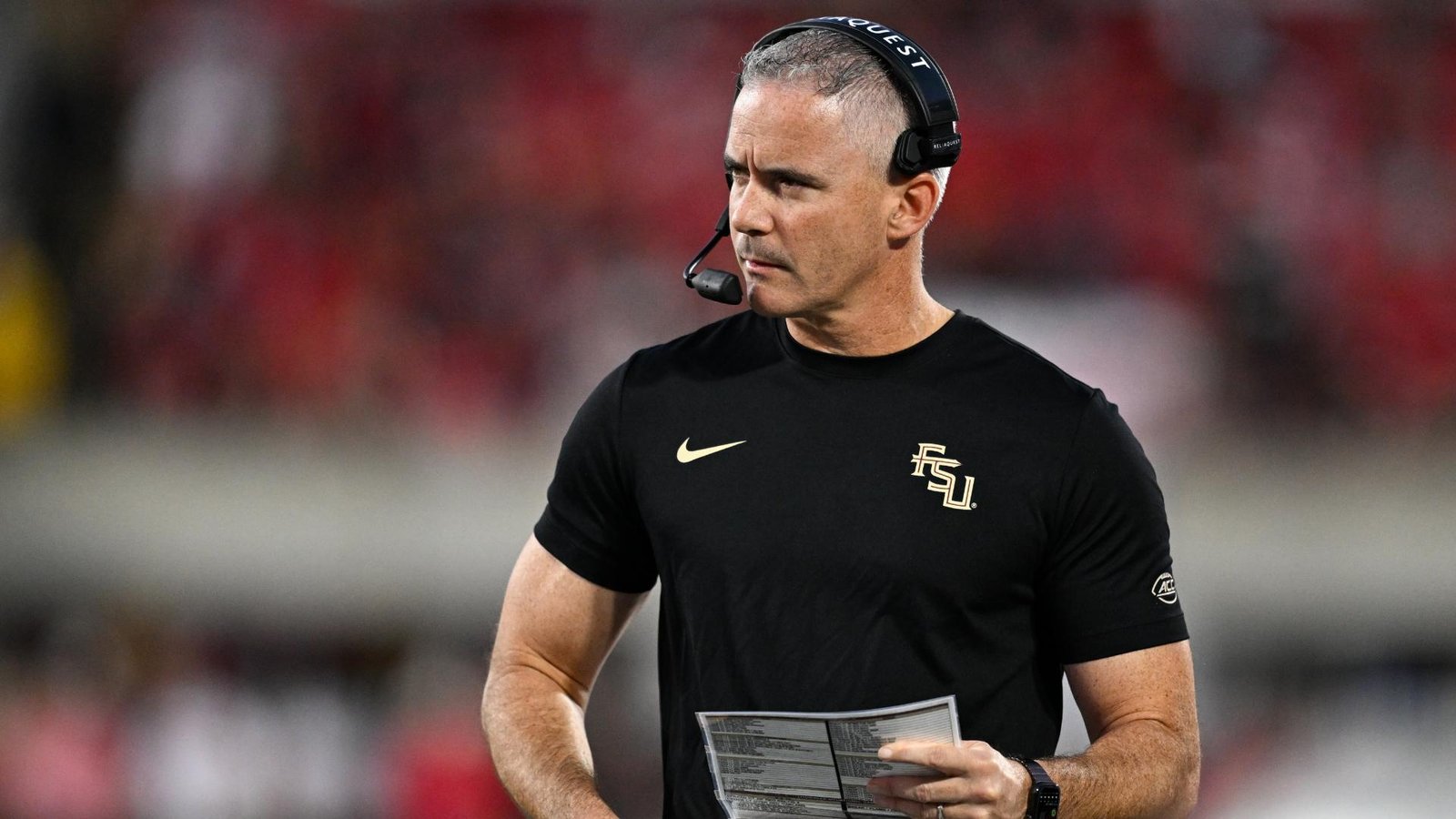
Florida State’s football programme is facing one of the most difficult periods in its modern history. After three consecutive losing seasons and a dramatic decline from ACC champions to the conference’s struggling side, the university has fired head coach Mike Norvell and begun confronting deeper problems involving leadership, recruiting, roster investment and internal coordination.
Florida State president Richard McCullough described the decision as a matter of the university’s future rather than simply a coaching change. Speaking about Norvell’s dismissal, he made the stakes clear:
“This is a big business decision. It’s the future, the fate of Florida State football.”
His comments reflect the wider consequences of the programme’s decline. A struggling football team can affect a university’s reputation, finances and ability to compete for a place in the changing college sports landscape. For Florida State, the situation is particularly serious because the Seminoles have been among the most vocal programmes seeking greater control over their conference future.
Once the ACC’s marquee football programme, Florida State now has the conference’s worst record since the beginning of 2024. Its struggles have also raised questions about whether another major conference would be interested in adding the Seminoles, even if an opportunity became available.
Florida State’s Fall Has Changed Its Position in College Football
Florida State’s decline is especially striking because of where the programme stood in 2023. Less than three weeks after winning the ACC championship, the university sued the conference over its grant of rights agreement and the $130 million withdrawal fee. The legal action was intended to challenge the existing arrangement and explore the programme’s potential conference options.
At the time, Florida State’s position as the ACC’s leading football programme gave university officials confidence to challenge the league’s structure. Although the dispute was eventually settled, the Seminoles continued looking for ways to influence their long-term position.
Florida State later joined Clemson, North Carolina and Miami in opposing Section 205 of the Protect College Sports Act. The provision would cap the number of teams in a Power 4 conference and require a programme to remain independent for three years before moving from one of the four major conferences to another.
However, the football team’s results have weakened the programme’s position. Since the start of 2024, Florida State has recorded a 4-17 record in ACC games, the worst conference stretch in school history over that period.
Conversations with 16 people familiar with the programme identified internal misalignment and dysfunction as major concerns within the football operation. One staff member described the working environment during Norvell’s increasingly difficult final period:
“Snakes in the grass, and no synergy.”
Several football and athletic department sources also identified the aftermath of Florida State’s exclusion from the College Football Playoff in 2023 as a turning point. According to those sources, the disappointment created a cloud over the programme that never fully disappeared.
Problems began accumulating across multiple areas, including transfer portal evaluations, high school recruiting, player development, football spending, quarterback recruitment, locker-room leadership, coaching appointments and injuries. Together, those issues contributed to three consecutive losing seasons and a collapse few people at the university expected after the 2023 ACC championship.
One source familiar with the football office compared Florida State’s decline with Indiana’s rise, describing the two programmes as examples of how quickly fortunes can change in college football.
Norvell’s Decision to Stay After the Alabama Interview
Florida State’s troubles began developing shortly after the programme’s successful 2023 campaign. In January 2024, Norvell interviewed for the Alabama head coaching position following Nick Saban’s departure.
Florida State officials became concerned that their coach could leave. According to the account, hours passed without Norvell communicating his decision. During that period, the university arranged a plane to bring potential replacement Lane Kiffin to Tallahassee for an interview.
Norvell ultimately chose to remain at Florida State because he believed the programme had a strong foundation and could build on its recent success. Despite the disappointment of missing the playoff, the 2023 season had demonstrated the team’s potential.
The playoff snub had already caused significant disruption. More than 20 players either opted out of the postseason or entered the transfer portal. Florida State consequently struggled against Georgia in the Capital One Orange Bowl, suffering a 63-3 defeat.
Norvell viewed that result as an isolated setback rather than evidence of a deeper problem. With the expanded 12-team College Football Playoff scheduled to begin in 2024, he believed a conference champion would have a much clearer route into the national championship competition.
The university responded by giving Norvell an eight-year contract worth more than $10 million annually. The agreement also included a buyout worth 85% of his remaining salary if he was fired. Florida State promised additional football resources, including a larger recruiting budget.
At that stage, both the coach and university leadership appeared confident about the programme’s future. The 2024 season, however, quickly changed that outlook.
The Quarterback Decision That Became a Major Setback
Replacing Jordan Travis was one of Norvell’s most important challenges heading into the 2024 season. Florida State explored several options in the transfer portal, including DJ Uiagalelei and Cam Ward, who both visited the programme.
Norvell preferred Ward, but the quarterback declared for the NFL draft on January 1, 2024. That left Florida State facing a difficult decision. Waiting for Ward to reconsider could have left the Seminoles without a proven transfer option, forcing Brock Glenn into the starting role.
Glenn had led Florida State’s offence to only 19 total points across the ACC championship game and the Orange Bowl. Several football staff sources also indicated that Ward’s asking price was approximately $1 million higher than Florida State’s offer.
Norvell therefore moved forward with Uiagalelei, believing he could help the former top-ranked quarterback recruit reach his potential. Whether Ward was genuinely available to Florida State remains unclear.
Miami continued pursuing Ward and eventually convinced him to withdraw from the 2024 NFL draft and join the Hurricanes. He later became the No. 1 overall pick in the 2025 NFL draft.
Uiagalelei’s Florida State career went in the opposite direction. He struggled during five starts, recording four touchdown passes and six interceptions before a finger injury ended his college career. The Seminoles used three quarterbacks during the season and, after dealing with a series of injuries, finished with a shocking 2-10 record.
The quarterback situation became one of the clearest examples of how Florida State’s transfer portal decisions failed to deliver the expected results.
Transfer Portal Strategy and NIL Spending Created More Problems
Norvell later acknowledged changing his transfer portal philosophy after the 2023 season. Previously, he had targeted players with proven production at smaller programmes. That approach helped Florida State build the team that won the ACC championship.
After the playoff disappointment, however, he increasingly pursued players from major programmes with whom he had established recruiting relationships. Many of those players had potential but lacked the consistent production Florida State needed.
The roster also reportedly developed problems away from the field. One source familiar with the football office described the locker room as:
“A bunch of guys who pocket watched.”
According to the source, some players became more concerned about their earnings than the interests of the team. The shift from a unified locker room to a group with competing priorities added to the programme’s difficulties.
Financial resources were another major issue. Florida State had been an early major spender in the name, image and likeness market in 2023, supported by one family that funded its collective for 18 months. That commitment ended after the season.
Multiple football and athletic department sources said the programme struggled to secure sufficient support from its collective and Seminole Boosters, the fundraising organisation connected to Florida State athletics. As the NIL market expanded, staff members believed the Seminoles were falling behind the most aggressive programmes.
Norvell discussed the financial challenges in an April interview with ESPN, explaining how the changing NIL environment affected recruiting.
“It was definitely a big factor. The NIL world really exploded at that moment. There are a lot of guys that we weren’t in the price range for. It was a struggle to get kids on campus. We made a choice to go after more potential. For what we needed in the moment, it was tough.”
There are different accounts of how much money Florida State made available to its football programme. Multiple football sources estimated that Norvell had $10 million to work with during the season, while university sources placed the total at $15 million for the calendar year.
Either figure represented a significant investment compared with much of Florida State’s opposition. Yet the Seminoles won only two games in 2024. One former staff member argued that the roster was capable of performing much better, suggesting an eight-win season would have been a reasonable expectation.
Miami’s Spending Increased the Gap
The financial competition became even more complicated after the House settlement allowed schools to distribute up to $20.5 million directly to athletes through revenue sharing.
Florida State responded by front-loading player contracts and spending approximately $25 million on its 2025 roster. The university also joined other public institutions in lobbying the state’s board of governors for temporary relief from rules requiring athletic programmes to remain self-sufficient.
The proposed relief allowed universities to use up to $22.5 million in auxiliary funds annually for athletics. However, rival Miami continued to invest aggressively in its football roster.
The Hurricanes reportedly spent around $35 million on their roster during the previous season. One source said high school recruits visiting Florida State would sometimes report receiving offers from Miami that were double or triple the Seminoles’ offers.
A source familiar with the football office argued that the programme’s problems could not be blamed entirely on Norvell, claiming that the coach had not always received the financial support required to compete with leading programmes.
Quarterback recruitment provided a particularly visible comparison. Miami brought in Ward, Carson Beck and Darian Mensah over three seasons, while Florida State signed Uiagalelei, Tommy Castellanos and Ashton Daniels.
One source familiar with Florida State’s football operation said Miami had been willing to pursue established quarterbacks from other programmes regardless of the financial cost. Florida State, by contrast, was described as operating within tighter limits and assembling a roster of players viewed as affordable options.
An agent also raised concerns about Florida State’s transfer recruitment. The agent said a defensive player he sent on an official visit in January received an offer more than $200,000 below what the player is earning at his new school.
The agent believed the offer was designed to save money and said communication with Florida State raised questions about who had authority within the front office. Football office sources responded that general manager John Garrett and his staff had only recently been hired and were still adjusting to their new roles.
The agent described the experience as confusing, saying it was not always clear who was speaking on behalf of the programme or making decisions about the financial offer.
A New Front Office Failed to Deliver an Immediate Turnaround
Florida State introduced a new-look front office after the 2025 season in an attempt to help Norvell rebuild the programme. The previous campaign had nearly cost him his job.
The Seminoles began the 2025 season with an encouraging 31-17 victory over Alabama. However, their performance declined once ACC competition began. The lowest point came in a 20-13 defeat at Stanford, a team that would finish the season with a 4-8 record.
The defeat was so damaging that university leaders and athletic director Michael Alford met to discuss whether Norvell should be dismissed immediately. McCullough still believed the coach could turn things around and decided to give him another season.
The administration estimated that replacing Norvell would cost approximately $170 million. That figure included the new coaching hire, Norvell’s buyout of more than $50 million, changes across the coaching staff and additional spending required to rebuild the roster.
Rather than immediately accepting those costs, Florida State increased its investment in the roster and strengthened its personnel department. Garrett, who had previously served as the programme’s director of scouting in 2022 and 2023, returned to help oversee the operation.
Those were also the two strongest seasons of Norvell’s tenure at Florida State. A source at another school said Garrett was surprised by how much the roster had deteriorated since his previous time with the Seminoles.
Recruiting and player development remained major concerns. Norvell had not secured a top-10 high school recruiting class, and the programme had struggled to develop its incoming players consistently.
Of the 13 Florida State players to earn first-team All-ACC honours since 2020, only one had signed with Norvell: punter Alex Mastromanno. Five of the six quarterbacks Norvell signed between 2020 and 2025 eventually transferred.
Roster Spending Raises Questions About the Programme’s Decisions
Florida State’s available roster budget for 2026 has become another point of disagreement. Football staff members placed the budget at approximately $24 million, while the university said the programme had received a total roster allocation of $31 million.
According to the university, that placed Florida State among the top 30 programmes nationally and among the top three in the ACC. However, it remained below the spending levels of leading national championship contenders, which were estimated to be in the range of $40 million to $50 million.
University sources nevertheless argued that a roster worth approximately $30 million should be capable of defeating ACC opponents spending significantly less.
They pointed to losses against Georgia Tech, Boston College, Stanford, Pittsburgh and NC State as results that should not have happened given the resources available. Florida State’s 17 ACC defeats since the beginning of 2024 included eight losses by a single score.
Three of those close defeats involved replay reviews, while another featured two unusual punts in which the ball took awkward bounces off helmets and contributed to the Seminoles losing the game.
The debate has created a difficult question for Florida State: was the programme simply unable to spend enough money to compete, or did it make poor decisions with the resources it already had?
One university source acknowledged that Florida State was not spending at the same level as Ohio State or Miami but insisted that the programme had invested heavily. The source also conceded that some decisions had not produced the expected results.
Fan Pressure Reaches a Breaking Point
Despite the concerns surrounding the roster and front office, university leadership initially remained hopeful that Norvell could restore the programme’s competitiveness. He was well-liked and respected by administrators, and at least one influential booster believed the coach had not lost his ability to lead a football team.
However, the losses continued to accumulate. Fan frustration became increasingly visible ahead of Florida State’s game against Clemson.
Before kickoff, a plane flew above Doak Campbell Stadium carrying a message demanding Norvell’s dismissal. The message read, with the coach’s surname misspelled, “FSU: FIRE NOVELL.”
Florida State then lost at home as a favourite. By the fourth quarter, the stadium was nearly empty as supporters left in frustration.
McCullough later described the Clemson defeat as a defining moment and the catalyst for his decision to fire Norvell. During a Sunday news conference, he explained why the university could no longer justify delaying the change.
“We’re at the point now like, ‘How can we afford not to do this?'”
The university also fired Alford in September and plans to conduct its coaching and athletic director searches simultaneously. Multiple sources within the institution said Florida State intends to invest whatever is necessary to improve the football programme’s position.
Florida State Begins Rebuilding Its Football Structure
McCullough has previously indicated that the university needs a broader internal restructuring of its athletic department. The objective is to improve coordination between the football programme, university leadership, the board and Seminole Boosters.
An early sign of that effort emerged on Tuesday night, when Seminole Boosters announced a partnership with The Battle’s End, Florida State’s collective.
Ingram Smith, chief executive of The Battle’s End, described the work ahead as a major challenge requiring a shared direction and commitment from everyone connected to the programme.
“The Battle’s End and Seminole Boosters have joined forces in a coordinated effort to build the future of Florida State football. Together, we are immediately beginning the work of assembling a competitive roster, with The Battle’s End leading NIL efforts as part of a shared commitment to restoring sustained success at Florida State.”
The partnership is intended to bring the collective and fundraising organisation together around a more coordinated approach to roster construction and NIL efforts.
Interim coach Rick Stockstill also emphasised the importance of cooperation during his Monday news conference. He said he believed Florida State was close to making progress but stressed that everyone involved needed to work towards the same objective.
“I really truly believe Florida State is close. But it’s going to take everybody pulling the rope in the same direction.”
The Next Leadership Team Faces a Major Challenge
Florida State’s next head coach and athletic director will inherit a programme with significant expectations and several problems to address. The Seminoles need to improve their recruiting, strengthen transfer portal evaluations, develop players more effectively and create a more unified football operation.
The university also needs to establish a sustainable financial structure that allows the programme to compete in an increasingly expensive college football environment. Simply spending more may not be enough if the money is not directed towards the right players and programme priorities.
Despite the team’s struggles, Florida State remains a major national football brand. Through Week 8, the Seminoles led the ACC with 19.92 million total viewers in Nielsen-rated games.
That audience demonstrates that interest in Florida State football has not disappeared. Supporters and television viewers continue to follow the programme, even as its results have deteriorated.
The challenge now is to make the team competitive enough to match the reputation of its brand. After years of internal disagreements, disappointing recruitment decisions and losses on the field, the university’s next leadership group will be under enormous pressure to deliver a clear direction and restore Florida State’s standing in the ACC.
Max Olson contributed to this report.
For breaking news and live news updates, like us on Facebook or follow us on Twitter and Instagram. Read more on Latest Sports on thefoxdaily.com.



COMMENTS 0