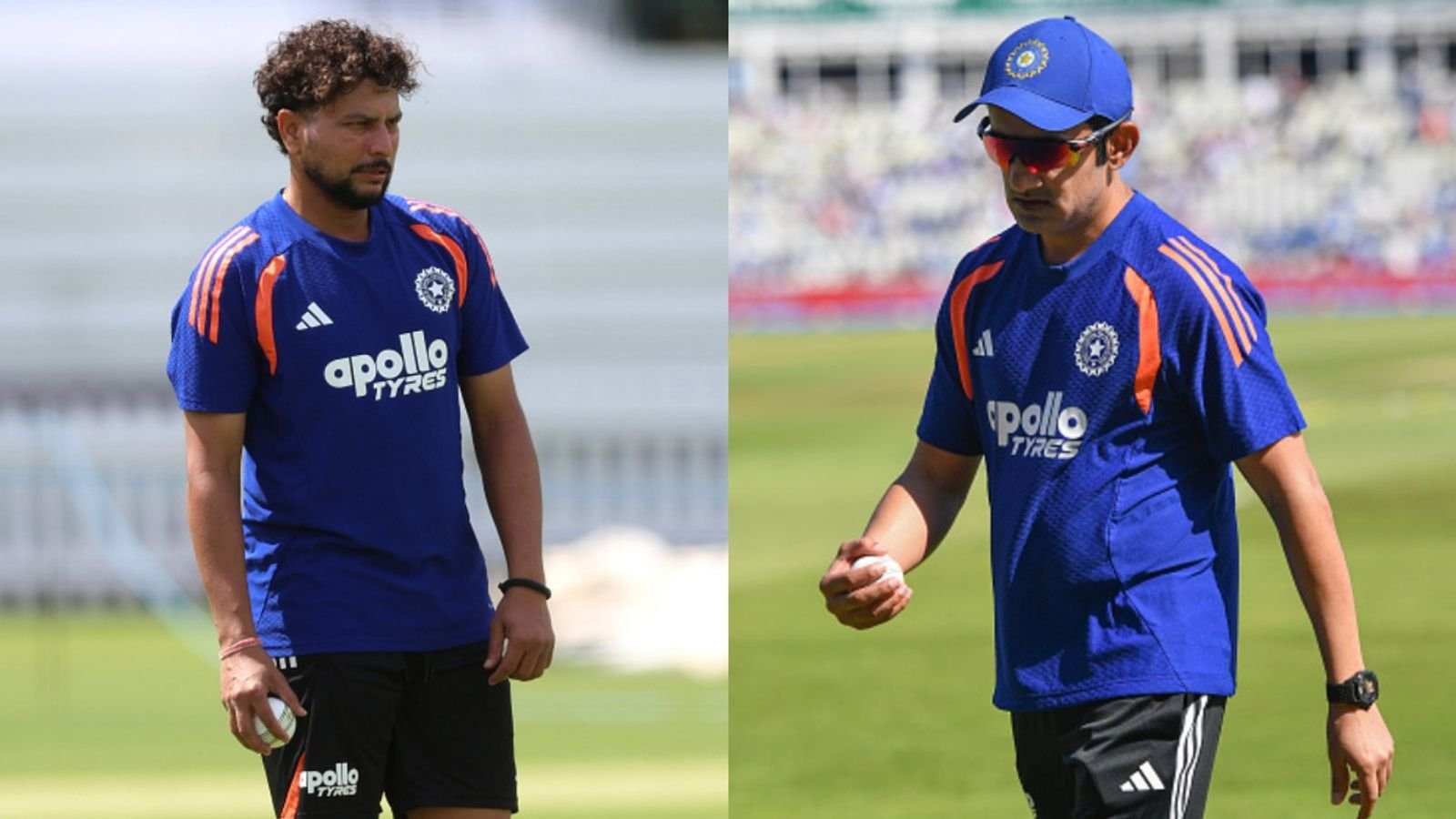
Gautam Gambhir has offered a clear message to Kuldeep Yadav ahead of the second IND vs SL Test, asking the left-arm wrist-spinner to remain patient and concentrate on executing his bowling instead of becoming desperate for wickets.
India will enter the second Test in Colombo on August 23 with confidence after their comprehensive 165-run victory over Sri Lanka in Galle. However, Kuldeep’s quiet outing in the series opener has created one of the major selection and tactical talking points ahead of the final match.
Kuldeep managed only one wicket from 25 overs in Galle, while Ravindra Jadeja and Manav Suthar enjoyed greater success with their finger spin. Gambhir, however, has publicly backed Kuldeep and suggested that the spinner should focus on the quality of his bowling rather than allowing the lack of wickets to affect his approach.
What did Gautam Gambhir say to Kuldeep Yadav?
Gambhir’s message to Kuldeep was simple: do not become obsessed with taking wickets.
“Bowl your best spell, don’t be desperate for wickets,” Gambhir said at the pre-match press conference.
The advice is particularly relevant for a wrist-spinner. Kuldeep’s biggest strength comes from his ability to create uncertainty through variations in trajectory, turn and angle. If he begins searching too aggressively for wickets, he can potentially move away from the discipline required to build pressure.
For a bowler who relies heavily on deception, patience is often as important as variation. Gambhir’s comments therefore appear to be aimed at keeping Kuldeep mentally relaxed rather than allowing his first-Test figures to dictate his confidence.
Why Kuldeep Yadav struggled in the first Test
Kuldeep’s one-wicket return in Galle does not necessarily tell the full story of his performance. The spinner bowled 25 overs but was not able to produce the same level of impact expected from him.
One major factor was the success of India’s other spinners. Ravindra Jadeja and Manav Suthar repeatedly made breakthroughs, meaning Kuldeep did not receive the same opportunity to bowl long, uninterrupted spells.
When a wrist-spinner is brought into an attack after other bowlers have already created pressure, the rhythm of the spell can be different. Instead of being allowed to attack a settled batter over a long period, the bowler may have to operate in shorter bursts.
That can make it harder to build pressure and establish the consistency of line and length required to bring a batter into a mistake.
Why Gambhir is still backing Kuldeep
India’s management has little reason to judge Kuldeep solely on one quiet performance. His international experience and ability to provide a different type of threat remain valuable assets.
Unlike conventional finger-spin, Kuldeep’s wrist-spin creates a different angle of attack. His variations can make him particularly dangerous when the pitch offers assistance to slow bowlers or when batters are forced to play against the turn.
That variation can become strategically important over the course of a Test match. A team does not necessarily need every bowler to take the same number of wickets. What matters is whether the bowling combination can create enough pressure and eventually claim all 20 opposition wickets.
Gambhir’s 20-wicket philosophy could decide India’s XI
Gambhir made it clear that selection will be based on the bowling combination India believes can take all 20 Sri Lankan wickets.
“We will try to field the best bowling attack that can get us 20 wickets,” Gambhir said.
This statement provides an important clue about India’s selection approach. The team is not necessarily committed to keeping the same XI simply because it won the first Test.
Instead, the management appears prepared to assess the conditions in Colombo and select the combination that gives India the best chance of winning the match.
That could work in Kuldeep’s favour if the pitch is expected to provide the type of assistance where a wrist-spinner can become a major weapon. At the same time, it leaves the door open for another option if the management believes a different bowling combination is better suited to the conditions.
Kuldeep Yadav vs Saransh Jain: India’s selection dilemma
The biggest question surrounding India’s bowling attack is whether Kuldeep retains his place or Saransh Jain receives an opportunity in the second Test.
Saransh is an experienced domestic performer and has reportedly taken 188 First-Class wickets for Madhya Pradesh. His presence gives India a credible alternative if the management decides that the conditions or tactical requirements favour another off-spinner.
The selection battle is therefore not necessarily about whether Kuldeep is a good enough bowler. It is about which type of spinner India believes will be most effective in Colombo.
| Factor | Kuldeep Yadav | Saransh Jain |
|---|---|---|
| Bowling style | Left-arm wrist-spin | Off-spin |
| International experience | Extensive | Less international experience |
| First-Test contribution | One wicket | Did not play |
| Domestic record highlighted | International track record | 188 First-Class wickets for Madhya Pradesh |
| Main selection argument | Variation and international pedigree | Domestic consistency and tactical option |
Kuldeep’s experience gives him a strong case for retention, but Saransh’s domestic record means the selection decision cannot be dismissed as a straightforward choice between an established player and an untested replacement.
Practice sessions add another layer to the Kuldeep debate
India’s training sessions in Colombo have added intrigue to the selection discussion.
Kuldeep was present during both recent net sessions but reportedly did not bowl. Saransh, meanwhile, was seen putting in significant work with the ball.
Those observations can generate speculation, but they do not automatically confirm the final playing XI. Teams often manage workloads during practice and may use different bowlers for different tactical preparations.
The final decision is expected to become clear when captain Shubman Gill announces India’s XI on August 23.
Why Kuldeep should not chase wickets
Gambhir’s advice has a strong tactical basis. Spin bowling in Test cricket is often about creating pressure over time rather than attempting to produce a wicket with every delivery.
A bowler who consistently lands the ball in the right areas can force batters to manufacture scoring opportunities. That pressure can eventually produce a mistake without the bowler needing to constantly change his approach.
For Kuldeep, this is particularly important because his variations are most effective when batters are uncertain about what is coming next. If he maintains a consistent line and changes his trajectory and spin intelligently, he can make batters play more often.
The danger of becoming desperate for wickets is that a bowler can start searching for spectacular deliveries rather than building a sustained spell.
Gambhir’s instruction therefore appears to be about process over outcome: bowl well first, and allow the wickets to follow.
Ravindra Jadeja and Manav Suthar have increased the pressure
Kuldeep’s situation has become more complicated because India’s other spinners performed strongly in Galle.
Ravindra Jadeja’s experience makes him one of the most dependable options in India’s attack, while Manav Suthar’s performance gives the team another left-arm spin option.
When two other spinners are already producing wickets, the management has greater flexibility. Kuldeep is no longer automatically required simply because India wants three spinners in the XI.
At the same time, that competition could also make his presence more valuable. If Jadeja and Suthar provide control, Kuldeep can potentially be used as the attacking wrist-spinner whose primary objective is to break partnerships.
What could Kuldeep do differently in Colombo?
Kuldeep’s most effective response would likely be to trust his natural strengths rather than attempt to force a dramatic turnaround.
He does not need to take a wicket with every over. Instead, he can focus on maintaining a consistent length, varying his pace when required and making batters commit to shots.
If he manages to build pressure for an extended period, the opportunities could arrive naturally. A wicketless spell can still have value if it restricts scoring and forces batters to take risks against other bowlers.
That is one of the most important differences between judging a Test spinner purely through wicket numbers and evaluating their broader contribution to the bowling attack.
Why the Colombo conditions could be crucial
The conditions in Colombo will play a major role in India’s selection decision. Spin is expected to remain an important part of the contest, but the exact behaviour of the surface will influence whether India prefers an additional wrist-spinner or another finger-spinner.
If the pitch offers enough assistance for wrist-spin, Kuldeep’s ability to turn the ball sharply and change the trajectory could make him a major threat.
If India believes control and consistency are more important, the management could prefer another bowler who fits that specific requirement.
This explains why Gambhir emphasized the idea of selecting the best attack rather than automatically repeating the winning XI.
Shubman Gill’s role in the bowling strategy
Captain Shubman Gill’s decisions will also be important. According to Gambhir, Gill’s bowling rotations in Galle were influenced by the early success of Jadeja and Suthar.
Because the finger-spinners were consistently producing breakthroughs, Kuldeep received comparatively limited opportunities to settle into extended spells.
That situation highlights an interesting tactical problem. A captain must use the bowlers who are producing results, but an underused bowler can struggle to establish rhythm if repeatedly brought on for short periods.
Gill will therefore need to balance immediate success with giving each bowler enough opportunity to influence the game.
What India’s second Test selection means for Kuldeep
If Kuldeep retains his place, it would represent a clear sign of trust from the management. It would also give him an opportunity to respond directly to his quiet first Test.
If he is left out for Saransh, it would not necessarily mean that India has lost faith in him. Instead, it could reflect a tactical decision based on conditions and the balance of the bowling attack.
Either way, Kuldeep’s response will be closely watched because wrist-spinners can be match-winners when conditions and rhythm align.
India’s bigger objective remains a series victory
The Kuldeep debate should ultimately be viewed within India’s larger objective. After winning the Galle Test by 165 runs, India has put itself in a strong position in the two-match series.
The second Test gives the team an opportunity to complete a series victory and continue its push in the World Test Championship campaign.
That means Gambhir and Gill are unlikely to make selection decisions based purely on individual reputation. The priority will be finding a bowling attack capable of taking 20 wickets while supporting the team’s broader match strategy.
Conclusion: Gambhir gives Kuldeep Yadav a clear message
Gautam Gambhir’s advice to Kuldeep Yadav ahead of the second IND vs SL Test is straightforward: focus on bowling well rather than becoming desperate for wickets.
Kuldeep’s one-wicket return from 25 overs in Galle was below expectations, but the circumstances of the match also limited his opportunity to establish a long rhythm. Jadeja and Suthar were highly effective, leaving the wrist-spinner with a smaller role.
Now, with Saransh Jain also in contention, Kuldeep faces genuine competition for his place in the Colombo XI. His international experience and unique wrist-spin variation give him a strong case, but India’s management has made it clear that conditions and the ability to take 20 wickets will determine selection.
The final decision will come when India announces its playing XI on August 23. For Kuldeep, the best response to the pressure may be exactly what Gambhir has advised: trust the bowling, stay patient and let the wickets come rather than chasing them.
For breaking news and live news updates, like us on Facebook or follow us on Twitter and Instagram. Read more on Latest Cricket on thefoxdaily.com.






COMMENTS 0