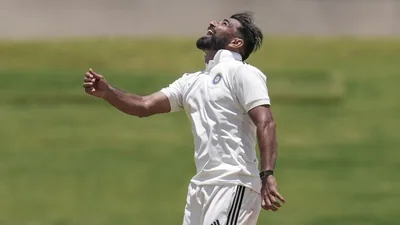
Mohammed Shami remains at the centre of an increasingly important selection debate after former India bowling coach Bharat Arun questioned the decision to keep the experienced fast bowler away from the national team.
Shami has not represented India since the Champions Trophy last year, yet his continued performances in domestic cricket have kept the possibility of an international comeback alive. Arun believes the door should not have been closed on a bowler whose experience, durability and red-ball record remain significant assets.
The debate also comes at a time when Indian Cricket is balancing two competing priorities: developing younger fast bowlers for the future while making the most of experienced players who can still perform at the highest level.
Why Mohammed Shami’s Selection Has Become a Talking Point
For several months, Shami’s absence from India’s plans has attracted attention. The 36-year-old pacer has remained active in domestic cricket and has continued to demonstrate his ability to operate effectively with the red ball.
His last appearance for India came during the Champions Trophy, after which he moved further away from the national setup. Despite his domestic performances, the selectors have preferred younger pace options, even during periods when Jasprit Bumrah has been unavailable.
That approach has naturally raised a larger question: should a proven international bowler be judged primarily on age and recent national-team availability, or should consistent domestic performances keep him in contention?
Bharat Arun strongly favours the second approach. His argument is that performance should remain the central consideration when deciding whether an experienced player deserves another opportunity.
Bharat Arun Defends Shami’s International Credentials
Arun believes Shami has been treated unfairly and argues that his international career should not be considered finished simply because he is 36.
The former bowling coach pointed to Shami’s extensive first-class career and his ability to continue performing despite the demands placed on a fast bowler. For Arun, experience becomes particularly valuable when it is combined with fitness, skill and competitive motivation.
One of the strongest arguments in Shami’s favour is his understanding of conditions. Over the years, he has developed the ability to use seam movement, changes of pace and accuracy to create pressure on batters.
That knowledge cannot be developed overnight. Younger fast bowlers can offer energy and long-term potential, but an experienced bowler can bring tactical awareness that becomes especially useful during difficult spells.
Arun’s position therefore goes beyond simply supporting an individual player. It raises the broader issue of how selectors should balance potential against proven performance.
The Previous Disagreement Between Shami and Ajit Agarkar
The relationship between Shami and the current selection setup has also attracted attention because of a public disagreement last year.
When Shami was not selected for India’s Test assignments against the West Indies, chief selector Ajit Agarkar raised questions regarding the fast bowler’s fitness.
Shami subsequently rejected concerns about his ability to play competitive cricket, pointing towards his participation in the Ranji Trophy for Bengal as evidence that he remained capable of bowling in first-class conditions.
The exchange added another layer to the selection story. While disagreements between players and selectors are not unusual in professional sport, public comments can make future selection decisions appear more significant.
However, the central issue today is not the disagreement itself. It is whether Shami’s current performances warrant another opportunity to prove himself at international level.
Shami’s Domestic Cricket Performances Keep the Door Open
Shami’s continued involvement in domestic cricket has prevented the comeback conversation from disappearing completely.
He is set to feature for East Zone in the Duleep Trophy final, giving him another important red-ball match in which to demonstrate his fitness, rhythm and effectiveness.
Domestic cricket can provide valuable evidence for selectors because it places experienced players under competitive pressure rather than relying only on training performances.
For a fast bowler, repeated spells in first-class cricket can also reveal whether he can maintain intensity over longer periods. That is particularly relevant for Test cricket, where fast bowlers need to recover between spells and remain effective across multiple days.
Shami’s opportunity in the Duleep Trophy final therefore carries significance beyond the result. His performance can become another data point in the ongoing discussion surrounding his international future.
Ishan Kishan Sees Strong Motivation in Shami
East Zone captain Ishan Kishan has also provided an encouraging assessment of Shami’s current mindset.
Kishan observed that Shami has been actively asking for additional overs when searching for wickets. That level of involvement suggests the pacer remains highly competitive and willing to take responsibility during important domestic matches.
More importantly, Kishan believes Shami’s intensity has stood out this season. The captain has seen the fast bowler maintain strong motivation despite not being a regular member of the Indian team.
That hunger could become one of the most important factors in the comeback debate. A player trying to return to international cricket must be prepared to perform consistently rather than depend only on past achievements.
According to Kishan’s assessment, Shami appears to have that motivation. His performances in domestic cricket are being driven by the desire to regain a place in the Indian squad.
Experience Versus Youth: India’s Pace Bowling Dilemma
The Shami debate reflects a wider challenge facing Indian cricket.
India has invested heavily in developing younger fast bowlers. The long-term objective is understandable: international cricket requires a deep pool of pace options capable of handling different conditions and workloads.
At the same time, experience cannot simply be replaced by age-based succession. Fast bowling is an area where tactical maturity can have enormous value.
| Factor | Mohammed Shami | Younger Pace Options |
|---|---|---|
| International experience | Extensive | Developing |
| Understanding of conditions | Highly developed | Still developing |
| Long-term availability | Shorter career window | Greater potential window |
| Immediate impact | Potentially significant | Depends on experience level |
| Leadership value | Strong through experience | Developing |
The ideal solution may not necessarily be choosing experience or youth exclusively. A balanced attack can sometimes benefit from both, particularly when experienced bowlers can guide players who are still establishing themselves internationally.
Why Age Alone May Not Tell the Full Story
Fast bowlers are often evaluated differently from batters because of the physical demands associated with pace bowling. Age can influence workload management, recovery and injury risk, but it does not automatically determine effectiveness.
That is the foundation of Arun’s argument. If an experienced bowler remains capable of performing consistently, age by itself should not end the discussion.
The more useful questions are whether the player is fit enough, whether his current bowling remains effective, and whether his skills fit the team’s requirements.
For Shami, domestic performances provide selectors with an opportunity to assess those factors directly.
Shami’s Value in Red-Ball Cricket
Shami’s strongest case arguably remains his record and expertise in longer-format cricket.
Test and first-class cricket demand a particular type of fast bowling. A bowler must be able to build pressure over extended periods, attack different areas of the pitch and adapt when conditions change.
Shami’s extensive first-class experience gives him a strong understanding of that process. His milestone of 100 first-class matches also highlights the longevity of his career in red-ball cricket.
For a team preparing for demanding Test assignments, such experience can be valuable both on the field and within the dressing room.
What Shami Must Show to Force a Return
Although Arun and Kishan have expressed confidence in Shami, selection ultimately depends on the current team-management strategy and the player’s performances.
The most convincing route back would be sustained domestic form combined with evidence that he can handle the physical demands of international cricket.
One strong performance may attract attention, but a consistent run of effective spells would provide a much stronger argument.
Selectors will also need to consider how Shami fits alongside India’s existing fast-bowling options. Team balance, workload management and the requirements of specific conditions are all likely to influence any future decision.
Could Shami Still Return to India’s Test Team?
The possibility of a comeback cannot be completely dismissed while Shami continues to perform and remains motivated to represent India.
His case is particularly interesting because he does not need to establish whether he can play international cricket for the first time. He has already spent years competing at the highest level.
The question is whether his present version remains good enough for the team’s current requirements.
That makes the Duleep Trophy final an important stage in the story. A strong performance would not guarantee selection, but it could strengthen the argument that Shami deserves serious consideration.
What This Means for Ajit Agarkar and the Selectors
Ajit Agarkar and the selection committee face a difficult balancing act. Indian cricket cannot depend indefinitely on senior players, but it also cannot ignore experienced performers without carefully assessing what they can still offer.
Selection policies need to look beyond reputation as well as beyond age. A former international star should not receive an automatic place, but neither should a player be ruled out solely because he has crossed a particular age.
Shami’s situation provides a useful test of that philosophy.
If the selectors believe younger bowlers offer a better combination of fitness, form and future potential, their decision will be understandable. If Shami continues producing compelling domestic performances, however, the pressure to reconsider him will naturally increase.
The Bigger Picture for Indian Cricket
The debate surrounding Shami represents more than one player’s comeback attempt. It reflects the changing structure of India’s fast-bowling group.
India now has greater depth in pace bowling than it did in many previous eras. That gives selectors more options, but it also makes competition for places tougher.
For established players, reputation alone is no longer enough. For younger players, potential alone may also not be enough. The strongest claims will come from performances, fitness and suitability to the team’s immediate needs.
Shami’s domestic campaign demonstrates that experienced players can still keep themselves relevant by performing rather than simply waiting for selection.
Conclusion: Mohammed Shami’s Comeback Case Is Still Alive
The debate over Mohammed Shami and his India future is unlikely to disappear quickly. Bharat Arun has made it clear that he believes the fast bowler still has plenty to offer, while Ishan Kishan’s observations suggest that Shami remains highly motivated to return to international cricket.
The selectors, led by Ajit Agarkar, must ultimately decide whether Shami’s current performances and physical readiness justify another opportunity.
For now, the Duleep Trophy final provides Shami with another competitive platform to make his case. A strong showing would not automatically reopen the India door, but it could make the argument for his return considerably harder to ignore.
The bigger lesson is equally important: in elite sport, age can influence selection, but sustained performance remains one of the strongest arguments a player can make.
For breaking news and live news updates, like us on Facebook or follow us on Twitter and Instagram. Read more on Latest Cricket on thefoxdaily.com.






COMMENTS 0