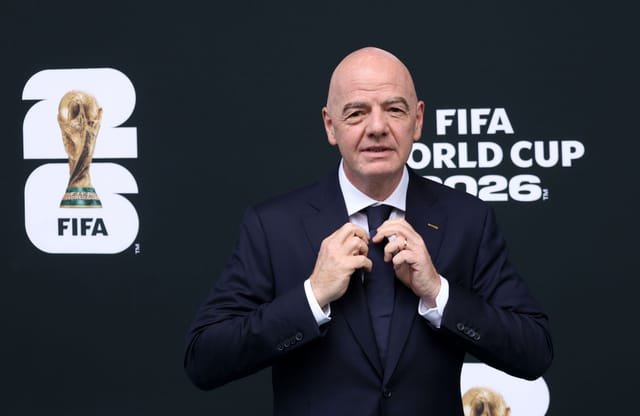
The 2026 FIFA World Cup was designed to celebrate growth, inclusion, and the global expansion of football. Yet, before the tournament has fully settled into its rhythm, one of the biggest talking points has nothing to do with matches on the pitch.
Instead, attention has turned toward FIFA President Gianni Infantino and a humorous comment about Italy’s absence from the competition. While addressing the expansion of the World Cup, Infantino joked that FIFA might eventually need to increase the tournament to 208 teams to ensure Italy qualifies.
The remark generated laughter in some circles but also triggered criticism from Italian football figures and politicians who viewed the comment as inappropriate given the country’s historic struggles in recent years.
Beyond the controversy, the incident highlights a far deeper issue: one of football’s most successful nations is facing a crisis that continues to raise difficult questions about its future.
What Did Gianni Infantino Say?
While discussing FIFA’s decision to expand the World Cup from 32 teams to 48 teams, Infantino joked that even larger expansions might be necessary if Italy hopes to return to the sport’s biggest stage.
The comment was intended as a playful observation about Italy’s recent qualification failures. However, because it came from football’s most powerful administrator, it attracted significant attention.
For many fans, the statement reflected the surprising reality that a nation with four World Cup titles is once again absent from the tournament.
Why the Joke Resonated Across Football
Humor often works best when it contains a degree of truth.
Italy’s absence from the 2026 FIFA World Cup is shocking not because qualification is guaranteed for elite nations, but because it represents a continuing pattern rather than an isolated failure.
The Azzurri have now missed three consecutive FIFA World Cups, a scenario that would have seemed unimaginable just over a decade ago.
For a nation that once set the standard for international football excellence, the decline has become impossible to ignore.
Italy’s FIFA World Cup Journey: From Champions to Spectators
| World Cup Edition | Italy’s Result |
|---|---|
| 2006 | Champions |
| 2010 | Group Stage Exit |
| 2014 | Group Stage Exit |
| 2018 | Did Not Qualify |
| 2022 | Did Not Qualify |
| 2026 | Did Not Qualify |
The contrast is remarkable. Twenty years ago, Italy was lifting football’s most prestigious trophy. Today, it finds itself watching the tournament from home once again.
How Italy Failed to Reach FIFA World Cup 2026
Italy entered qualification with expectations of securing a place at the expanded tournament.
Despite the increase to 48 teams, qualification remained elusive.
After finishing behind Norway in their qualifying group, the Azzurri were forced into the playoffs. Their hopes ultimately ended in heartbreak following a penalty shootout defeat against Bosnia and Herzegovina after a fiercely contested final.
The result triggered widespread disappointment throughout Italian football and intensified scrutiny on the federation’s long-term strategy.
The Fallout: Major Changes Across Italian Football
The qualification failure produced immediate consequences.
Several key figures departed their positions as pressure mounted throughout the national football structure.
| Position | Status After Qualification Failure |
|---|---|
| Head Coach Gennaro Gattuso | Departed |
| Delegation Chief Gianluigi Buffon | Departed |
| FIGC President Gabriele Gravina | Departed |
Such sweeping changes demonstrate the seriousness with which Italy views its ongoing World Cup struggles.
For a nation that measures success through international achievements, missing three consecutive tournaments represents a crisis rather than merely a disappointing result.
Political Backlash Against Infantino’s Comments
Not everyone appreciated the FIFA president’s attempt at humor.
Several Italian voices argued that the situation deserved respect rather than jokes.
Critics pointed out that FIFA’s president occupies a position requiring neutrality and professionalism, particularly when discussing member nations experiencing difficult periods.
The backlash illustrates how emotionally charged the issue has become within Italy.
For supporters, journalists, and officials alike, the country’s football decline remains a source of national frustration.
Why Italy’s Decline Is One of Football’s Biggest Mysteries
Unlike smaller football nations, Italy possesses every resource necessary for success.
The country boasts:
- A rich footballing tradition.
- World-class domestic clubs.
- Elite coaching expertise.
- Strong youth infrastructure.
- Passionate fan support.
- Extensive football investment.
Given those advantages, repeated qualification failures raise legitimate questions about deeper structural problems.
The issue extends beyond talent. It concerns player development, tactical evolution, administration, and long-term planning.
The Expansion of the World Cup Makes the Failure Even More Significant
One reason the 2026 disappointment has generated such intense discussion is the tournament’s expanded format.
For the first time, 48 nations are competing in the World Cup.
The increase was intended to create opportunities for more countries to participate while enhancing football’s global reach.
Many analysts believed the expansion would virtually guarantee qualification for traditional powers like Italy.
That assumption proved incorrect.
The inability to secure one of the additional places has amplified concerns about the current state of Italian football.
What Gennaro Gattuso Said After the Defeat
Following the playoff loss, then-head coach Gennaro Gattuso expressed both disappointment and pride.
He acknowledged the pain of missing the tournament while praising the commitment shown by his players throughout the qualification campaign.
His comments reflected the emotional impact of the result on everyone involved.
For players, coaches, and supporters, the dream of returning to the World Cup had once again slipped away.
Comparing Italy’s Situation to Other Former World Champions
| Nation | World Cup Titles | Recent Status |
|---|---|---|
| Brazil | 5 | Regular Contender |
| Germany | 4 | Qualified for 2026 |
| Italy | 4 | Failed to Qualify |
| Argentina | 3 | Defending Champions |
| France | 2 | Title Contender |
The comparison highlights how unusual Italy’s situation has become among football’s elite nations.
While other former champions continue competing regularly at the highest level, Italy remains trapped in a cycle of underachievement.
A Unique Angle: Is Italy Paying the Price for Football’s Evolution?
One factor often overlooked is how dramatically international football has changed over the past decade.
Smaller nations have improved significantly thanks to better coaching, advanced analytics, enhanced scouting networks, and increased investment.
The gap between traditional powers and emerging football nations has narrowed considerably.
Italy’s struggles may not solely reflect internal decline. They may also reflect the reality that global football is more competitive than ever before.
Success now requires constant innovation rather than reliance on historical prestige.
Can Italy Recover Before the Next World Cup?
Despite current frustrations, writing off Italy would be a mistake.
Football history is filled with examples of major nations recovering from difficult periods.
The country’s youth academies continue producing talented players, while Serie A remains one of Europe’s strongest leagues.
The key challenge lies in transforming individual talent into a coherent national-team project capable of competing consistently on the international stage.
Leadership appointments over the next few years could prove decisive.
Prediction: Italy’s Absence Could Become the Catalyst for Reform
Major failures often create opportunities for meaningful change.
Missing a third consecutive World Cup may ultimately force Italian football to address longstanding issues more aggressively than ever before.
Comprehensive reforms involving youth development, coaching education, talent identification, and federation governance could emerge as a direct consequence of this disappointment.
If implemented effectively, those changes may eventually position Italy for a strong comeback.
Conclusion
Gianni Infantino’s joke about expanding the FIFA World Cup to help Italy qualify generated headlines, controversy, and debate. While some viewed the remark as harmless humor, others considered it an unnecessary dig at a nation already enduring one of the most difficult periods in its football history.
Yet the larger story extends far beyond a single comment. Italy’s failure to qualify for FIFA World Cup 2026 represents a defining moment for one of the sport’s most decorated countries.
The challenge now is not responding to jokes or criticism. The challenge is rebuilding a footballing powerhouse capable of returning to the global stage where many believe it still belongs.
Until that happens, every World Cup without Italy will continue to raise the same uncomfortable question: how did one of football’s greatest nations fall so far behind?
For breaking news and live news updates, like us on Facebook or follow us on Twitter and Instagram. Read more on Latest Sports on thefoxdaily.com.





COMMENTS 0