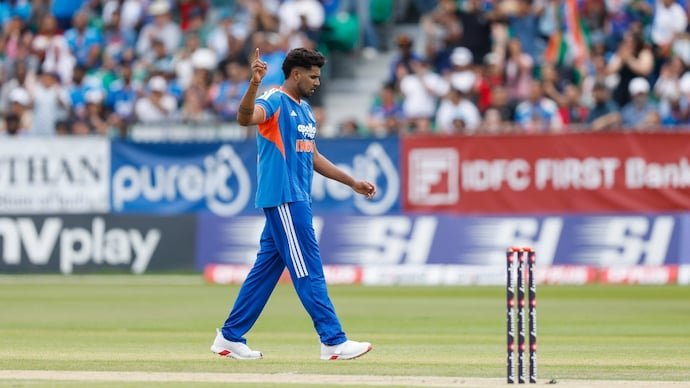
Harshit Rana’s comeback story in the India vs Ireland 1st T20I is a classic tale of resilience, redemption, and raw fast-bowling impact. Despite India suffering a surprise defeat in Belfast, the young pacer’s performance stood out as a defining moment of the match.
After months on the sidelines due to a knee injury that ruled him out of the T20 World Cup and IPL 2026, Harshit returned to international cricket with pace, aggression, and control—qualities that immediately tilted the early momentum in India’s favour.
A Comeback Written Through Pain and Patience
Harshit Rana’s journey back to the Indian team has not been easy. A serious knee injury during a T20 World Cup warm-up match against South Africa disrupted his rapid rise in Indian cricket.
What followed was surgery, long rehabilitation, and the mental challenge of watching major tournaments from the sidelines.
For a fast bowler, such setbacks can be career-defining. But Harshit’s return in Belfast showed that he has not only recovered physically but also grown stronger mentally.
Match Impact: 3/24 That Changed the Game Early
In his first spell of the match, Harshit Rana immediately justified his selection. His opening burst reduced Ireland to 36/3 inside the powerplay, putting India in complete control early on.
He combined sharp bounce with disciplined seam movement, forcing mistakes from the Irish top order.
Harshit Rana’s key wickets:
- Ross Adair – caught off a mistimed pull shot
- Tim Tector – dismissed via extra bounce at mid-off
- Lorcan Tucker – key death-over wicket after a well-made 50
Each wicket came at crucial stages, ensuring Ireland could not build uninterrupted partnerships during their innings.
Bowling Breakdown: What Made Harshit Rana So Effective
Harshit’s success in Belfast was not accidental. It came from a combination of pace variation, smart lengths, and consistent pressure-building deliveries.
He repeatedly tested both edges of the bat, especially against set batters like Lorcan Tucker and Benjamin Calitz.
His ability to extract awkward bounce on a slow Belfast pitch made him the most threatening bowler on either side.
Key bowling strengths on display:
- Hard length hitting with controlled aggression
- Use of slower deliveries at the right moments
- Ability to generate bounce even on flat surfaces
- Early powerplay breakthroughs
Powerplay Domination: India’s Best Phase in the Match
The most impactful phase of Harshit Rana’s spell came in the powerplay, where he dismantled Ireland’s top order and gave India a strong platform.
At one stage, Ireland were reeling at 36/3, with India seemingly in control of the match.
However, cricket’s unpredictable nature meant that even a brilliant spell could not guarantee victory when the team effort fell short.
Support Bowling Struggles Undermine Harshit’s Efforts
While Harshit Rana impressed, the rest of India’s bowling unit struggled to maintain the same intensity.
Once Ireland recovered through Gareth Delany’s counterattack, India’s grip on the match loosened significantly.
Supporting bowling concerns:
- Prasidh Krishna conceded 57 runs in 4 overs without a wicket
- Washington Sundar leaked 19 runs in a single over
- Axar Patel struggled early before taking late wickets
This imbalance meant Harshit’s early breakthroughs were not fully capitalized on.
Batting Collapse Overshadows Bowling Brilliance
India’s chase of 183 never gained momentum, with the team bowled out for 148. Despite Abhishek Sharma’s explosive knock and a brief contribution from Shivam Dube, the batting unit failed to build partnerships.
This lack of stability meant Harshit Rana’s performance could not translate into a winning result.
Shreyas Iyer’s Praise Highlights Harshit’s Importance
India captain Shreyas Iyer acknowledged Harshit’s impact after the match, praising his resilience and performance after injury.
“Harshit Rana bowled phenomenally well. Coming back from injury and performing like this is brilliant,” Iyer said.
This endorsement highlights Harshit’s growing importance in India’s fast-bowling structure, especially in the absence of senior pacers.
Why Harshit Rana’s Performance Matters for India
Despite the defeat, Harshit Rana’s comeback provides India with a major positive ahead of a packed T20 calendar. His ability to strike early and maintain pressure makes him a valuable asset in overseas conditions.
With Jasprit Bumrah resting and rotation policies in place, India’s bowling depth will be tested—and Harshit appears ready to take on that responsibility.
Strategic importance moving forward:
- Reliable powerplay wicket-taker
- Option for bounce-friendly overseas pitches
- Long-term T20 World Cup squad contender
The Bigger Picture: India’s Fast-Bowling Future
India’s fast-bowling pipeline continues to produce impactful names, and Harshit Rana’s return adds depth to an already competitive pool.
What makes him particularly valuable is his ability to bowl with intent without losing control—a rare combination in young fast bowlers.
If managed well, he could evolve into a key strike bowler in India’s T20 plans over the next few years.
Conclusion: A Loss, But a Personal Victory for Harshit Rana
India may have lost the first T20I against Ireland, but Harshit Rana’s performance stood out as a reminder of his potential and resilience.
From injury setbacks to international impact, his journey reflects the determination required to succeed at the highest level.
While India will need collective improvement to level the series, Harshit’s comeback has already given the team a crucial silver lining—and possibly a long-term bowling solution.
For breaking news and live news updates, like us on Facebook or follow us on Twitter and Instagram. Read more on Latest Sports on thefoxdaily.com.






COMMENTS 0