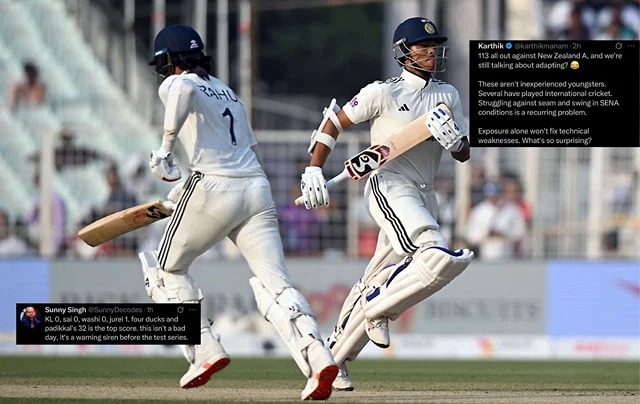
India A endured a difficult start to their red-ball tour of New Zealand, collapsing for just 113 runs on the opening day of the first unofficial Test at Bert Sutcliffe Oval in Lincoln on Saturday, October 24. Despite featuring several established international players and members of India’s Test-bound contingent, the visitors struggled against New Zealand A’s disciplined bowling attack and were dismissed in 39.3 overs.
The disappointing performance quickly attracted attention among cricket fans on social media, with supporters questioning the team’s batting approach ahead of India’s upcoming two-match Test series against New Zealand. Reactions on X reflected concerns about the form of the experienced players as well as the ability of the wider batting group to adapt to challenging overseas conditions.
New Zealand A capitalised on the collapse, with Simon Keene emerging as the standout bowler after taking five wickets. India’s batting effort was rescued to some extent by Yash Rathod, whose unbeaten 44 provided the innings with its only substantial contribution and helped the visitors cross the 100-run mark.
The situation became more concerning for India A when their bowlers failed to make an immediate impact after the hosts began their reply. New Zealand A reached 64 without losing a wicket in 20 overs, putting the Indian side under further pressure on the opening day.
India A’s Batting Collapse Raises Questions Ahead of Test Series
India A entered the contest with a lineup that included players expected to be important to the touring party’s red-ball preparations. However, the visitors struggled to build partnerships, losing wickets at regular intervals and failing to establish the foundation required for a competitive first-innings total.
The score of 113 was particularly disappointing because the team had experienced batters capable of anchoring an innings. Instead, early dismissals and the failure of several middle-order players left Rathod with the task of preventing an even more damaging collapse.
India A’s innings also demonstrated the difference between individual batting ability and the collective discipline required in red-ball cricket. Test matches reward patience, sound defensive technique and the ability to leave deliveries outside the ideal scoring areas. When wickets fall quickly, batters must often adjust their natural attacking instincts and prioritise rebuilding the innings.
That adjustment proved difficult for the visitors. New Zealand A’s bowlers maintained enough pressure to prevent India A from establishing a stable partnership, while the Indian batters struggled to convert starts into meaningful scores.
Although one innings cannot provide a complete assessment of a team’s preparation, the collapse offers a warning about the challenges facing the touring side. The upcoming matches will provide further opportunities for the batters to adapt, but the first innings exposed areas that require attention.
KL Rahul Falls for a Duck as India’s Top Order Struggles
Veteran wicketkeeper-batter KL Rahul endured a disappointing outing, departing for a duck after facing just eight deliveries. His early dismissal removed one of the most experienced members of the batting lineup and placed additional responsibility on the remaining top-order players.
Rahul’s role in red-ball cricket extends beyond scoring runs quickly. As an experienced international batter, he is expected to help establish a platform against the new ball and provide stability when conditions favour the bowlers. His failure to get off the mark was therefore a setback for India A’s attempt to build a substantial total.
Yashasvi Jaiswal, Rahul’s opening partner, also failed to produce a significant innings. The left-handed batter scored 17 from 45 deliveries before being dismissed, leaving the visitors without the strong opening partnership they needed.
Jaiswal’s time at the crease suggested a more patient approach than a rapid scoring burst, but he was unable to turn that time into a substantial contribution. In red-ball cricket, occupying the crease can help reduce pressure on the middle order, particularly when the opening bowlers are finding movement or extracting assistance from the pitch.
However, patience alone does not guarantee success. Batters must also identify scoring opportunities, manage changes in line and length, and respond when bowlers adjust their plans. India A’s opening partnership never developed into a platform from which the middle order could build.
The early wickets also increased the pressure on the players who followed. Once a team loses established batters cheaply, the remaining players must balance the need to score runs with the risk of further dismissals. India A could not find the combination of resistance and controlled scoring required to recover.
Devdutt Padikkal Shows Resistance but Misses a Bigger Score
Devdutt Padikkal provided one of the few signs of resistance for India A, spending 77 deliveries at the crease before being dismissed for 32. His innings was the highest contribution among the established batters in the supplied score details, but it was not enough to prevent the collapse.
Padikkal’s stay at the crease offered an opportunity to stabilise the innings after the early setbacks. In a low-scoring first innings, a batter who can absorb pressure and occupy the crease becomes especially important because that resistance can allow partners to settle and rebuild.
However, Padikkal was unable to convert his start into a score that could change the course of the innings. With wickets falling around him, India A needed someone to produce a substantial contribution rather than merely delay the collapse.
His dismissal left the lower order facing a difficult situation. Instead of entering with a platform to build on, the remaining batters had to contend with an innings already under pressure and a New Zealand A attack that had gained confidence.
For Padikkal, the innings may be viewed as a missed opportunity rather than a complete failure. He showed an ability to remain at the crease for a prolonged period, but the next step is to turn that time into a score capable of influencing the match.
Sai Sudharsan, Dhruv Jurel and Washington Sundar Fail to Deliver
India A’s problems extended beyond the opening pair. Sai Sudharsan was dismissed for a duck after facing 13 deliveries, while Dhruv Jurel managed just one run from 13 balls. Washington Sundar also failed to score, departing after six deliveries.
These dismissals were particularly damaging because India A needed its middle order to absorb pressure and rebuild after losing early wickets. Instead, the team continued to lose batters without establishing meaningful partnerships.
Sudharsan’s dismissal meant the visitors could not use his presence to stabilise the innings. Jurel’s brief stay offered little opportunity to form a partnership, while Sundar’s failure added to the team’s difficulties as the innings moved towards its conclusion.
The individual scores also highlight why a batting collapse should not automatically be attributed to one player or one moment. Several batters failed to contribute, meaning the problem was spread across the lineup rather than confined to the openers.
In longer-format cricket, middle-order players are often required to respond to different match situations. Sometimes they must accelerate after a strong start; on other occasions, they need to defend carefully and rebuild following early wickets. India A’s middle order was unable to perform that stabilising role in Lincoln.
The upcoming red-ball fixtures will give the players further opportunities to demonstrate their ability to adapt. For the coaching staff, the innings provides material to assess shot selection, decision-making and the team’s response when wickets fall in clusters.
Simon Keene’s Five-Wicket Haul Destroys India’s Hopes of a Big Total
New Zealand A fast bowler Simon Keene was the standout performer with the ball, claiming five wickets as India A were dismissed for 113. His haul played a central role in ensuring that the hosts maintained control of the first innings.
A five-wicket haul is an important achievement in any innings, particularly when it helps dismiss an opposition for a low total. Keene’s performance rewarded New Zealand A’s ability to keep the pressure on India’s batters and take advantage of their failure to build partnerships.
However, the supplied match details do not provide a complete account of every dismissal or the precise conditions under which Keene took his wickets. It would therefore be inappropriate to attribute the entire collapse to one specific bowling tactic.
What is clear is that New Zealand A prevented the visitors from establishing a reliable scoring rhythm. India A were dismissed inside 40 overs, a relatively short innings in the context of a four-day or multi-day red-ball match.
The result also placed the hosts in a strong position to respond with the bat. Having bowled out India A cheaply, New Zealand A could approach their innings without the immediate pressure of chasing a substantial first-innings total.
Yash Rathod Provides India’s Only Major Resistance
Amid the collapse, Yash Rathod emerged as India’s most effective batter. His unbeaten 44 from 49 deliveries was the highest score of the innings and helped India A move beyond 100 runs.
Rathod’s contribution stood out because he continued scoring while wickets fell at the other end. His innings offered a reminder that the visitors retained the ability to find scoring opportunities even when the broader batting performance was poor.
His unbeaten status also meant that he remained at the crease when the innings ended, having run out of partners. Although 44 was not enough to transform the total into a competitive score, it prevented the collapse from becoming even more severe.
Rathod’s approach contrasted with the difficulties experienced by several of the more established players. While the top and middle order failed to build a substantial partnership, he managed to score at a healthier rate and provide some resistance against the bowling attack.
Nevertheless, his innings should be considered within the context of the team’s overall performance. One batter scoring 44 cannot compensate fully for multiple low scores, particularly when the opposition is able to build an opening partnership in reply.
For India A, the challenge in subsequent matches will be to turn individual contributions into collective success. Rathod’s performance offered a positive element, but a stronger team total will require more batters to spend time at the crease and convert starts into substantial scores.
New Zealand A Openers Put India Under More Pressure
India A’s difficulties continued when New Zealand A began their response. Anshul Kamboj and Akash Deep shared the new ball, but the Indian bowlers were unable to secure an early breakthrough on a grass-covered pitch.
At the time of the supplied report, New Zealand A had reached 64 without losing a wicket after 20 overs. Rhys Mariu was unbeaten on 33 from 68 deliveries, while Curtis Heaphy had scored 19 not out from 54 balls.
The opening partnership gave the hosts a solid start and reduced the immediate pressure associated with replying to a low first-innings total. Rather than losing early wickets and allowing India A back into the contest, the New Zealand batters were able to settle at the crease.
The partnership also exposed the importance of making early inroads after a disappointing batting performance. When a team has been dismissed cheaply, its bowlers need to respond with disciplined lines, accurate lengths and sustained pressure to prevent the opposition from building a substantial advantage.
India A’s inability to break the opening stand meant that the hosts could approach the remainder of their innings with greater confidence. The visitors would need patience and consistent bowling to change the momentum.
The grass-covered surface was a notable feature of the match, but its presence alone does not establish how much assistance the bowlers received. Pitch behaviour can vary depending on moisture, preparation and how the surface changes during play. The match details confirm the conditions described in the report, but do not provide enough evidence to quantify their effect on either side.
Fans React to India A’s Disappointing Batting Display
India A’s collapse prompted reactions from cricket supporters on X, with some expressing concern about the batting performance ahead of the upcoming Test series. The headline phrase, “Just a trailer for what is coming”, captured the anxiety surrounding the team’s prospects in New Zealand.
Such reactions reflect the expectations that accompany a touring squad containing established international players. Supporters naturally look to India A fixtures for signs of readiness, particularly when the matches form part of the preparation for a senior international assignment.
However, social media responses should not be treated as a definitive assessment of the team’s capabilities. Fan comments often reflect immediate frustration with a result, while a broader evaluation requires consideration of conditions, opposition quality, player roles and performances across multiple matches.
The first innings does provide legitimate reasons for concern. Several batters failed to score, Padikkal could not convert his start into a bigger contribution, and the team was dismissed for 113. Those are concrete outcomes rather than merely reactions to an unfavourable result.
At the same time, the innings is only one part of a longer preparation programme. The remaining red-ball matches will provide a better indication of whether India A can correct its problems and develop the consistency required for the senior Test series.
Without a complete set of verified individual posts, specific reactions should not be attributed to named users or presented as representative of all Indian Cricket supporters. The broader response, however, highlights how closely fans are following the team’s preparation.
Why the India A Tour Matters Ahead of the New Zealand Test Series
India A’s red-ball matches against New Zealand A form part of the build-up to the two-match Test series between the senior sides. According to the supplied report, India A are scheduled to play three red-ball matches before the opening Test at Basin Reserve in Wellington, beginning on November 19.
Such fixtures provide an opportunity for players to adapt to conditions outside India and test their techniques against unfamiliar bowling attacks. They also offer match practice in the longer format, where patience and sustained concentration can be as important as scoring ability.
For batters, the benefits include facing different bowling angles, learning how to manage movement and adjusting to the demands of batting for extended periods. For bowlers, the matches offer opportunities to build workloads, develop partnerships and understand how to maintain pressure across long spells.
However, preparation matches do not guarantee success at senior international level. The quality of the opposition, the match situation and the conditions can differ, while individual selection decisions remain dependent on a range of factors.
India A’s opening-day collapse therefore provides a warning rather than a final verdict. The batting unit must demonstrate greater resilience, particularly when early wickets create pressure. The bowlers, meanwhile, will need to find ways to restrict New Zealand A and prevent the hosts from establishing a decisive advantage.
What India A Must Improve After the 113-Run Collapse
The first priority for India A is to build stronger partnerships. The team cannot depend on one player producing a substantial score while several others fail to make meaningful contributions. In red-ball cricket, partnerships help absorb pressure, force bowlers to work harder and create opportunities for scoring later in an innings.
The second priority is managing the transition between attack and defence. An aggressive approach can be effective when the bowlers lose control, but players must recognise when conditions or match circumstances require greater patience. Equally, excessive caution can create pressure if batters fail to rotate the strike or capitalise on scoring opportunities.
Third, the team needs a more effective response to losing wickets in quick succession. When early dismissals occur, the next batter must assess the situation rather than simply continue with a predetermined approach. A period of consolidation can help prevent a difficult start from turning into a complete collapse.
Finally, India A must improve its bowling response. After being dismissed for 113, the visitors needed early wickets to keep the hosts’ advantage under control. The opening partnership between Mariu and Heaphy made that task more difficult, leaving India A with the challenge of breaking through and limiting New Zealand A’s lead.
The next stages of the match will help determine how much ground India A can recover. A stronger bowling performance could limit the damage, but the visitors will ultimately need a more consistent batting effort in their next innings and the remaining fixtures.
Conclusion: A Difficult Start, but an Opportunity to Respond
India A’s dismissal for 113 against New Zealand A was a disappointing beginning to an important red-ball preparation series. KL Rahul’s duck, Jaiswal’s modest contribution and the failure of several middle-order batters left the visitors heavily reliant on Rathod’s unbeaten 44.
Keene’s five-wicket haul helped New Zealand A take control, and the hosts strengthened their position by reaching 64 without loss in reply. The opening day therefore exposed weaknesses in both India’s batting resilience and its ability to make early breakthroughs with the ball.
The concerns expressed by fans are understandable, given the upcoming senior Test series. Yet the most meaningful assessment will come from how the team responds. India A still have further red-ball cricket ahead, offering opportunities to improve partnerships, refine shot selection and adapt to New Zealand conditions.
For now, the first unofficial Test has delivered a clear message: India A need a more collective performance if they are to turn individual talent into a competitive team effort. The reaction to the collapse may be sharp, but the remaining matches will provide the evidence needed to judge whether the setback becomes a turning point or a recurring problem.
For breaking news and live news updates, like us on Facebook or follow us on Twitter and Instagram. Read more on Latest Cricket on thefoxdaily.com.






COMMENTS 0