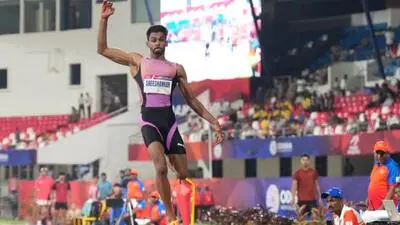
India Commonwealth Games 2026 Athletics campaign officially begins in Glasgow with one of the nation’s strongest track and field squads in recent years. Featuring Olympic medallists, national record holders, rising youngsters and experienced campaigners, the Indian team enters the competition with growing confidence after an exceptional domestic season. From Murali Sreeshankar‘s inspiring comeback in the long jump to Tejas Shirse’s record-breaking sprint hurdles and Gurindervir Singh‘s historic 100m performances, Indian athletics has built significant momentum heading into one of the biggest multi-sport events of the year.
The competition represents far more than another medal opportunity. It is an important benchmark for Indian athletics, showcasing how the country’s investment in coaching, sports science and athlete development is beginning to produce world-class performances across multiple disciplines rather than relying on just a handful of stars.
India Enters Glasgow with High Expectations
India has sent a balanced athletics contingent comprising experienced international performers and exciting young talent. The able-bodied squad features athletes competing across sprints, hurdles, middle-distance events, jumps and throws, while India’s para-athletics team is also expected to contribute significantly to the overall medal tally.
Unlike previous editions where expectations largely revolved around a few established names, the 2026 campaign sees Indian athletes entering several events with genuine medal prospects thanks to remarkable improvements achieved throughout the domestic season.
The preparation has also been comprehensive. Much of the squad completed an extended overseas conditioning camp in Poland to acclimatize to European weather and competition standards, while several elite athletes followed customized training programs in different countries before arriving in Glasgow.
Why India’s Athletics Team Looks Stronger Than Ever
The biggest reason behind India’s optimism is the extraordinary improvement witnessed during the national season.
Several national records were rewritten across multiple disciplines, highlighting a broader rise in performance standards rather than isolated success stories. The Athletics Federation’s challenging qualification standards forced athletes to consistently push beyond previous benchmarks, creating an intensely competitive domestic circuit.
This competitive environment helped athletes peak at the right time while ensuring that those selected for Glasgow arrived after producing career-best performances.
| Key Strength | Impact on India’s Campaign |
|---|---|
| Multiple National Records | Higher confidence and improved international competitiveness |
| European Training Camp | Better preparation for weather and competition conditions |
| Experienced Medal Contenders | Leadership under pressure in major championships |
| Young Emerging Talent | Greater medal opportunities across more events |
| Improved Domestic Competition | Athletes arriving in peak competitive form |
Murali Sreeshankar’s Remarkable Comeback Story
Among India’s biggest medal hopes is Murali Sreeshankar, whose journey over the past year has become one of resilience and determination.
Recovering from a serious patellar tendon injury is among the toughest challenges for any long jumper because the take-off leg absorbs enormous force during competition. Returning to elite-level jumping after surgery requires months of rehabilitation, rebuilding strength, restoring confidence and gradually regaining technical precision.
Instead of simply returning to competition, Sreeshankar has re-established himself among the world’s elite jumpers by consistently crossing the eight-metre mark. Such consistency often matters more than producing one exceptional jump, especially in championship events where changing weather conditions demand technical stability.
Having already experienced Commonwealth Games success, Sreeshankar understands the pressures of major international championships. That experience could prove invaluable in Glasgow, where unpredictable conditions often challenge even the world’s best jumpers.
Why Weather Could Become a Decisive Factor
Track and field competitions are heavily influenced by weather, particularly in outdoor championships held in northern Europe.
Cold temperatures affect muscle flexibility, rain changes the texture of runways, while shifting winds can either assist or hinder performances depending on the event. Sprint races, hurdles and horizontal jumps are especially sensitive to weather changes.
Athletes who remain mentally composed despite fluctuating conditions usually enjoy an advantage over equally talented competitors who struggle to adapt.
India’s overseas preparation was designed specifically to help athletes adjust to these conditions, reducing the likelihood of performance drops caused by unfamiliar environments.
Gurindervir Singh Leading India’s Sprint Revolution
Indian sprinting has undergone a remarkable transformation in recent years, and Gurindervir Singh has become one of its biggest symbols.
Breaking the national record in the men’s 100 metres represented more than an individual achievement—it demonstrated that Indian sprinting is steadily narrowing the gap with traditional sprinting nations.
Historically, India struggled to compete in short sprint events dominated by athletes from Jamaica, the United States and several Caribbean countries. Recent improvements in coaching methods, biomechanics, strength training and sports science are beginning to change that narrative.
Entering Glasgow with one of the fastest season-best timings in the field provides Gurindervir with genuine confidence. However, championship sprinting differs significantly from clocking fast times during domestic competitions. Success depends on explosive starts, composure under pressure and executing every phase of the race perfectly.
Tejas Shirse Emerging as India’s Next Hurdling Star
Another athlete attracting considerable attention is Tejas Shirse, whose rapid improvement has placed India firmly on the international hurdles map.
The 110m hurdles demands exceptional speed, rhythm and technical precision. Every hurdle must be attacked with near-perfect timing because even minor errors can cost valuable hundredths of a second.
Breaking the national record shortly before the Commonwealth Games demonstrates excellent form at precisely the right moment. More importantly, Shirse’s performances suggest that Indian hurdling is entering an exciting new phase where international finals are becoming increasingly realistic goals rather than distant ambitions.
With one of the quickest season performances among competitors, Shirse has every opportunity to challenge for a place on the podium if he successfully negotiates the preliminary rounds.
Beyond Neeraj Chopra: India’s Expanding Athletics Depth
For several years, India’s international athletics identity revolved largely around Neeraj Chopra’s extraordinary achievements.
While Chopra remains one of the country’s biggest sporting icons, the current Commonwealth Games squad illustrates an important evolution. India now possesses medal contenders across numerous disciplines instead of relying on a single superstar.
This diversification represents one of the healthiest developments in Indian athletics. Success across sprints, jumps, hurdles and middle-distance events indicates stronger grassroots development and improved talent identification throughout the country.
Such depth also creates healthy competition within the national setup, encouraging athletes to continually raise performance standards.
How Domestic Competitions Have Raised India’s Standards
The impressive performances witnessed before Glasgow were not accidental.
Domestic competitions have become increasingly competitive, with athletes understanding that international qualification now demands exceptional performances rather than simply winning national titles.
Higher qualifying standards have encouraged athletes to improve technical execution, physical conditioning and psychological preparation.
This shift reflects a broader change in Indian athletics, where excellence is measured against global benchmarks rather than domestic dominance alone.
Events to Watch During India’s Athletics Campaign
- Men’s Long Jump – Murali Sreeshankar seeks to upgrade his previous Commonwealth medal.
- Men’s 100m Sprint – Gurindervir Singh attempts to convert record-breaking form into international success.
- Men’s 110m Hurdles – Tejas Shirse aims to continue his rapid rise on the global stage.
- Javelin Throw – Neeraj Chopra remains among India’s strongest medal contenders.
- Para Athletics – Indian para athletes continue to strengthen the nation’s overall medal prospects.
Why Glasgow Could Shape India’s Future Athletics Success
The significance of Glasgow extends beyond medals.
Strong performances at the Commonwealth Games can boost athlete confidence, attract greater investment, inspire young talent and strengthen India’s preparations for future global championships.
Major international competitions also expose athletes to high-pressure environments that cannot be replicated during domestic events. Learning to manage expectations, recover between rounds and compete against world-class opposition accelerates long-term development.
For younger athletes making their Commonwealth Games debut, Glasgow offers invaluable experience that could influence their careers for years to come.
A Comparison with Previous Commonwealth Games Campaigns
Compared to earlier editions, India’s current athletics squad appears considerably more balanced.
Previous campaigns often depended heavily on individual brilliance. The 2026 squad, however, features realistic medal possibilities across multiple disciplines, reducing pressure on any one athlete while increasing the team’s overall medal potential.
This broader distribution of talent reflects the growing maturity of Indian athletics and suggests that sustained international competitiveness may finally be taking shape.
Expert Insight: The Importance of Championship Consistency
One lesson repeatedly demonstrated in international athletics is that championships reward consistency more than spectacular individual performances.
Athletes who regularly perform near their personal best under pressure usually outperform competitors capable of occasional brilliance but inconsistent execution.
India’s leading athletes have shown encouraging consistency throughout the season, giving coaches confidence that recent improvements can translate into championship success rather than remaining isolated performances.
Key Takeaway: India’s biggest strength entering Glasgow is no longer one superstar athlete. It is a growing pool of record-breaking performers capable of competing across several track and field disciplines at the highest level.
Conclusion: A Defining Opportunity for Indian Athletics
The India Commonwealth Games 2026 athletics campaign arrives at an exciting moment for the sport. Record-breaking domestic performances, improved international preparation and an increasingly deep talent pool have created genuine optimism that India can surpass its previous achievements.
Murali Sreeshankar’s inspiring comeback, Gurindervir Singh’s sprint revolution, Tejas Shirse’s emergence among elite hurdlers and the presence of established champions collectively make this one of India’s most balanced athletics teams in Commonwealth Games history.
Whether the final medal tally exceeds expectations or not, Glasgow represents another important milestone in India’s athletic evolution. If the current trajectory continues, the country’s growing depth across multiple disciplines could transform it into an increasingly consistent force on the global athletics stage in the years ahead.
For breaking news and live news updates, like us on Facebook or follow us on Twitter and Instagram. Read more on Latest Sports on thefoxdaily.com.






COMMENTS 0