When the Perfect Ball Meets the Leaving Batter
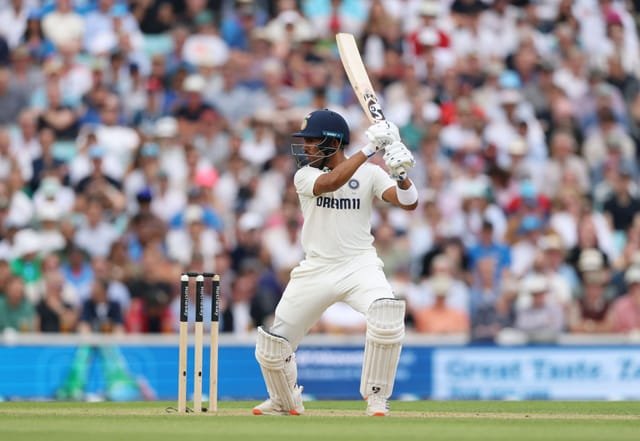
There are dismissals in cricket that happen because a batsman makes a mistake, and there are dismissals that happen because a bowler bowls something close to perfect. Dhruv Jurel’s dismissal on Day 2 of the one-off Test between India and Afghanistan at Mullanpur belonged firmly in the second category. The right-hander had looked composed and purposeful in his brief innings, striking four boundaries from 20 deliveries, when Mohammad Saleem Safi produced a delivery that would have challenged far more experienced batters.
The fifth ball of the 102nd over: a length delivery pitching outside off stump. Jurel read it as a leaving delivery, shaped to allow it to pass. The ball, however, had different intentions. It nipped back sharply, cut past the outside edge that was not offered, found the gap between bat and body, and hit the top of off stump with the kind of brutal precision that sends bowlers into an aggressive celebration and leaves batters staring at the ground trying to process what just happened. Safi picked up his fourth wicket of the innings. Jurel departed for 19 off 20 balls, dismissed by a delivery he could not reasonably have done much more to survive.
India, at the moment of the dismissal, were 452 for five. The contest was not in doubt. But the manner of the wicket, and the morning’s other dismissals, gave Afghanistan’s bowling attack the only meaningful consolation available on a day that the hosts have largely dominated.
Day 1 in Review: The Platform That Made Day 2 Possible
To appreciate the full context of Day 2’s action, the foundation laid on the opening day deserves its due. India’s Day 1 batting was, by any measure, a statement of the kind of controlled aggression that a home Test should produce when the conditions are good and the bowling attack is below international standard.
KL Rahul led from the front with a century: 100 off 165 balls, the kind of authoritative opening partnership innings that sets the tone for everything that follows. His presence at the crease through the first session provided the stability from which the middle order could build, and his hundred represented a significant contribution to India’s Test transition project, confirming his value as a red-ball anchor in the evolving lineup.
Sai Sudharsan, making his case for the contested number three position that has been one of the selection talking points of India’s recent Test discussions, contributed 81 off 104 balls. The innings was not a perfect advertisement for his credentials in the most demanding form of the game, falling 19 short of a century that would have made the selection debate considerably simpler, but it was a substantial and technically credible contribution against an attack that, while limited, still required genuine application to bat through.
India ended Day 1 at 368 for three after 85 overs. Shubman Gill was unbeaten on 103 and Rishabh Pant was on 50. The platform was not merely solid. It was exceptional.
Day 2 Morning: Gill’s 126, Pant’s 81, and the Three Wickets That Fell
The story of Day 2 was the continuation and eventual conclusion of the Gill-Pant partnership, followed by the brief and unfortunate interlude of Jurel’s dismissal and the subsequent fall of Pant himself. Together, the morning produced three wickets from the position of comprehensive security, a natural consequence of an attack eventually finding the right delivery for the right moment.
Gill and Pant extended their overnight stand, adding runs at a rate that maintained the first innings momentum without the reckless acceleration that can end well-set partnerships prematurely. The fourth wicket partnership ultimately realized 169 runs, a contribution that pushed India’s first innings total into genuinely imposing territory and removed any realistic prospect of the contest being competitive.
Gill’s innings ended when he was caught behind for 126. The dismissal converted an already impressive knock into a century of the kind that Test Cricket reserves for its best batting days: a hundred that spans two days, built in conditions of fluctuating difficulty, concluded with the captain having made a statement about his own qualities and the team’s ambitions simultaneously. For a player who captained India’s Test side in England before this assignment, a score of 126 at home in a significant match carries weight beyond the numbers themselves.
Pant’s dismissal came with the total more advanced, the partnership’s value already banked, and the innings at a stage where the push toward a declaration-ready total was the primary objective. His 81 off 121 balls, featuring six fours and three sixes, extended the electric brand of batting he had displayed since arriving at the crease on Day 1. He became Hashmatullah Shahidi’s first wicket of the innings, falling to the Afghanistan captain who had patiently worked through the earlier phases of India’s dominance. Pant’s failure to convert his fifty into a hundred will be a minor source of personal frustration, but the innings’ overall contribution to India’s total was substantial and the manner of his play again confirmed the qualities that Abhishek Nayar had identified after Day 1’s controlled fifty.
| Batter | Runs | Balls | Fours | Sixes | How Dismissed |
|---|---|---|---|---|---|
| KL Rahul | 100 | 165 | — | — | Out (Day 1) |
| Sai Sudharsan | 81 | 104 | — | — | Out (Day 1) |
| Shubman Gill | 126 | — | — | — | Caught behind (Day 2) |
| Rishabh Pant | 81 | 121 | 6 | 3 | b Shahidi (Day 2) |
| Dhruv Jurel | 19 | 20 | 4 | 0 | b Saleem Safi (nip-backer, top of off stump) |
| Washington Sundar | 8* | — | — | — | Batting (at time of writing) |
| Manav Suthar | 4* | — | — | — | Batting (at time of writing, Test debut) |
The Dismissal in Detail: What Made Safi’s Delivery So Dangerous
Mohammad Saleem Safi’s dismissal of Jurel was not a fluke or a mishit. It was the execution of a specific plan that the Afghan seamer has been working toward through the innings, and the culmination of a bowling spell that earned him four wickets against what is, on paper, one of the most talented batting lineups in world cricket.
The leaving technique in cricket is one of the most fundamental and regularly drilled skills in a batsman’s repertoire. The batsman identifies a delivery angling away from off stump or passing outside the line of off stump, makes the assessment that it is not threatening enough to require a stroke, and allows it to pass. The danger, always, is the ball that moves in the opposite direction to the batter’s read. A delivery pitching outside off and then nipping back through the gate is the bowler’s mechanism for punishing the instinct to leave.
Jurel’s read was not unreasonable. The ball’s initial trajectory suggested away movement or straightness. The sharp nip back that arrived instead was the kind of late movement that only conditions and quality of execution produce together. The top of off stump is the specific target when a delivery does precisely what Safi’s did, because it catches the gap between the bat that has started to move outside the line and the body that has not committed to coverage. The stumps are exposed for a fraction of a second and a fraction of a second is all a well-directed ball needs.
Safi’s four wickets in the innings represent a performance that will be among the highlights of Afghanistan cricket’s Test match record. Bowling against India in a Test match, on a good pitch, and taking four top-order wickets is not a small achievement for any seamer. The specific dismissal of Jurel, through the leaving technique, may be the delivery he remembers longest.
Dhruv Jurel: A Promising Innings Cut Short
For Dhruv Jurel, the dismissal came at the worst possible moment. Nineteen off 20 balls at a strike rate of 95, with four boundaries already struck, represented the opening passage of an innings that was building toward the kind of contribution that number six requires in a Test match: fast enough to maintain momentum, substantial enough to push the total beyond a competitive reach.
Jurel is a wicketkeeper-batter whose ascent through India’s Test setup has been one of the more interesting stories of the current transition. He offers a specific profile behind the stumps and provides batting value at a position where India have needed genuine contributions rather than tail-end cameos. His four fours in 20 balls showed the intent and the technique to play attacking cricket without recklessness. The dismissal was not one that reflected poor judgment or technical breakdown. It was simply the kind of delivery that can get any batter out at any level of the game.
His response, standing at the crease looking at the dislodged bail, was the universally recognizable expression of a batter who knows they have been beaten by quality rather than their own error. The stun in his reaction was appropriate. He had done very little wrong.
The Bigger Picture: India’s First Innings and What Comes Next
At the time of writing, India stood at 464 for six after 107 overs, with Washington Sundar on eight and the debutant Manav Suthar on four. The pair’s task is to extend the total as far as the captain and the pitch conditions warrant before the declaration comes.
Suthar’s presence at the crease on his debut, batting at number nine in a Test where the total is already beyond 460 for six, is the ideal scenario for a new international player. The pressure of a genuine match situation without the pressure of an impossible run-chase or a narrow lead to manage. He is batting with Washington Sundar, an experienced and technically capable partner. The conditions are not hostile. The bowling attack is limited. It is the kind of environment in which a debut can produce a score that builds confidence for the harder Tests ahead.
The question of when India will declare is the only remaining one that the first innings raises. The total already stands well beyond what Afghanistan are likely to be capable of chasing, and Shubman Gill’s captaincy instincts will involve a calculation of when the declaration optimizes the time available to bowl the visitors out in their second innings while maintaining the first innings advantage. A total somewhere above 500 seems probable. Exactly where that number lands depends on how long Sundar, Suthar, and the remaining lower order can extend the partnership.
Mohammad Saleem Safi: The Afghan Seamer Who Made His Mark
In the context of Afghanistan’s overall position in this Test, four wickets from a seamer represents the kind of individual excellence within a team performance that will be lost if the broader result is as comprehensive as it appears it will be. Afghan cricket, still developing its Test match infrastructure and still building the experience base that allows touring squads to compete at the highest level, produces genuine individual talents. Safi’s performance deserves to be acknowledged on its own terms, separate from the match result.
His four wickets against India’s deep and accomplished batting lineup, on a good pitch in conditions more favorable to batting than bowling, required accuracy, patience, and the ability to produce variations at specific moments of a long spell. The Jurel dismissal was the finest of the four: a delivery that would have tested any batsman in the world. That it came in a Test match, against an India lineup featuring current and former international cricketers, gives it a validity that domestic or practice match performances do not carry.
Conclusion: A Dismissal to Remember in a Day That Belongs to India
Day 2 at Mullanpur has continued the narrative that Day 1 began: India building a total that removes any competitive threat from the contest while providing individual milestones and moments of quality that make the cricket worth watching beyond the match result. Gill’s 126, Pant’s 81, Rahul’s century from Day 1 and Sudharsan’s 81 have all contributed to a first innings that will be the foundation of an almost certain win.
Within that context, Jurel’s brief innings and Safi’s perfect delivery provide one of the day’s defining images: a bowler at the peak of a spell finding the delivery that no one can do much about, and a batsman walking off having been beaten by quality rather than error. In a match India are winning comprehensively, it is the kind of moment that reminds you that cricket, even in its most one-sided phases, is never entirely without its own internal dramas.
India are 464 for six and batting. The declaration approaches. And Mohammad Saleem Safi will finish Day 2 with four Test wickets against one of the strongest batting lineups in the world, earned the proper way.
For breaking news and live news updates, like us on Facebook or follow us on Twitter and Instagram. Read more on Latest Sports on thefoxdaily.com.






COMMENTS 0