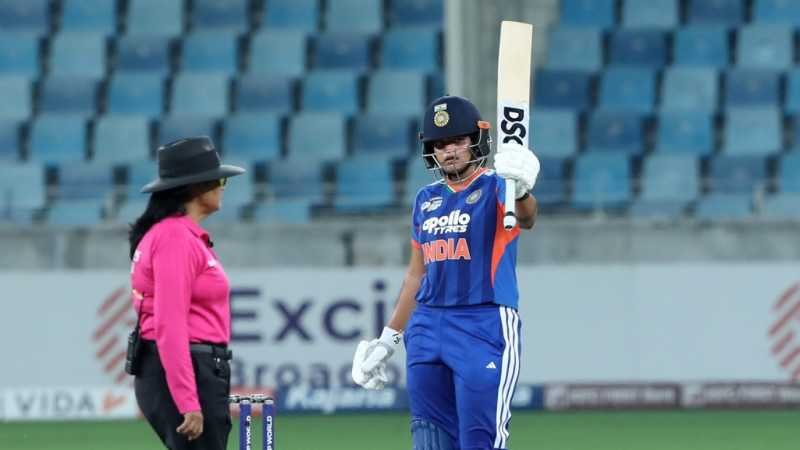
India Women vs Bangladesh Women in the first semi-final of the Womenâs Asia Cup 2026 ended with India producing enough quality in the key moments to secure a 40-run victory in Dubai. After posting 149 for 6, India restricted Bangladesh to 109 for 7 in their 20 overs and booked a place in the tournament final.
The victory was built around two standout performances. Shafali Verma overcame several dropped chances to smash 64 from 40 balls, while Deepti Sharma delivered a crucial three-wicket spell that dismantled Bangladesh’s chase. Despite four dropped catches and other fielding mistakes, India’s superior batting depth and disciplined spin attack proved decisive.
India reach another Asia Cup final
The victory continued India’s remarkable record in the Women’s T20 Asia Cup. They marched into their sixth final in six editions, maintaining their dominance in the tournament’s history.
Bangladesh won the toss and chose to bowl on a surface that was not particularly easy for stroke-making. The decision initially appeared promising as several Indian batters struggled to find their timing.
However, Shafali’s aggressive approach changed the complexion of the innings. Her ability to score quickly allowed India to recover from periods when the other batters found run-scoring difficult.
India eventually reached 149 for 6, giving Bangladesh a target of 150. It was not an overwhelming total on paper, but the slow pitch and India’s variety in the bowling attack made the chase increasingly difficult.
Shafali Verma survives four chances and makes Bangladesh pay
Shafali’s innings was the defining batting contribution of the semi-final, although Bangladesh will look back at several missed opportunities that allowed her to remain at the crease.
The opener received reprieves at 6, 11, 50 and 56. Bangladesh had multiple opportunities to remove her, but Shafali repeatedly escaped and immediately punished the fielding side.
One of the earliest chances came against Sultana Khatun. Fahima Khatun was unable to complete a catch at long-on, giving Shafali an early lifeline. Smriti Mandhana was dismissed soon afterwards, but Shafali continued attacking.
Nahida Akter then failed to hold another low opportunity at mid-on. Instead of allowing Bangladesh to regain control, Shafali responded by hitting Sultana for consecutive sixes over long-off.
Her aggression ensured India reached 45 for 1 at the end of the powerplay despite Pratika Rawal finding scoring difficult at the other end.
Marufa Akter creates early pressure
Bangladesh’s new-ball bowling deserved credit for making India work for their runs. Marufa Akter repeatedly tested Shafali with movement and variations, including an inswinger and a legcutter that beat the batter’s outside edge.
Sultana Khatun also created opportunities early in the innings. Bangladesh were therefore not short of chances; their major problem was converting those chances into wickets.
That distinction became important as the innings progressed. Against a batter of Shafali’s attacking ability, missed opportunities can quickly become expensive. India eventually benefited from exactly that scenario.
Pratika Rawal and Harmanpreet Kaur struggle for fluency
India’s innings was not dominated entirely by attacking strokeplay. Pratika Rawal started positively, opening her account with a well-timed off-drive and later hitting Rabeya Khan for a six.
However, the middle phase proved difficult for her. Rawal finished with 20 from 24 balls, unable to rotate the strike consistently.
Harmanpreet Kaur experienced a similar problem. At one stage, the India captain had only three runs from 15 deliveries, which slowed the innings considerably.
India managed just 33 runs in the seven overs following the powerplay. On a surface where timing was already challenging, the slow middle period created additional pressure on the lower order.
Shafali reaches fifty and continues attacking
Shafali eventually brought up her half-century from 35 balls. But even after reaching the milestone, Bangladesh continued to offer her opportunities to extend her stay.
Immediately after reaching fifty, Shafali was involved in a run-out chance at the bowler’s end following a misunderstanding with Harmanpreet. Fahima Khatun failed to complete the throw cleanly.
Shafali then attacked Sultana again, pulling a six over deep midwicket. She attempted another big shot from the next delivery, but Shorna Akter could not complete the catch.
The ball eventually reached the boundary after passing through the fielder’s hands, but Shafali was dismissed later in the same over when she holed out to long-on.
Her final score of 64 from 40 deliveries gave India the attacking foundation they needed. The innings contained power, risk and plenty of fortune, but the scoreboard ultimately reflected the value of her contribution.
Late acceleration gives India a defendable total
With the top order struggling for consistency, India needed their middle and lower order to provide a final push.
Richa Ghosh supplied useful momentum with 21 from 16 balls, while Deepti Sharma scored 13 from just six deliveries. Harmanpreet remained unbeaten on 24 from 28 balls.
Those contributions helped India reach 149 for 6. Considering the slow conditions and Bangladesh’s early bowling pressure, the total gave India enough room to attack with their spinners during the chase.
| India batting | Runs |
|---|---|
| Shafali Verma | 64 (40) |
| Harmanpreet Kaur | 24* (28) |
| Richa Ghosh | 21 (16) |
| Deepti Sharma | 13 (6) |
| India | 149/6 |
Bangladesh make a positive start but struggle against spin
Bangladesh began their chase with positive intent. Juairiya Ferdous and Dilara Akter attacked during the opening overs, with both batters finding two boundaries each inside the first three overs.
However, Bangladesh could not convert those boundaries into a sustained scoring surge. A large number of dot balls meant they were only 18 without loss after three overs.
India captain Harmanpreet Kaur responded by introducing spin from both ends. The change immediately reduced Bangladesh’s scoring opportunities.
N Shree Charani bowled the final over of the powerplay as a wicket maiden, dismissing Ferdous and claiming her 50th T20I wicket in the process.
That wicket was significant because Bangladesh had lost their early momentum just as India began tightening their bowling plans.
Deepti Sharma takes control of the semi-final
Deepti Sharma then delivered the spell that effectively settled the contest. She struck with her first over, dismissing Ferdous after the Bangladesh batter attempted an attacking shot and was caught at deep midwicket.
Nigar Sultana and Sobhana Mostary briefly rebuilt the innings with a 31-run partnership. But the partnership consumed 34 deliveries, meaning Bangladesh were falling further behind the required run rate.
Deepti eventually broke the stand by bowling Mostary. The dismissal triggered a decisive collapse.
Bangladesh lost three wickets for only 17 runs across 15 deliveries. Prema Rawat removed Nigar Sultana, while Deepti dismissed Sharmin Akhter to leave Bangladesh at 83 for 5 in the 16th over.
From that position, Bangladesh required an extraordinary acceleration against a bowling attack that had already taken control of the middle overs.
India’s fielding remains a concern
Although India won comfortably, their fielding performance was one of the few negatives from the match.
India dropped several chances during Bangladesh’s chase. Rawal missed an overhead opportunity involving Dilara in the opening over and later dropped Mostary at backward point.
Smriti Mandhana also misjudged a boundary catch, while Richa Ghosh and Nandani Sharma collided while attempting to reach another opportunity near square leg.
These mistakes did not change the result because Bangladesh could not capitalise. However, against a stronger opponent in the final, similar errors could become significantly more costly.
India’s bowling attack created enough chances to dominate, but the fielding unit did not consistently finish the job. That will likely be an area the team will want to sharpen before the title clash.
Why India’s spin attack proved decisive
The biggest tactical difference between the two sides was India’s ability to exploit the slow conditions through spin.
Once Harmanpreet introduced spin from both ends, Bangladesh found it increasingly difficult to maintain the required scoring rate. The batters were forced to take more risks as the target moved further away.
Deepti’s control was particularly important. Rather than relying solely on attacking deliveries, she created pressure through dot balls and used the mounting asking rate to force Bangladesh into mistakes.
The three-wicket haul therefore had value beyond the wickets themselves. It disrupted partnerships, increased the required rate and prevented Bangladesh from building a late-innings platform.
Bangladesh needed a Shafali-like innings
There was an interesting contrast between the two innings. India had Shafali, who could turn limited opportunities into rapid runs. Bangladesh’s batters were unable to produce a similar match-changing innings.
Shorna Akter top-scored for Bangladesh with an unbeaten 22, while Dilara Akter made 21. Their contributions showed resistance but were not enough to keep the chase alive.
Bangladesh finished on 109 for 7, meaning they fell 40 runs short of India’s total.
| Bangladesh batting | Runs |
|---|---|
| Shorna Akter | 22* |
| Dilara Akter | 21 |
| Bangladesh | 109/7 |
India vs Bangladesh: Key numbers
- India: 149/6 in 20 overs.
- Bangladesh: 109/7 in 20 overs.
- Result: India won by 40 runs.
- Shafali Verma: 64 from 40 balls.
- Shafali’s fifty: 35 balls.
- Deepti Sharma: 3 wickets.
- N Shree Charani: 50th T20I wicket.
- Harmanpreet Kaur: 24 not out.
- Richa Ghosh: 21 from 16 balls.
- India’s Asia Cup record: Sixth final in six editions.
What India must fix before the final
India will be delighted with the result, but the semi-final also exposed an obvious weakness. Their fielding needs to improve before the final.
The team created enough chances to restrict Bangladesh much earlier, yet repeated dropped catches allowed the chase to continue longer than necessary. Better opposition could punish those errors far more severely.
India’s batting also had a prolonged middle-over slowdown. Shafali’s acceleration covered much of the issue, but the top and middle order cannot always expect one player to carry the scoring rate.
At the same time, the positives are substantial. India have multiple bowling options, experienced leadership, an explosive opener and enough depth to recover when conditions are difficult.
What Bangladesh can take from the defeat
Bangladesh will be disappointed by the result, particularly because they had opportunities to dismiss Shafali early. However, their new-ball attack showed that India were not completely comfortable on the Dubai surface.
The next step is converting pressure into wickets. Dropped chances against high-quality batters can completely change a T20 match, and that was precisely what happened in this semi-final.
Bangladesh’s opening batters also showed positive intent, but the side needs greater scoring efficiency once spin enters the game. Too many dot balls made the required rate climb rapidly.
Final Verdict
India produced a strong enough all-round performance to beat Bangladesh by 40 runs and reach the Women’s Asia Cup 2026 final. Shafali Verma’s 64 from 40 balls provided the foundation, while Deepti Sharma’s three wickets ensured Bangladesh never developed enough momentum during the chase.
The 149-run total was built despite several Indian batters struggling for timing, while Bangladesh’s inability to capitalise on multiple fielding errors ultimately proved costly. India’s own fielding was also below their best, making that one area they must address before the final.
Nevertheless, the larger picture remains highly positive for India. Six finals in six editions underlines their consistency in the competition, and the combination of Shafali’s attacking batting, Deepti’s control and India’s varied bowling attack makes them strong contenders to lift the Asia Cup trophy.
For breaking news and live news updates, like us on Facebook or follow us on Twitter and Instagram. Read more on Latest Cricket on thefoxdaily.com.






COMMENTS 0