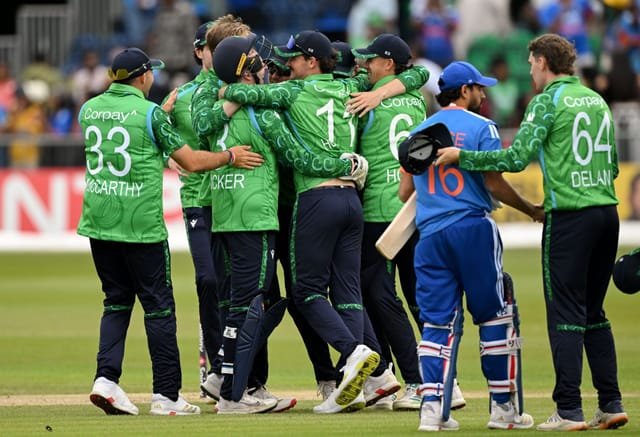
India vs Ireland T20I series loss surprised the cricket world as Ireland defeated the Men in Blue 2-0 in the two-match series. The result became one of India’s most unexpected setbacks after the team arrived as reigning T20 champions with high expectations.
Ireland defeated India by 34 runs in the first T20I before completing a thrilling one-run victory in the second match at the Civil Service Cricket Club in Belfast. The hosts produced a complete team performance, while India struggled in several key areas.
The defeat was not caused by one single mistake. A combination of tactical issues, batting failures and missed opportunities contributed to India’s historic series loss.
1. India Failed to Adapt to Belfast Conditions
The biggest difference between India and Ireland during the series was the ability to adjust to the playing conditions.
Unlike the batting-friendly pitches commonly seen in India, Belfast offered more assistance to bowlers. The surfaces had grass covering, extra bounce and movement, making stroke-making more difficult.
Indian batters, who often dominate flat pitches and clear boundaries in franchise cricket, struggled when conditions demanded patience and smart shot selection.
Many attempted aggressive shots but failed to calculate the ground dimensions and bowling conditions correctly.
| Condition | India’s Challenge | Ireland’s Advantage |
|---|---|---|
| Pitch Movement | Batters struggled against movement | Bowlers used conditions effectively |
| Ground Size | Forced risky boundary attempts | Field placements created pressure |
| Weather | Required technical adjustment | Ireland adapted naturally |
Ireland’s bowlers consistently pushed Indian batters into uncomfortable areas. They understood that success would come from controlling shots rather than simply bowling faster.
India assistant coach Ryan ten Doeschate also admitted that the team needs to adjust better when travelling to different countries and facing different challenges.
2. Top-Order Collapse Put India Under Constant Pressure
India’s batting struggles were one of the biggest reasons behind the series defeat. Despite having a strong batting lineup, the top order failed to provide stability in both matches.
The early wickets allowed Ireland to control the momentum and put pressure on India’s middle order.
| Batter | Performance in Series |
|---|---|
| Sanju Samson | Scored 5 and 0 |
| Abhishek Sharma | 49 off 20 in first match, golden duck in second |
| Ishan Kishan | Scored 1 and 12 |
| Shreyas Iyer | Managed only 13 runs across two innings |
In the first T20I, India slipped to 60 for 3 during the powerplay and later collapsed further to 90 for 5.
The second match was even worse as India lost four wickets for just 35 runs.
Although Tilak Varma produced a fighting half-century, India were unable to complete the chase and fell short by one run.
Why the Top Order Failure Hurt India So Much
Modern T20 cricket depends heavily on momentum. A strong opening partnership allows teams to attack later without unnecessary risk.
However, India’s repeated early wickets created a completely different situation. The middle order had to rebuild instead of attacking from the start.
This exposed the importance of having batters who can control difficult phases of an innings.
3. Dropped Catches Changed the Momentum
India’s fielding performance also played a major role in the defeat. The team dropped six catches across the two matches, giving Ireland valuable second chances.
In T20 cricket, even one missed opportunity can completely change the result. India missed multiple chances that allowed Irish batters to continue scoring.
| Match | Dropped Catches | Impact |
|---|---|---|
| 1st T20I | 3 catches dropped | Ireland crossed 180 runs |
| 2nd T20I | 3 catches dropped | Key Irish batters survived |
Tim Tector, Gareth Delany and Lorcan Tucker benefited from missed chances in the opening game, while Harry Tector’s crucial innings in the second match also came after India missed opportunities.
These mistakes allowed Ireland to post competitive totals that eventually proved enough.
Comparison: Why Ireland Outperformed India
| Area | India | Ireland |
|---|---|---|
| Batting Approach | Aggressive but lacked adjustment | Controlled and calculated |
| Bowling | Good spells but lacked consistency | Used conditions perfectly |
| Fielding | Multiple missed chances | Sharp and disciplined |
| Pressure Moments | Failed to finish games | Stayed calm |
The Bigger Lesson for India Before England Tour
The Ireland series provides an important learning opportunity before India’s upcoming England white-ball tour.
The biggest takeaway is that international cricket cannot be approached with the same strategy everywhere. Conditions, opponents and match situations require constant adjustments.
India’s batting depth and talent remain strong, but the team must improve decision-making in unfamiliar environments.
What India Needs to Improve Going Forward
- Better overseas adaptation: Players must adjust quicker to different pitches.
- Strong starts: The top order needs to provide stability.
- Sharper fielding: Dropped catches cannot continue at international level.
- Balanced team selection: India need the right mix of specialists and all-rounders.
Conclusion
India vs Ireland T20I series loss was a reminder that even the strongest teams can struggle when they fail to adapt. Ireland’s historic 2-0 victory came through better execution, smarter tactics and stronger performance in key moments.
For India, the defeat is a warning before the England series. The team has the talent to bounce back, but improving adaptability, batting discipline and fielding intensity will be essential.
For breaking news and live news updates, like us on Facebook or follow us on Twitter and Instagram. Read more on Latest Sports on thefoxdaily.com.






COMMENTS 0