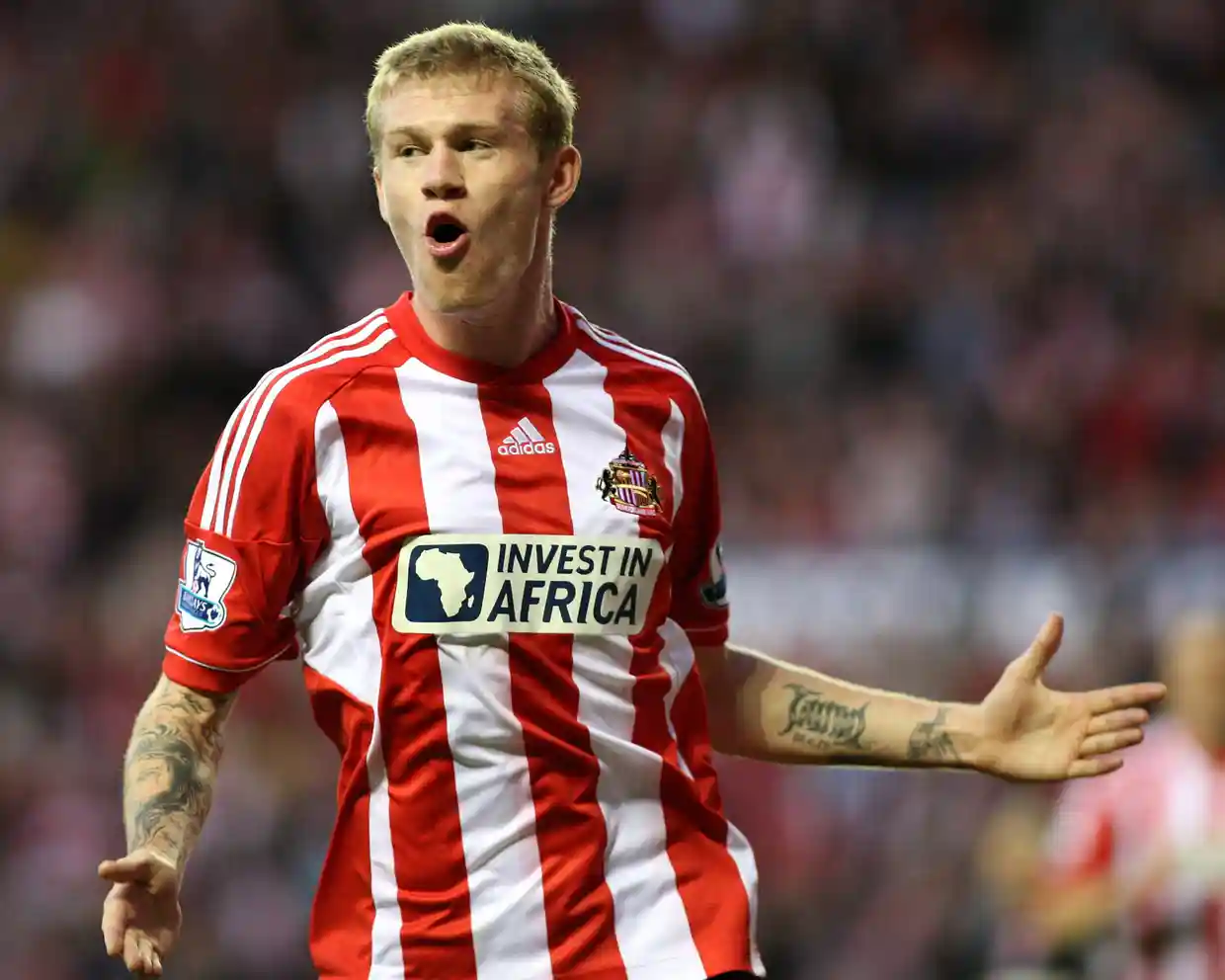
Former Republic of Ireland international James McClean has opened up about the controversy surrounding his refusal to wear the Remembrance Day poppy, his childhood in Derry during the aftermath of the Troubles, and the personal consequences that followed him throughout his Football career. In his autobiography, The Walls, the 37-year-old reflects on the experiences that shaped his identity, his relationships with English football supporters, and his uncertain future at Derry City.
McClean earned 103 caps for the Republic of Ireland, becoming the most-capped footballer from Northern Ireland to represent the country. He also played 150 Premier League matches across five seasons and made more than 800 professional appearances. Despite those achievements, he believes the controversy surrounding his political and historical beliefs has overshadowed much of his career.
James McClean Opens Up About His Public Image
McClean believes many people have developed an inaccurate impression of his personality because of his outspoken views and long-running disagreements over the poppy campaign.
“The perception of me is that, basically, I am a madman,” McClean says. “I’m outspoken. I’m a loudmouth. I’m very opinionated and I hate all things British. That’s from people who don’t know me. The reality is quite the opposite. I’m pretty boring. I go training, go home and switch off. A lot of my days are quite bland, quite basic.”
Although he acknowledges that his public image has become closely associated with controversy, McClean considers his football career a success. He points to his international appearances, Premier League experience and individual achievements as evidence of what he accomplished on the pitch.
However, the repeated hostility he experienced over his refusal to wear the poppy has left a lasting mark on his personal life.
“It’s completely changed me as a person,” McClean says. “It’s made me a bit of a recluse because I don’t trust a lot of people now. I’ve been stung bad.”
Growing Up in Derry During the Aftermath of the Troubles
McClean was born in Derry in 1989 and grew up in Creggan, a predominantly Republican community deeply affected by the Troubles in Northern Ireland. His childhood experiences help explain why the Remembrance Day poppy carries a different meaning for him than it does for many people in Britain.
Creggan was particularly affected by Bloody Sunday, the 1972 incident in which British soldiers killed 14 unarmed civilians in Derry. Six of those killed came from the Creggan area. In 2010, following the publication of the Saville Inquiry report, then-British Prime Minister David Cameron apologised for the killings, describing the massacre as “unjustified and unjustifiable”.
McClean’s upbringing took place against this difficult historical backdrop. In his autobiography, he recalls how violence and intimidation were part of everyday life in his community.
“I grew up in a very Republican community still dealing with the effects of the Troubles. You would see gunmen on the street. People got shot, kneecapped. To get access to my street you had to go through a lane where you sometimes saw masked men doing punishment beatings. But you weren’t scared. You knew you’d done nothing wrong. That was the norm … but it’s not normal.”
McClean also writes that learning to make a petrol bomb was one of his early childhood experiences. Looking back, he is grateful that his own children are growing up in a different environment.
“I’m very thankful they don’t have to. It’s a different era now. I just want them to be proud to be Irish.”
Why James McClean Refused to Wear the Remembrance Day Poppy
McClean’s refusal to wear the poppy became a major controversy in November 2012, when he was playing for Sunderland in the Premier League. For the footballer, the decision was rooted in his understanding of British military history and the experiences of people in Derry.
The poppy is worn by many people across Britain to remember members of the armed forces who died in military conflicts. McClean has explained that, because of his upbringing and the history of British Army actions in Derry, he could not comfortably wear a symbol that he believed also represented the military responsible for the deaths of people in his community.
“There was never a decision for me to make,” he says. “Wearing the poppy was just never going to happen.”
McClean said the situation could have been handled differently by Sunderland. He recalled that the club issued a statement supporting the poppy appeal while describing his refusal as a personal decision.
At the time, McClean wanted to explain his position publicly but says he was repeatedly advised by the club to leave the matter alone. Having recently won the club’s player of the year award, he felt that Sunderland had not adequately protected him as the controversy intensified.
Death Threats and Abuse During His Premier League Career
The controversy quickly became more serious than criticism from football supporters. McClean recalls receiving a threat that he would be shot if he appeared on the pitch during Sunderland’s away match against Fulham.
The match was televised, and McClean says the threat was taken seriously enough for two police officers to be assigned to stand outside his home the night before the game. His wife, Erin, was frightened by the situation.
Manager Martin O’Neill brought McClean on during the second half, and the winger was booed whenever he touched the ball by sections of both the Fulham and Sunderland support.
The hostility continued throughout his career in England. McClean says he repeatedly encountered death threats and threats of sexual violence directed at his wife. He also admits that he sometimes allowed the abuse to influence his mindset on the pitch.
“My reaction was always to fight fire with fire. I went into some games in the wrong frame of mind. It wasn’t: ‘Can I help the team?’ It was: ‘I hope I score today so I can shush them up.’”
McClean acknowledges that he sometimes sought confrontation rather than avoiding it. He also admits that certain social media posts were intended to provoke people who disagreed with his views.
One example was a photograph of him listening to the Wolfe Tones song The Broad Black Brimmer, which is associated with Irish republicanism. McClean writes that he knew the post would anger some people.
From Sunderland to Wrexham: McClean’s Career in English Football
McClean moved to England in August 2011 after Sunderland signed him from Derry City. He made his Premier League debut in December of that year and quickly established himself as a regular starter, impressing with his pace, skill and work rate.
Before the poppy controversy began, he remembers his early experience in English football as largely positive. He said he had not encountered significant problems related to politics during his initial months in the country.
After Sunderland, McClean played for Wigan Athletic and West Bromwich Albion before joining Stoke City, where he made 111 appearances between 2018 and 2021. He later played for Wrexham, the Welsh club that attracted international attention following its takeover by Hollywood actors Ryan Reynolds and Rob McElhenney.
McClean describes his time at West Brom as one of the most enjoyable periods of his career, even as the poppy controversy continued to follow him from season to season.
He believes the political atmosphere surrounding Brexit contributed to the hostility he experienced. He also acknowledges making a serious mistake during the COVID-19 lockdown when he posted a photograph of himself wearing a balaclava alongside his two eldest children, accompanied by a caption referring to a history lesson.
Although McClean says his refusal to wear the poppy was a heartfelt decision, he had hoped that other players might eventually understand or share his position. That did not happen on the scale he expected.
McClean Questions the Physical Standards of Premier League Football
In his autobiography, McClean also reflects on the extraordinary athleticism of some Premier League players. He praises the ability of stars such as Kevin De Bruyne and Eden Hazard, recognising that certain opponents possessed exceptional technical skills.
However, he also raises concerns about the physical strength and speed of some players he faced after returning to the Premier League following a period away from the competition.
McClean suggests that some players appeared to have benefited from performance-enhancing assistance, although he acknowledges that he has no concrete evidence to support his suspicions.
His comments remain personal observations rather than substantiated allegations of doping. He says the differences he perceived against top Premier League teams sometimes left him questioning how opponents could be so much faster and stronger.
James McClean Discusses Autism and His Relationship With Food
McClean also shares personal details about his health and family life in The Walls. After his daughter Willow was diagnosed with global developmental delay and autism, his wife encouraged him to undergo an assessment himself.
He was subsequently found to be at the high-functioning end of the autism spectrum. McClean believes the diagnosis has helped him better understand aspects of his personality, although he continues to struggle with his relationship with food, exercise and body image.
He describes maintaining a strict diet for most of the time but sometimes binge-eating when travel or other circumstances prevent him from exercising. He also admits to making himself sick after eating excessively and then punishing himself with intense gym sessions.
McClean recognises that this pattern is unhealthy and says it leaves him feeling guilty. His willingness to discuss these struggles adds another dimension to an autobiography that explores both his public controversies and private difficulties.
James McClean’s Dispute With Derry City
After years in English football, McClean returned to Derry City in January, hoping to bring his career full circle. Instead, his homecoming has been overshadowed by a dispute with the club’s ownership.
McClean has not played for Derry City since July and believes the relationship has broken down beyond repair.
“I was meant to be coming home for the fairytale ending. But you quickly realise the promises are just bullshit.”
He added that the dispute had left him feeling betrayed by people he expected to trust.
“It’s not good. It’s a player against owner and there’s only one winner. I think that’s it in terms of Derry City. You never think you’ll be betrayed by your own so it’s painful.”
A Derry City spokesperson told the Guardian that the club could not comment on McClean’s personal feelings and rejected the suggestion that it had failed to fulfil promises made to him.
The club subsequently issued a statement explaining that it had attempted to resolve the matter privately. It also cited confidentiality and sensitive medical details relating to McClean’s hip condition as reasons for previously avoiding public comment.
McClean, meanwhile, has maintained that he is fit to play, despite being left out of the squad by interim manager Mark Connolly. The disagreement has cast uncertainty over the remainder of his football career.
Could Boxing Be James McClean’s Next Career?
Despite the uncertainty surrounding his future in football, McClean says he is not overly concerned about the possibility of his playing career ending. He has trained in boxing on and off for approximately a decade and has devoted more time to the sport over the past 18 months.
McClean has been in contact with Misfits Boxing, the promotion founded by YouTuber KSI and the Sauerland brothers. The organisation is known for staging bouts involving online personalities, former athletes and other crossover boxing participants.
Although McClean does not intend to pursue a traditional professional boxing career, he is enthusiastic about the prospect of entering the ring once his contract with Derry City expires.
“Boxing is giving me that purpose to wake up and train hard.”
Describing his preferred style, McClean said he likes to put constant pressure on his opponents and use his fitness to maintain an aggressive approach.
“I’m a pressure fighter. I like to be constantly in someone’s face because I’ve got the fitness to maintain that. I’m not saying I’m by any stretch of the imagination a [Gennady] Golovkin or a Canelo [Álvarez], but I love watching them.”
He added that three or four fights a year would be enough for him. Rather than attempting to build a lengthy boxing career, he sees the sport as a fresh challenge and a way to maintain his motivation.
James McClean Reflects on His Future
McClean’s story is one of sporting achievement, personal conviction and the consequences of becoming a controversial public figure. His refusal to wear the Remembrance Day poppy was a decision shaped by his upbringing in Derry and his understanding of the city’s history, but the reaction to it affected his career and personal relationships for years.
His autobiography, The Walls, offers an account of those experiences while also acknowledging his own mistakes, confrontational behaviour and personal struggles. By discussing his childhood, family, autism diagnosis and uncertainty over his future, McClean presents a more complicated picture than the public image he believes has defined him.
With his relationship with Derry City in doubt and boxing emerging as a possible next chapter, McClean is preparing for a future beyond the football pitch. Despite the disappointment surrounding his return to his hometown club, he remains open to the possibility that the end of one chapter could lead to something new.
“It could be a blessing,” McClean says softly. “It could end up a blessing in disguise.”
About James McClean’s Autobiography
James McClean’s autobiography, The Walls, published by Sandycove, explores his childhood in Derry, his football career, the poppy controversy and the personal experiences that shaped his life. The book provides an account of the events behind one of the most persistent controversies involving an Irish international footballer in English football.
For breaking news and live news updates, like us on Facebook or follow us on Twitter and Instagram. Read more on Latest Football on thefoxdaily.com.






COMMENTS 0