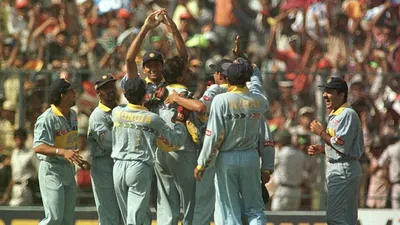
Javagal Srinath occupies a special place in Indian Cricket history. Before speed guns became a constant feature of television broadcasts and before India regularly produced bowlers capable of crossing 150 kph, Srinath was already carrying the country’s fast-bowling attack against some of the world’s strongest batting line-ups.
His career is remembered for 315 ODI wickets, four World Cup appearances, outstanding spells in Test cricket and a reputation for generating serious pace even on Indian pitches. Yet one of the most fascinating parts of his legacy concerns a delivery that reportedly reached 156 kph but was never officially recorded in the way modern speed-gun readings are.
That detail has made Srinath’s career an unusual bridge between two eras. Modern Indian cricket celebrates raw speed through bowlers such as Umran Malik and Mayank Yadav, but Srinath was competing with some of the fastest bowlers in world cricket decades earlier, often without the technological spotlight that exists today.
His story, however, is about much more than one unofficial speed figure. Srinath’s career demonstrates how an Indian fast bowler developed into a genuine strike weapon through pace, movement, accuracy and resilience while operating in an era when spin remained central to India’s cricketing identity.
Who was Javagal Srinath?
Javagal Srinath was an Indian fast bowler from Karnataka who became India’s leading pace spearhead during much of the 1990s. He made his international debut at a time when India’s fast-bowling resources were generally viewed differently from those of countries such as Australia, South Africa, Pakistan and the West Indies.
Srinath initially operated behind established Indian bowlers including Kapil Dev and Manoj Prabhakar. As that generation moved toward the end of its international careers, Srinath assumed greater responsibility.
He eventually became the leading fast bowler of his generation for India, first forming a strong partnership with Venkatesh Prasad and later helping create the pathway for the next generation, including Zaheer Khan.
His nickname, “The Mysore Express,” reflected the combination of his Karnataka roots and his ability to generate serious pace.
The first major sign came on his first-class debut
Srinath’s emergence was dramatic rather than gradual.
Playing for Karnataka during the 1989-90 season, he took a hat-trick on his first-class debut and finished the match with five wickets in the innings. He followed that performance with 25 wickets from six matches.
Those numbers alone did not guarantee international selection, but his pace immediately made him difficult to ignore.
His opportunity came as India prepared for the England tour. Once he began bowling in the national nets, the selectors had a fast bowler with a different kind of weapon: genuine pace combined with the ability to attack the stumps.
That combination would become central to Srinath’s international career.
How Srinath became India’s pace spearhead
Srinath did not simply succeed because he bowled quickly. His effectiveness came from the interaction between pace, movement and accuracy.
He was particularly dangerous when attacking the batter with an inswinger. His cutters also allowed him to remain effective when conditions did not provide conventional seam movement.
His strong physical build enabled him to generate power through his delivery stride, while his hit-the-deck approach meant batters could not simply wait for the ball to arrive at a comfortable height.
That made him particularly valuable on Indian pitches, where fast bowlers often had to work harder for movement and assistance.
Instead of waiting for the pitch to do the work, Srinath could create pressure through his own bowling characteristics.
His rise during the early 1990s
Srinath’s development continued through international cricket. His first tour of Australia did not immediately produce spectacular statistics, but the experience exposed him to a different level of pace bowling, bounce and international competition.
He subsequently improved during India’s 1992 tour of South Africa, taking 12 wickets in three Tests.
That period was important because South African conditions provided a challenging environment for an Indian fast bowler. Srinath’s ability to compete there helped establish him as more than a home-conditions bowler.
Over time, he became one of India’s most dependable pace options across different countries and surfaces.
The Gloucestershire season that transformed his reputation
One of the most significant chapters in Srinath’s development came during his county cricket stint with Gloucestershire in 1995.
He reportedly collected 87 wickets in the season, an extraordinary return that demonstrated how effective he could become with sustained exposure to English conditions and a demanding first-class schedule.
His best first-class figures during that period were 9/76.
The county experience also gave Srinath an opportunity to refine his understanding of seam movement and long spells. Instead of simply relying on speed, he learned how to build pressure across extended periods.
That experience became valuable when he returned to international cricket.
The Ahmedabad masterclass against South Africa
Srinath reached another level during India’s 1996-97 home series against South Africa.
In Ahmedabad, India defended a relatively modest target of 170 and bowled South Africa out for only 105. Srinath was at the centre of the attack, producing a spell that became one of the defining performances of his career.
The performance was notable because it showed that India’s premier fast bowler could dominate a world-class batting side even without the type of traditionally fast-bowling conditions associated with countries such as Australia, England or South Africa.
He finished that series with 18 wickets from three Tests.
The performance also earned enormous praise from India’s captain at the time, Sachin Tendulkar, who highlighted it as an outstanding exhibition of fast bowling by an Indian bowler.
The mysterious 156 kph delivery
This is where Srinath’s story takes a fascinating turn.
During India’s return tour in the 1996-97 period, reports emerged that Srinath had produced a delivery measured at approximately 156 kph.
But unlike modern speed-gun records, the figure was not officially established in a widely recognised statistical record.
A later account published by Cricinfo stated that Srinath’s speeds during the period between December 1996 and February 1997 were above 150 kph and comparable with leading fast bowlers of the era.
The same account referred to a delivery attributed to Srinath that had reportedly reached 156 kph. However, the exact date and match could not be confirmed, meaning the figure should be treated as a reported or attributed speed rather than an officially authenticated international record.
That distinction is especially important when comparing Srinath with modern bowlers.
Why Srinath’s reported speed is difficult to compare with modern records
Modern cricket has sophisticated speed-measuring technology that records deliveries consistently and displays the readings to television audiences.
Older cricket did not always have the same level of standardisation.
Different venues could use different measurement systems, and some historic claims were based on reports rather than official competition databases. Therefore, comparing a reported 156 kph delivery from the 1990s directly with a modern speed-gun reading requires caution.
That does not make Srinath’s pace unimportant.
It simply means that his legacy should be evaluated through the broader evidence: contemporary observations, repeated high-speed spells, wicket-taking ability and performances against elite opposition.
The remarkable point is that Srinath was regularly discussed alongside some of the fastest bowlers in world cricket at a time when India was not yet known as a producer of extreme pace.
Srinath versus the fastest bowlers of his era
| Bowler | Era association | Notable pace context |
|---|---|---|
| Javagal Srinath | 1990s | Regularly operated at high pace and was reportedly timed above 150 kph |
| Allan Donald | 1990s | One of the most feared fast bowlers of his generation |
| Lance Klusener | 1990s | Produced extreme pace while also contributing heavily with the bat |
| Shoaib Akhtar | Late 1990s onward | Established himself as one of cricket’s most recognisable express pacers |
The comparison highlights Srinath’s significance. He was operating in an era when express pace was associated particularly strongly with Pakistan, South Africa, Australia and the West Indies. India’s leading fast bowler was increasingly joining that conversation.
The shoulder injury that threatened his pace
Fast bowling places enormous physical demands on the body, and Srinath’s career was no exception.
A shoulder problem in 1997 affected his bowling and eventually required surgery for a rotator cuff issue. For a bowler whose effectiveness depended heavily on pace and a powerful delivery action, such an injury could have marked the beginning of decline.
Instead, Srinath demonstrated remarkable resilience.
During India’s 1998 home series against Australia, he was still capable of reaching speeds around 148 kph. That was significant because he was doing so after dealing with a serious physical setback.
His ability to retain pace after surgery helped reinforce his reputation as one of India’s most durable fast bowlers of the period.
The 1999 World Cup proved his pace was still elite
Srinath’s performance during the 1999 World Cup in England provided another important reference point.
He reportedly reached 149 kph during the tournament and was regarded as the second-fastest bowler at the World Cup, behind Shoaib Akhtar’s 154.5 kph figure.
That comparison is revealing.
Srinath was not merely a fast bowler by Indian standards. He was competing near the top end of the international pace spectrum.
He also managed to combine that speed with experience and control, making him an important part of India’s campaign.
His World Cup record remains a major part of his legacy
Srinath appeared in four World Cups for India and collected 44 wickets across those tournaments.
His final World Cup appearance came in 2003 in South Africa, where he took 16 wickets at an average of 23.
Those numbers show how long his international career remained relevant.
He was not simply a 1990s fast-bowling phenomenon. He remained India’s major pace presence into the early 2000s, helping the team compete during a transitional period.
The record that shows his long-term importance
Srinath’s ODI numbers provide perhaps the clearest measure of his overall contribution.
He finished his career with 315 ODI wickets, making him India’s leading fast bowler in the format at the time and the only Indian quick to enter the 300-wicket ODI club.
The achievement becomes even more impressive when viewed historically.
India eventually developed a deeper fast-bowling system, producing bowlers such as Zaheer Khan, Jasprit Bumrah and Mohammed Shami. Srinath helped establish the expectation that an Indian fast bowler could be a central part of the attack rather than merely a supporting option.
Why Srinath was more important than his speed
The biggest mistake in evaluating Srinath would be to reduce his career to the reported 156 kph figure.
Speed attracts headlines, but pace alone does not produce 315 ODI wickets or sustained success across a 12-year international career.
Srinath’s real contribution was proving that an Indian fast bowler could combine speed with tactical discipline.
He could swing the ball, use cutters, attack the stumps and maintain pressure through long spells. His ability to adapt helped him remain effective even when his raw pace was not at its absolute peak.
That is a much more meaningful legacy than a single number on a speedometer.
Why India’s modern pace revolution owes something to Srinath
India’s current fast-bowling depth did not appear overnight.
Modern names such as Jasprit Bumrah, Mohammed Shami, Mayank Yadav and other high-speed Indian pacers operate within a cricketing environment that is far more comfortable with fast bowling than it was several decades ago.
Srinath belonged to the generation that helped change that perception.
He demonstrated that an Indian fast bowler could lead an attack, bowl quickly overseas and challenge elite batters without needing a heavily bowler-friendly pitch.
In that sense, Srinath was part of the foundation on which India’s later fast-bowling culture was built.
Why Srinath retired at 33
Srinath announced his retirement from international cricket at the age of 33.
For a bowler of his quality, the decision came while he potentially still had cricket left in him. But the repeated physical problems and the increasing demands placed on his body played a major role in his decision.
He retired from Test cricket in 2002 and hoped to continue through the ODI portion of India’s 2003-04 tour of Australia. However, he was unable to regain sufficient fitness.
His retirement was therefore not simply the end of a career. It marked the closing of an important chapter in India’s transition toward becoming a team capable of relying heavily on fast bowling.
From India’s pace spearhead to international match referee
Srinath’s post-playing career has also been notable.
Rather than remaining solely associated with broadcasting or coaching, he moved into match officiating and became one of the most prominent match referees in international cricket.
The transition reflects another side of his cricketing personality: an understanding of the game that extended beyond bowling.
As a former international player, he brought firsthand knowledge of the pressures faced by teams and players into his work as an official.
The real lesson from the “156 kph” story
The fascination with Srinath’s reported 156 kph delivery is understandable, particularly in an era obsessed with extreme pace.
But the more interesting historical lesson is what the number represents.
It represents a period when Indian cricket was beginning to move away from the idea that fast bowling was primarily the domain of other nations. Srinath arrived before speed measurement became a mainstream part of cricket culture, yet he was already competing with the fastest bowlers in the world.
Today, a 150-plus kph delivery immediately appears on television graphics and social media. Srinath’s fastest reported speeds belong to a different technological era, which makes precise comparisons difficult.
Nevertheless, his performances provide enough evidence to establish that he was genuinely quick and, more importantly, consistently dangerous.
Conclusion: Javagal Srinath’s legacy goes beyond the speed gun
Javagal Srinath was one of the defining Indian fast bowlers of the 1990s and early 2000s. His hat-trick on first-class debut, 87-wicket county season, dominance against South Africa, four World Cup appearances and 315 ODI wickets tell the story of a bowler who transformed India’s pace identity.
The reported 156 kph delivery remains one of the most intriguing details of his career, but it should be treated carefully because it was never established as a standard official speed-gun record.
What cannot be questioned is the broader evidence. Srinath regularly operated at extreme pace, challenged some of the world’s best batters and remained dangerous even after serious shoulder problems.
Modern Indian fast bowling has reached heights that Srinath could only have imagined when he first emerged. Yet the journey toward that era had to begin somewhere.
For India, Srinath was one of the people who made genuine pace feel possible.
His greatest legacy, therefore, is not the 156 kph number. It is the belief that an Indian fast bowler could stand at the top of an international attack and make the world’s best batters uncomfortable.
For breaking news and live news updates, like us on Facebook or follow us on Twitter and Instagram. Read more on Latest Cricket on thefoxdaily.com.






COMMENTS 0