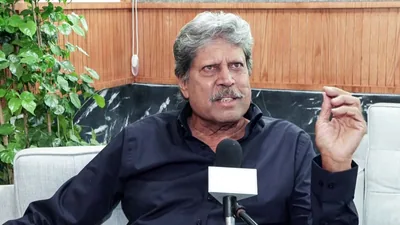
Kapil Dev on India’s spin struggles has highlighted a major concern for Indian Test cricket as the team looks to rebuild after a difficult period at home. The legendary former captain believes the lack of domestic cricket among established players has contributed to the batting unit’s problems against quality spin bowling.
India have struggled against spin in recent home Test series, with defeats against New Zealand and South Africa exposing weaknesses against turning deliveries. The transition following the Test retirements of Virat Kohli, Rohit Sharma and Ravichandran Ashwin has added another layer of difficulty for a younger Indian side.
Kapil believes regular domestic red-ball cricket could provide an important solution. Speaking at the launch of Bengaluru Blasters ahead of the inaugural JITO Premier League, he called on the Board of Control for Cricket in India (BCCI) to make multi-day domestic cricket a priority for senior players.
Kapil Dev urges senior players to play domestic cricket
According to Kapil, experienced players can improve their own skills against spin while simultaneously helping the next generation understand the demands of longer-format cricket.
“Playing domestic cricket is very important. The reason why Indian teams struggle against spin is because the top players don’t play enough domestic cricket,” Kapil said.
He added that the BCCI should take a stronger position on the participation of established cricketers in domestic competitions, particularly in multi-day matches.
“That’s where the BCCI should put its foot down and make everyone play multi-day matches. The other aspect is that the younger generation will get to learn from the top players,” he added.
The former India captain’s argument is particularly relevant during a period of transition. Domestic cricket provides batters with regular exposure to different pitches, match situations and bowling styles, while multi-day games also demand patience and technical discipline that can be difficult to develop exclusively through limited-overs cricket.
Why India’s batters are struggling against spin
India have traditionally been regarded as one of the strongest teams against spin, particularly in home conditions. However, recent results have challenged that reputation.
The retirements of several experienced Test batters mean India no longer have the same level of accumulated experience in the middle order. Younger players now face the responsibility of succeeding in conditions where opponents can exploit turning surfaces.
Kapil believes the modern cricket calendar is another factor. The growth of T20 cricket has given players greater exposure to aggressive batting but does not necessarily replicate the demands of Test cricket.
“In recent times, India has not been the best against spin bowling. They play too many T20s and ODIs. Test matches are a different ball game. I hope they can put their heads together,” Kapil said.
The difference is significant. In T20 cricket, batters are often encouraged to attack from the beginning of an innings, while Test cricket requires them to repeatedly defend, rotate the strike and build partnerships over long periods.
Against spin, those skills become even more important because batters must judge length early, use their feet effectively and manage changes in pace and turn.
Domestic cricket could benefit India’s next generation
Kapil’s proposal is not only about helping established international players. He also believes their participation would improve the development environment for younger cricketers.
When senior international players appear in domestic matches, emerging batters and bowlers gain an opportunity to compete against and learn from experienced opponents. Such exposure can accelerate development and provide a clearer understanding of the standards required at international level.
For young Indian batters, facing quality domestic spinners across multiple days can also provide valuable preparation for Test cricket. Instead of learning to counter spin only after reaching the international level, players can develop those skills throughout their domestic careers.
The challenge for the BCCI is finding the right balance between domestic commitments, international cricket, franchise competitions and player workload. Senior players are already involved in demanding schedules, making mandatory participation a complicated issue.
Kapil Dev also raises fast-bowling workload concerns
Kapil did not limit his comments to India’s batting problems. The former fast-bowling all-rounder also warned about the physical demands placed on modern pace bowlers, particularly because of the huge expansion of T20 cricket.
He believes players need to understand their own physical limitations while the BCCI must monitor workloads carefully to reduce the risk of injuries.
“One should know about one’s own body. There is too much T20 cricket happening, so you have to be careful about the toll it takes on the body,” Kapil said.
He also highlighted the physical demands of fast bowling and urged administrators to consider how much cricket pacers can realistically handle.
“Our body is actually not tuned to being a fast bowler. Our body is more tuned to being a batter. The BCCI should look into how much workload can be given to fast bowlers,” he added.
India face a crucial Test transition
Kapil’s comments arrive at an important stage for Indian Test cricket. The departures of Kohli, Rohit and Ashwin have removed several years of experience from the side, leaving younger players to establish themselves in the longest format.
That transition makes preparation particularly important. India cannot rely solely on international Test matches to solve technical weaknesses, especially against spin in conditions where opponents are likely to attack the stumps and exploit turn.
Domestic cricket could therefore become an important part of India’s Test rebuilding process. Regular multi-day matches would give senior players a chance to sharpen their red-ball skills while allowing younger cricketers to gain experience alongside established names.
At the same time, the workload of fast bowlers will require careful management as India continue to compete across Test, ODI and T20 cricket.
Kapil Dev’s central message is therefore broader than simply asking players to play more domestic cricket. He is calling for a stronger connection between India’s domestic structure and international ambitions, with preparation, player development and workload management receiving greater attention.
For a team attempting to rebuild its Test identity, addressing those areas could prove crucial. India’s ability to counter spin and keep its premier fast bowlers fit may have a major influence on how successfully the next generation takes over from the previous era.
For breaking news and live news updates, like us on Facebook or follow us on Twitter and Instagram. Read more on Latest Cricket on thefoxdaily.com.






COMMENTS 0