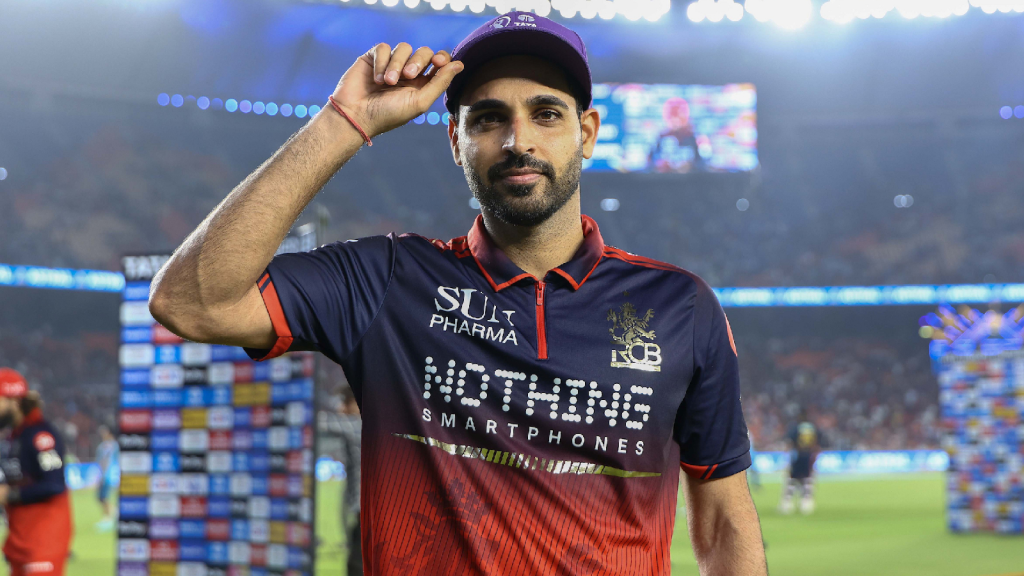
India’s preparations for the decisive fifth T20I against the West Indies have taken an unexpected turn after veteran fast bowler Bhuvneshwar Kumar was added to the squad following an injury to Arshdeep Singh. The change comes with the five-match series level at 2-2, leaving both teams with everything to play for in the final encounter.
Bhuvneshwar, 36, is in line for an international comeback after nearly four years away from the Indian team. His last T20I appearance came against New Zealand in November 2022. Although he was initially expected to return during India’s upcoming tour of New Zealand, Arshdeep’s shoulder injury has brought his potential comeback forward.
The Board of Control for Cricket in India (BCCI) confirmed that Bhuvneshwar had been added to the squad after Arshdeep sustained a blow to his bowling shoulder during the fourth T20I in Hyderabad on Wednesday. However, the experienced pacer’s availability for the series decider was not guaranteed, with a final decision dependent on his recovery before the match.
The development gives India an experienced pace-bowling option at a crucial stage of the series. It also raises questions about how the team will approach the final match, particularly if conditions in Bengaluru favour seam bowling or rain interrupts the contest.
Why Bhuvneshwar Kumar Has Been Added to India’s T20I Squad
Bhuvneshwar’s inclusion follows an injury sustained by Arshdeep during India’s fourth T20I against the West Indies in Hyderabad. The left-arm seamer took a blow to his bowling shoulder, prompting the selectors and team management to bring in an experienced replacement ahead of the final match.
In a statement, BCCI secretary Devajit Saikia confirmed the circumstances surrounding the squad change and explained that Bhuvneshwar’s participation would depend on his recovery.
The distinction between being added to the squad and being declared fit to play is important. Bhuvneshwar’s inclusion provides India with an additional option, but it does not automatically confirm his place in the playing XI. The team must assess his readiness and decide whether he can contribute effectively in a high-pressure international fixture.
For India, the immediate priority is to maintain bowling balance without compromising the team’s chances of winning the series. Arshdeep’s absence would remove a left-arm pace option, while Bhuvneshwar would offer a different set of skills through his ability to move the ball and vary his pace.
Bhuvneshwar Kumar’s International Comeback After Four Years
Bhuvneshwar’s potential return is significant because he has been away from India’s T20I setup since November 2022. During his international career, the right-arm seamer established a reputation for controlling the new ball, exploiting movement in the air and off the pitch, and delivering variations during the closing overs.
Unlike a bowler who relies primarily on pace, Bhuvneshwar has built much of his success around accuracy, swing and changes in trajectory. These qualities can be valuable in T20 cricket, where batters frequently attempt to attack from the opening overs and accelerate towards the end of an innings.
His experience could be especially useful in a series decider, where a single expensive over or an early breakthrough can influence the outcome. However, international cricket presents different demands from domestic competitions, and his selection would need to account for his fitness, current rhythm and ability to handle the conditions.
The upcoming match would also provide an opportunity to assess how his bowling approach fits India’s present T20I combination. His return would not simply be about restoring a familiar name to the squad; it would be about determining whether his specific strengths can address the team’s needs in the final match.
Bhuvneshwar Kumar’s Recent T20 Form Strengthens His Case for Selection
One of the strongest arguments in favour of Bhuvneshwar’s return is his recent performance in the Indian Premier League (IPL). The veteran pacer has been among the leading wicket-takers across the previous two IPL editions, collecting 45 wickets during that period, according to the supplied report.
That record suggests he has continued to make an impact in the shortest format despite his absence from the international side. For a bowler returning after a lengthy break, recent competitive performances can provide an important indication of his ability to handle the demands of T20 cricket.
Bhuvneshwar also remains the highest wicket-taker among Indian pacers in T20 cricket, according to the report. His experience across domestic and franchise competitions gives India another option when the team needs to break partnerships, control scoring or defend a total.
However, IPL performances and international requirements are not identical. Conditions, opposition strategies and the pressure associated with representing India can differ considerably. His recent wicket-taking record strengthens the case for considering him, but it does not eliminate the need for a fitness assessment before the series decider.
What makes Bhuvneshwar valuable in T20 cricket?
Bhuvneshwar offers several qualities that could help India in different phases of a T20 innings.
- New-ball swing: His ability to move the ball can create opportunities for early wickets, particularly when conditions offer assistance to seam bowlers.
- Control over line and length: Consistent bowling can restrict batters from scoring freely, even when outright pace is not the primary weapon.
- Variations at the death: Changes in pace and trajectory can make it more difficult for batters to predict deliveries during the closing overs.
- Experience under pressure: Having played at the highest level, he brings familiarity with the tactical decisions involved in defending totals and managing difficult passages of play.
These qualities could become particularly relevant if India face a challenging run chase or need to defend a modest total. Nevertheless, the effectiveness of swing and slower deliveries depends on conditions, execution and the opposition’s approach.
India vs West Indies T20I Series: How the Contest Reached 2-2
The fifth T20I has become a winner-takes-the-series contest after India and the West Indies exchanged victories during the first four matches. Neither side has managed to establish a decisive advantage, setting up a high-pressure finish.
According to the supplied report, India won the opening and third matches in Lucknow and Indore, while the West Indies secured victories in Ranchi and Hyderabad. The results have left the teams level at two wins apiece.
The pattern of the series makes the final match particularly important. India have already demonstrated their ability to defeat the West Indies, but the visitors have responded with victories of their own. The decisive encounter will therefore test which team can execute its plans more effectively under pressure.
The series has also been described as high-scoring, making the balance between batting aggression and bowling discipline an important consideration. In T20 cricket, a team can score rapidly and still lose if it fails to control the opposition’s response. Equally, a strong bowling performance can change a match even when the batting side has established a promising position.
Why the fifth T20I matters for India
A series decider offers more than an opportunity to secure a trophy or series victory. It also provides an indication of how a team responds when there is little room for error.
For India’s batters, the challenge will be to establish a competitive total or manage the chase without allowing pressure to dictate their decisions. For the bowlers, early breakthroughs, disciplined middle overs and effective execution at the death could prove decisive.
The possible absence of Arshdeep would add another selection consideration. India would need to determine how best to distribute the pace-bowling workload while ensuring that the attack retains options for different phases of the innings.
Bhuvneshwar’s potential return could help address that challenge, provided he is fit enough to play. His experience may offer the team an alternative approach to controlling the innings, although the final decision will depend on the conditions and the team’s assessment of its available bowlers.
Arshdeep Singh’s Shoulder Injury: What It Means for India’s Bowling Attack
Arshdeep’s injury is the immediate reason for Bhuvneshwar’s inclusion. The left-arm fast bowler sustained a blow to his bowling shoulder during the fourth T20I against the West Indies in Hyderabad.
A shoulder injury can be particularly significant for a fast bowler because bowling places repeated physical demands on the shoulder and the surrounding muscles. The precise implications depend on the nature and severity of the injury, which the supplied report does not establish.
It would therefore be premature to draw conclusions about the length of Arshdeep’s recovery or the seriousness of the problem without further medical information. The confirmed development in the supplied report is that he sustained a blow and that Bhuvneshwar was added to the squad as a result.
Arshdeep’s left-arm angle also gives India a different option from a right-arm seamer. A change in bowling angle can affect how batters approach deliveries, particularly when they are attempting to score through the off side or adjust to movement away from or towards the bat.
If Arshdeep is unavailable, the team management will have to consider how to replace those specific qualities rather than simply looking for another fast bowler. Bhuvneshwar’s control and movement could help, but the two bowlers do not offer identical skill sets.
That distinction matters in a series where both teams have already demonstrated their ability to win. India’s selection decision must account for individual fitness as well as the overall combination of the bowling attack.
Rain Threat in Bengaluru Adds Another Challenge to the Series Decider
Weather is another factor that could influence the fifth T20I. The supplied report highlights a rain threat and a muggy forecast for Bengaluru on Saturday, creating uncertainty around the conditions for the decisive match.
Rain can affect a T20 contest in several ways. A delayed start may reduce the time available for play, while interruptions during an innings can force teams to reassess their scoring plans. Depending on the competition’s playing conditions, a shortened match may also change the calculations required to set or chase a target.
Humidity and moisture can influence how players experience conditions, but their actual effect on bowling and batting cannot be determined from a general forecast alone. The pitch, outfield, timing of any showers and the amount of uninterrupted play will all matter.
For the team management, the possibility of interruptions makes flexibility particularly important. Batters may need to adjust their approach if fewer overs become available, while bowlers must be prepared to execute plans without assuming that the match will follow its original schedule.
The toss could also influence tactical decisions, depending on the conditions at the time. However, it would be inaccurate to assume in advance that either batting first or chasing will provide a definite advantage. Such decisions must be based on the actual match-day circumstances.
How weather could affect India’s team combination
If the conditions offer assistance to seam bowling, India’s selection panel may place additional value on bowlers capable of exploiting movement and maintaining control. Bhuvneshwar’s skill set could be relevant in that situation, but the team would still need to assess his fitness before including him.
If the match is interrupted or shortened, execution may become even more important than a team’s preferred long-term bowling plan. Captains could have fewer overs available to use particular bowlers, making flexibility in the attack valuable.
These remain conditional possibilities rather than confirmed developments. The eventual effect of the weather will depend on the conditions experienced during the match itself.
India’s Updated T20I Squad for the West Indies Decider
Following Bhuvneshwar’s addition, the squad listed in the supplied report contains a mix of specialist batters, wicketkeepers, all-rounders, spinners and fast bowlers. The selection provides India with several options, although the final playing XI will depend on fitness, tactical requirements and the assessment before the match.
The updated squad, as provided in the report, is listed below.
- Shreyas Iyer (Captain)
- Abhishek Sharma
- Vaibhav Sooryavanshi
- Ishan Kishan (Wicketkeeper)
- Sanju Samson (Wicketkeeper)
- Tilak Varma (Vice-Captain)
- Shivam Dube
- Kuldeep Yadav
- Axar Patel
- Ravi Bishnoi
- Nitish Kumar Reddy
- Arshdeep Singh
- Prince Yadav
- Mayank Yadav
- Naman Dhir
- Bhuvneshwar Kumar
There is an important distinction between the squad list and the final match-day selection. Although Bhuvneshwar has been added, his participation remains subject to recovery, while the report identifies Arshdeep’s shoulder injury as the reason for the change. The presence of Arshdeep’s name in the supplied squad list does not, by itself, establish that he will be fit to play.
India’s team management will need to balance the availability of experienced players with the requirements of the conditions. A strong squad provides options, but those options only become useful when the selected players are fit and suited to the roles required.
What Bhuvneshwar’s Return Could Mean for India’s T20 Plans
Bhuvneshwar’s potential return raises a broader question about the value of experienced specialists in modern T20 cricket. The format increasingly rewards batters who can attack consistently, placing pressure on bowlers to combine wicket-taking ability with control.
Experience can help a bowler recognise when to prioritise a breakthrough and when to limit the opposition’s scoring. It can also support decisions about field placement, changes in pace and the use of different deliveries against specific batters.
However, experience alone does not guarantee success. T20 cricket can quickly punish predictable lengths, inaccurate yorkers or slower deliveries that fail to deceive the batter. A returning player must still execute the required skills against an opposition that has prepared to exploit weaknesses.
For India, Bhuvneshwar’s IPL performances provide a reason to consider him, while the four-year gap since his last T20I highlights the importance of assessing his readiness for international cricket. The fifth match could offer an opportunity for a comeback, but only if the team believes he can make an immediate contribution.
His possible selection should also be viewed separately from longer-term decisions about India’s bowling combination. One match cannot, on its own, establish whether an experienced player should become a regular part of the T20I setup again. That assessment would require sustained performances, fitness and consistency over time.
What Happens Next Before the Fifth T20I?
The immediate focus will be on the fitness assessments ahead of the series decider. The BCCI has indicated that Bhuvneshwar’s participation will be determined according to his recovery, leaving the final decision open until closer to the match.
Several factors will shape India’s preparations:
- Bhuvneshwar’s fitness: The team must establish whether he is ready to bowl at the required intensity.
- Arshdeep’s recovery: Further assessment will determine whether the injured left-arm seamer can be considered for selection.
- Weather conditions: The forecast and the actual state of the playing surface could influence the team’s tactical approach.
- Bowling balance: The management must select a combination capable of taking wickets while controlling runs throughout the innings.
- Series pressure: With the contest level at 2-2, both teams will need to manage their decisions carefully in a match that determines the series winner.
Until the final fitness and selection decisions are confirmed, Bhuvneshwar’s inclusion should be understood as an opportunity for India rather than a guaranteed appearance. The experienced pacer has a strong recent record in the IPL, but his immediate role will depend on whether he is ready for international competition.
India vs West Indies Fifth T20I: The Key Takeaway
Bhuvneshwar Kumar’s addition to India’s T20I squad has given the team an experienced pace-bowling option ahead of a decisive match against the West Indies. His recent IPL performances strengthen the case for his return, while his ability to swing the ball and vary his pace could be useful if he is declared fit.
At the same time, Arshdeep Singh’s shoulder injury creates uncertainty around India’s bowling combination, and the possibility of rain adds another variable to the contest. The team must make its final decisions based on player fitness and the conditions available in Bengaluru.
With the five-match series tied at 2-2, the fifth T20I presents both teams with a clear opportunity to secure the series. Whether Bhuvneshwar makes his long-awaited international return will be one of the main selection questions, but the larger challenge for India will be assembling a balanced attack capable of delivering under pressure.
For breaking news and live news updates, like us on Facebook or follow us on Twitter and Instagram. Read more on Latest Cricket on thefoxdaily.com.






COMMENTS 0