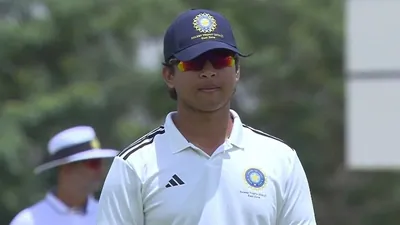
Vaibhav Sooryavanshi produced one of the most encouraging innings of his young first-class career when he scored 92 against Central Zone in the Duleep Trophy semifinal.
The scorecard shows an explosive innings: 92 runs from 81 balls, seven fours, seven sixes and a strike rate of 113.58. On the surface, those numbers appear to be another example of the destructive batting style that has made Sooryavanshi one of the most exciting young players in Indian Cricket.
However, the more important aspect of the innings was not simply how aggressively he scored. It was the way the 15-year-old showed signs of adapting his game to the demands of red-ball cricket.
Vaibhav Sooryavanshi’s 92 Was More Than Just Boundary Hitting
Seven fours and seven sixes meant that 70 of Sooryavanshi’s 92 runs came through boundaries. That represents more than three-quarters of his total score and highlights the extraordinary power he possesses at such a young age.
But the remaining 22 runs came from 67 deliveries. That detail tells a different story about his innings.
During those deliveries, Sooryavanshi was often defending, rotating the strike or waiting for the right opportunity rather than attempting to attack every ball. That patience is particularly important for a batter whose reputation has been built around aggressive strokeplay.
The biggest challenge for Sooryavanshi in first-class cricket was never expected to be his ability to hit boundaries. Instead, it was whether he could learn to remain patient when bowlers were able to control the contest for extended periods.
Sooryavanshi Added Patience Without Losing His Aggression
Sooryavanshi began his innings in typically aggressive fashion. He reached 40 from only 28 deliveries and immediately put pressure on the Central Zone bowlers.
He was also given a significant reprieve after a top edge was dropped when he was on 40. Instead of becoming overly aggressive after receiving the second opportunity, he showed greater restraint and eventually reached his record-breaking half-century from 42 balls.
Interestingly, his scoring rate slowed after reaching fifty. His first 50 runs came from 42 deliveries, while his next 42 runs required another 39 balls.
For a naturally attacking batter, that change of tempo was significant. It showed that he was capable of moving between different gears rather than relying on constant aggression.
The Young Batter Is Learning to Add More Gears
Becoming a better red-ball batter does not necessarily mean becoming more defensive. For Sooryavanshi, the goal should be to retain the attacking qualities that make him special while developing the ability to play according to the situation.
His innings against Central Zone suggested that this process has already started.
When bowlers provided him with deliveries in his hitting area, he attacked without hesitation. His seven sixes demonstrated that his natural attacking instincts remain intact.
At other moments, however, he defended good deliveries, played grounded strokes and allowed his opening partner Abhimanyu Easwaran to control the scoring during certain periods.
This ability to understand when to attack and when to wait is one of the most important differences between limited-overs and first-class batting.
Why His Red-Ball Development Matters
In T20 cricket, a sequence of dot balls can create immediate pressure because the batter has a limited number of deliveries available. In first-class cricket, however, a batter can afford to spend time defending and waiting for the right ball.
Sooryavanshi appears to be learning this distinction quickly.
Before the semifinal, he had scored 215 runs from 13 first-class innings at an average of 16.53. His previous first-class best was 93 for Bihar against Meghalaya.
That meant his red-ball record had not yet matched the extraordinary performances and age-related records he had produced in white-ball cricket.
The 92 against Central Zone does not answer every question about his first-class future, particularly given his age. But it provides an encouraging indication that he is beginning to understand the demands of the longer format.
The Dismissal at 92 Shows There Is Still More to Learn
Ironically, Sooryavanshi’s dismissal highlighted one of the areas where he still has room to develop.
With his maiden first-class century within reach, he attempted another aggressive shot towards the leg side against Harsh Dubey. The ball went towards deep mid-wicket, where he was caught.
He finished on 92, only eight runs short of his first-class century.
The disappointment was clear as he left the field, but the dismissal should not overshadow the quality of the innings that came before it.
At just 15 years old, Sooryavanshi is still learning how to balance risk and reward in red-ball cricket. Not every decision will be perfect, and that is part of the development process.
92 Instead of 100 Could Still Be a Major Turning Point
The difference between 92 and 100 may appear significant on a scorecard, but the bigger takeaway from the innings is the expansion of Sooryavanshi’s batting options.
He demonstrated that he can attack when the conditions allow it, defend when necessary and rotate the strike without abandoning his natural style.
That combination could become extremely valuable as his career develops.
Sooryavanshi does not need first-class cricket to remove the aggressive qualities that have made him stand out. Instead, he needs to develop the judgment to know when those qualities should be unleashed.
His 92 against Central Zone was therefore about much more than missing a century. It was evidence that the teenager is beginning to understand how to make time work in his favour in red-ball cricket.
What Could This Mean for Vaibhav Sooryavanshi’s Future?
It would be premature to make major predictions about a 15-year-old based on one innings. However, the signs from this Duleep Trophy semifinal will encourage selectors and supporters.
The combination of explosive strokeplay, improved patience, defensive ability and better shot selection gives Sooryavanshi another dimension as a batter.
If those skills continue developing while his attacking instincts remain intact, his potential in first-class cricket could become just as intriguing as his already impressive record in the shorter formats.
For now, the 92 may be remembered as the innings in which Vaibhav Sooryavanshi showed that he is not simply learning how to hit the ball harder. He is learning how to build an innings.
For breaking news and live news updates, like us on Facebook or follow us on Twitter and Instagram. Read more on Latest Cricket on thefoxdaily.com.






COMMENTS 0