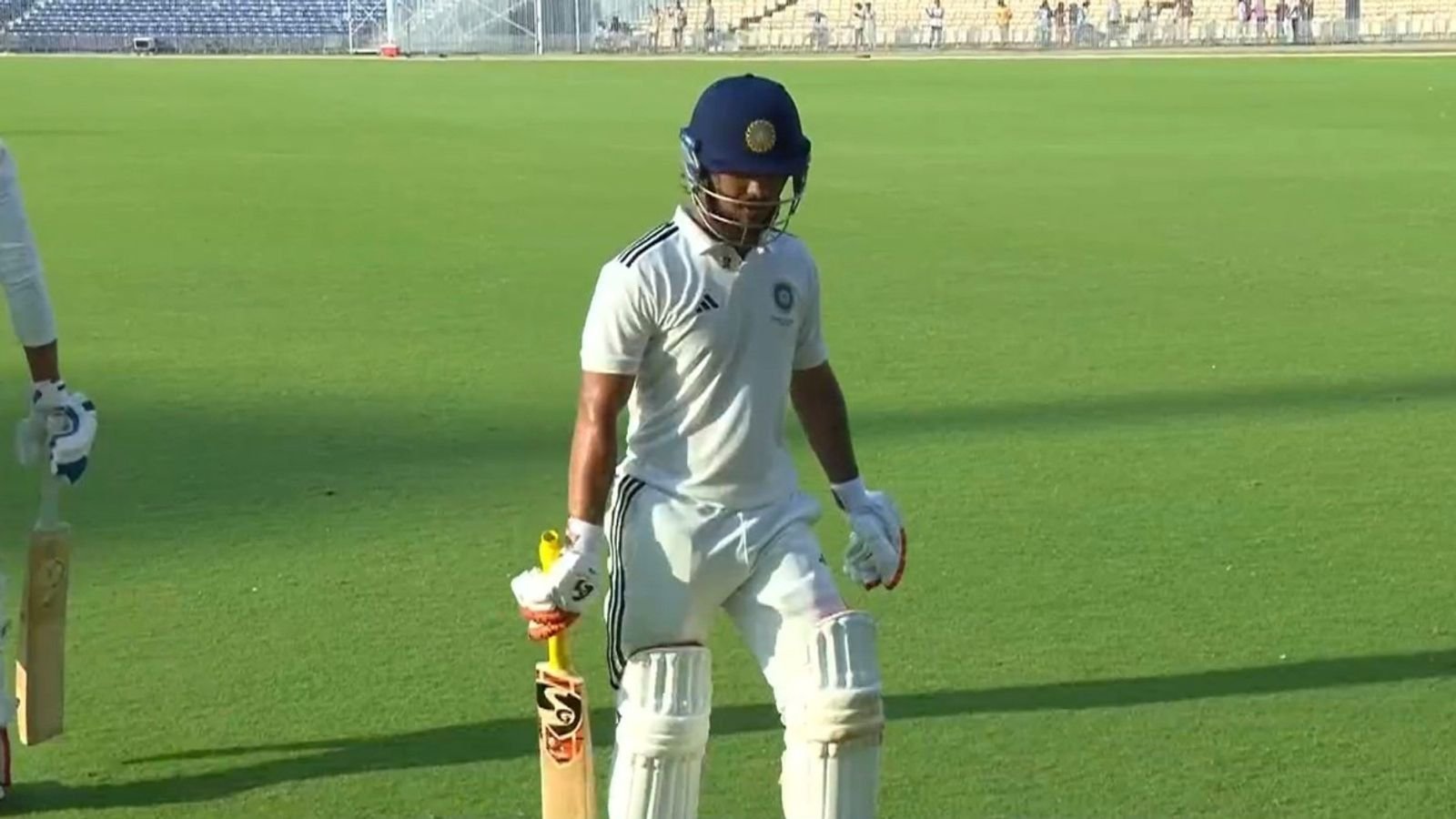
Ishan Kishan produced one of the defining knocks of the Duleep Trophy 2026 final, scoring a belligerent 270 as East Zone piled up 708 against South Zone on Day 2 in Chennai. The enormous total broke East Zone’s previous highest score in the competition, a record that had stood for 40 years.
Starting the day at 385/4, East Zone eventually batted through 163 overs before being bowled out. Kishan dominated the contest with an innings built around 30 fours and seven sixes, while Kumar Kushagra provided crucial support with a century.
The scale of East Zone’s total has placed Tilak Varma’s South Zone under immediate pressure. With the pitch having offered considerable assistance to batters during the opening two days, South Zone now have to construct a substantial response while also managing the challenge of a long first innings.
Ishan Kishan turns the Duleep Trophy final into a personal landmark
Kishan’s 270 was not simply a big score; it placed his name alongside some of the most significant batting performances in Duleep Trophy history.
His innings became the second-highest individual score in a Duleep Trophy final. He also became the first captain to score more than 250 in a Duleep Trophy final, adding another distinction to an already remarkable performance.
Overall, the 270 ranks among the highest individual scores recorded in Duleep Trophy cricket. For East Zone, the knock also came within sight of Arun Lal’s monumental 287 against West Zone in the 1986 edition.
That historical connection makes Kishan’s innings particularly interesting. Arun Lal’s 287 remains East Zone’s benchmark in the competition, while Kishan has now produced the second-highest score by an East Zone batter in Duleep Trophy cricket.
East Zone erase a 40-year-old team record
The most important team achievement on Day 2 was East Zone’s total of 708. Before this match, their highest Duleep Trophy score was 561, which they made against West Zone in the 1986 semi-final.
That record survived for four decades before Kishan’s team finally surpassed it. The difference is substantial: East Zone did not merely edge past 561; they moved well beyond it and crossed the 700-run mark.
The record illustrates how extraordinary the batting conditions and East Zone’s execution were across the first two days. It also places South Zone’s bowlers in a difficult position because they spent a considerable amount of time on the field without being able to consistently break partnerships.
For East Zone, however, the record provides more than statistical value. A score above 700 in a final can alter the entire tactical balance of a multi-day match because the opposition must first survive a huge workload at the crease.
How East Zone started Day 2
East Zone resumed Day 2 at 385/4, with Kishan unbeaten on 111 and Kumar Kushagra on 63. South Zone had the second new ball available, creating an opportunity to attack the two established batters before the partnership could become too damaging.
That breakthrough never arrived quickly enough.
Kishan continued to accumulate runs while Kushagra settled into his role at the other end. South Zone’s pace attack struggled to force an error, allowing the fifth-wicket partnership to grow into one of the defining stands of the innings.
By the time Kishan reached 150, he had faced 204 deliveries. His progress demonstrated the combination of patience and aggression that ultimately made his innings so difficult to contain.
Kumar Kushagra provides the perfect support act
While Kishan naturally dominated the headlines, Kumar Kushagra’s 101 was crucial to East Zone’s record total. The wicketkeeper-batter reached his century from 128 balls and gave the innings valuable momentum.
Kushagra eventually fell for 101 from 132 deliveries, with eight fours and five sixes. His dismissal ended a fifth-wicket partnership worth 230 runs.
The importance of that stand cannot be overstated. South Zone needed an early breakthrough after the overnight score, but instead Kishan and Kushagra added another 230 runs and moved East Zone from a strong position into an overwhelmingly dominant one.
At the end of the first session, East Zone had reached 491/5, with Kishan unbeaten on 171. The scoreboard already suggested that South Zone’s bowlers were facing a marathon day.
Kishan reaches 200 with aggressive strokeplay
The second session became Kishan’s showcase. South Zone attempted to unsettle him with banter, with Tilak Varma and Mohammed Siraj involved in the exchanges. Kishan’s response was delivered with the bat.
He struck three fours in an over from Shreyas Gopal before continuing to attack. Devdutt Padikkal was also brought into the bowling attack as South Zone searched for an alternative method of breaking the partnership and controlling the scoring rate.
In the 122nd over, Kishan reached his double century from 270 balls. Rather than becoming conservative after reaching 200, he continued looking for boundaries.
Anukul Roy played the supporting role at the other end while Kishan repeatedly targeted the boundary. South Zone spread the field, but that created another problem: the defensive setup reduced immediate wicket-taking opportunities while allowing Kishan to pick off runs when the ball entered his hitting zones.
The 250 comes before fatigue forces Kishan off
Kishan reached another landmark in the 130th over, bringing up his 250 from 300 deliveries. At that point, his innings had already become historically significant.
But the physical demands of such a long innings eventually became apparent. Immediately after reaching 250, Kishan returned to the dressing room retired hurt as fatigue caught up with him.
His temporary departure created an unusual twist in the innings. East Zone still had runs to add, but their most destructive batter was no longer at the crease.
Roy eventually fell for 45 from 98 balls shortly before the tea interval, leaving East Zone at 626/6. Despite Kishan’s absence, the team had already built a commanding platform.
Kishan returns to chase the triple century
Kishan returned during the third session after East Zone lost further wickets. His reappearance immediately revived the possibility of a triple century.
He resumed his aggressive approach, but South Zone had adjusted their field. With the boundary riders spread around the ground, easy fours and sixes became harder to find, while Kishan appeared increasingly unwilling to spend long periods running between the wickets.
South Zone’s bowlers eventually found the breakthrough they needed. Kishan attempted another attacking stroke but was caught at long-off by Smaran Ravichandran off Tripurana Vijay.
His dismissal ended a monumental innings of 270 from 334 balls, including 30 fours and seven sixes.
The triple century was therefore left unfinished, but Kishan had already done enough to reshape the match. His 270 had taken East Zone into territory that South Zone now have to negotiate carefully.
South Zone finally close out the innings
Tripurana Vijay played a significant role in ending East Zone’s resistance. After dismissing Kishan, he also removed Mukesh Kumar for a four-ball duck in the same over.
East Zone were eventually bowled out for 708 in 163 overs.
For South Zone, the bowling figures underline how difficult the day was. Mohammed Siraj, one of the side’s leading fast-bowling options, bowled 25 overs without taking a wicket and conceded 140 runs.
That statistic captures the scale of East Zone’s batting dominance. Even a bowler of Siraj’s international experience was unable to make the breakthrough South Zone needed during a lengthy spell.
Why South Zone face an uphill task
South Zone now have to respond to a first innings total of 708, making their immediate objective simple: bat for a long time and avoid giving East Zone a chance to take control with early wickets.
The pitch has largely favoured batting during the opening stages of the final, which provides South Zone with some reason for optimism. However, a surface that has supported strokeplay for two days can change as the match progresses.
Wear and tear could eventually bring the bowlers into the contest. Footmarks may become more useful to spinners, while variable bounce can become a factor as the surface deteriorates.
That makes South Zone’s first innings particularly important. They cannot afford a collapse simply because they are attempting to match East Zone’s enormous score.
What South Zone need to do from here
South Zone’s response should be built around survival first and acceleration second. The target of 709 to avoid conceding a first-innings deficit is enormous, and chasing it aggressively from the beginning could expose the batting lineup to unnecessary risks.
The first priority will be to establish partnerships. East Zone have already demonstrated how valuable long stands can be, and South Zone will need their own version of that strategy.
The second challenge is managing the spinners. After more than 160 overs in the field, East Zone’s bowling unit will eventually have opportunities to exploit a deteriorating surface.
South Zone also need to consider the match situation rather than the scoreboard alone. If reaching 709 becomes unrealistic, preserving wickets and batting deep may become more important than trying to erase the entire deficit immediately.
Who wins if the Duleep Trophy final ends in a draw?
The first-innings lead could become decisive if the Duleep Trophy final finishes without a result.
Because East Zone have already scored 708, South Zone must go past that total to secure a first-innings lead. If South Zone fail to cross 708 and the match eventually ends in a draw, East Zone would win the title on the basis of their first-innings advantage.
This makes South Zone’s innings especially important even if the pitch continues to favour batting. Reaching a large total is not only about avoiding defeat; it could determine which team is crowned champion if neither side can force a victory.
Kishan’s 270 changes the tactical equation
The biggest difference between the two teams after Day 2 is not simply the number of runs on the scoreboard. It is the amount of pressure created by those runs.
East Zone can now attack South Zone’s top order knowing that they have a massive cushion behind them. Their bowlers do not need to chase wickets recklessly because the first-innings total gives them room to experiment with attacking fields.
South Zone have the opposite problem. Every early wicket increases the pressure because the scoreboard already looks enormous.
This is why Kishan’s innings could prove decisive even if he does not bowl or contribute further. A 270-run captain’s knock has fundamentally changed the conditions under which the rest of the final will be played.
Historical significance of Kishan’s innings
Kishan’s performance belongs in a particularly strong statistical category. Scoring 270 in a Duleep Trophy final requires both extraordinary concentration and the ability to repeatedly convert opportunities once a batter becomes established.
The fact that he crossed 250 as captain makes the achievement even more distinctive. He also came within 17 runs of Arun Lal’s East Zone record of 287, meaning his innings is now one of the most significant individual performances by an East Zone batter in the competition’s history.
At 25, Kishan still has considerable cricket ahead of him, making the innings potentially important beyond this final. Long first-class performances can demonstrate qualities that are difficult to measure through shorter formats: patience, concentration, shot selection and the ability to bat through changing phases of a match.
Final outlook: East Zone hold the advantage
East Zone have put themselves in a commanding position in the Duleep Trophy 2026 final. Ishan Kishan’s 270, Kumar Kushagra’s 101 and a total of 708 have given them the strongest possible platform after two days.
The 40-year-old team record has been broken, Kishan has produced the second-highest score in a Duleep Trophy final and East Zone have forced South Zone into a huge first-innings battle.
South Zone are not out of the contest. The batting-friendly nature of the pitch means they can still build a substantial total, and a long series of partnerships could change the momentum. But the longer the match progresses without South Zone making significant progress towards 708, the more control East Zone will have.
The next phase of the final will therefore be decided by South Zone’s response. If their batters withstand the pressure and cross East Zone’s total, the contest could become dramatically more competitive. If they collapse short of 708, Kishan’s historic innings may ultimately prove to be the foundation of an East Zone title-winning performance.
For breaking news and live news updates, like us on Facebook or follow us on Twitter and Instagram. Read more on Latest Cricket on thefoxdaily.com.






COMMENTS 0