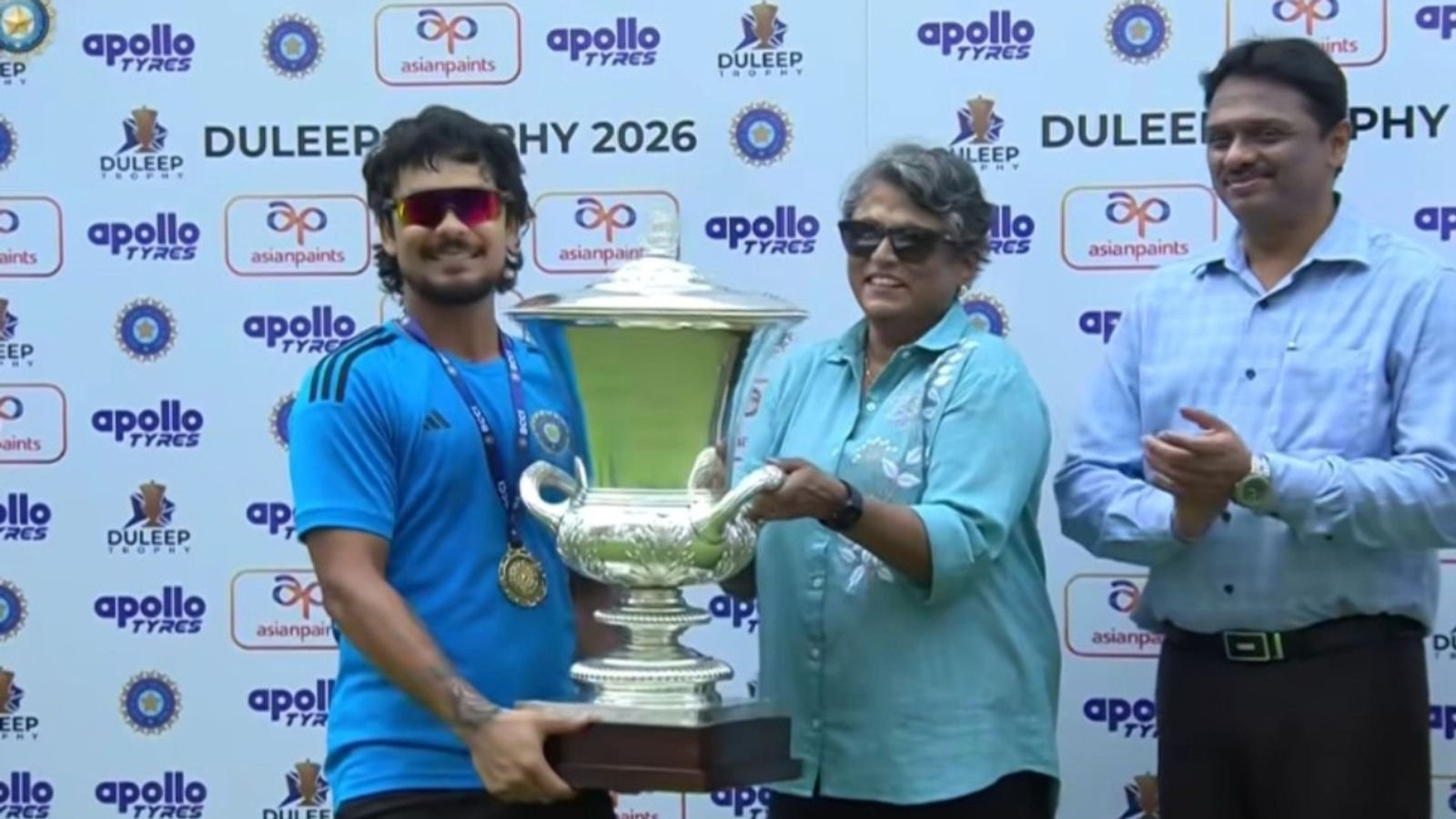
East Zone won the Duleep Trophy 2026 after the final against South Zone ended in a draw at the M.A. Chidambaram Stadium in Chennai on Thursday. Despite there being no outright result on the final day, East Zone were crowned champions because their enormous first-innings advantage had already put them firmly ahead in the contest.
The triumph ended a 13-year wait for East Zone, who had last lifted the prestigious domestic first-class trophy in 2013. Captain Ishan kishan was the central figure in their campaign, producing a remarkable 270 in the first innings to help his team reach a mammoth 708.
South Zone fought hard after being placed under significant pressure, but the deficit created during the opening innings proved too large to overcome. With the final eventually ending without a decisive result, East Zone’s first-innings superiority became the determining factor.
East Zone crowned Duleep Trophy champions
The Duleep Trophy final had already tilted heavily in East Zone’s favour after their first innings. Their total of 708 created a substantial gap between the two teams and gave South Zone a difficult task from the outset.
South Zone were eventually dismissed for 336 in their first innings, leaving East Zone with a lead of 372 runs. Instead of immediately pushing for another innings victory, East Zone opted to bat again and extend their advantage.
That tactical decision meant South Zone entered the final stages of the match with an almost impossible mathematical challenge. By the time the final day arrived, East Zone had accumulated an overall lead of 584 runs.
The final day’s play could not produce the result South Zone needed, allowing East Zone to celebrate their first Duleep Trophy title in 13 years.
Ishan Kishan’s 270 sets up East Zone’s triumph
The foundation of East Zone’s championship-winning performance was laid by their captain. Ishan Kishan produced one of the standout knocks of the tournament, scoring 270 runs in the first innings.
His innings combined sustained concentration with aggressive strokeplay and helped East Zone build a total that placed enormous pressure on their opponents.
Kishan’s contribution was not limited to the first innings either. He followed his double-century with another important knock in East Zone’s second innings, scoring 80 from 98 deliveries.
Across the two innings of the final, Kishan accumulated 350 runs, underlining just how influential he was throughout the championship match.
His first-innings 270 was also a career-best score and one of the highest individual efforts ever recorded in a Duleep Trophy final. It turned a competitive final into a match in which East Zone were able to dictate terms for much of the contest.
How East Zone built their massive advantage
East Zone’s first-innings score of 708 was the key statistical feature of the final. Once they crossed the 700-run mark, South Zone needed an extraordinary response simply to stay within touching distance.
Instead, South Zone managed 336. The difference of 372 runs gave East Zone a commanding platform and effectively removed the pressure of needing to chase a victory through an aggressive declaration.
| Match stage | East Zone | South Zone |
|---|---|---|
| First innings | 708 | 336 |
| First-innings lead | 372 runs | – |
| Second innings | 212/5 declared/at stumps in reported phase | – |
| Overall advantage | 584 runs | – |
| Final result | Champions | Draw |
The decisive factor was therefore not a last-day collapse or dramatic finish. East Zone had effectively secured the championship advantage much earlier through their batting performance.
Why the final could end in a draw and East Zone still win
First-class tournament finals can use competition-specific rules to determine the champion when a match ends without an outright result. In this final, East Zone’s substantial first-innings lead was enough to secure the title.
That makes the result different from a conventional knockout match where a draw could require another mechanism to determine the winner. Here, the large advantage accumulated during the match rewarded the team that had performed better over the course of the final.
South Zone’s resistance prevented East Zone from completing an innings victory, but it was not enough to erase the huge deficit created earlier.
South Zone unable to recover from 372-run deficit
South Zone faced an uphill battle after being bowled out for 336. The deficit meant that even a strong second innings would primarily be about survival rather than setting up a realistic path to victory.
Their first-innings performance had some individual resistance, but East Zone’s 708 had already established a significant difference in batting output.
The pressure on South Zone increased further because East Zone had the luxury of batting again and extending the lead. By the final stages, the overall advantage had reached 584 runs, leaving South Zone with no practical route to overturn the match situation.
The draw was therefore a reflection of South Zone’s ability to resist defeat rather than evidence that the two sides had been evenly matched throughout the final.
East Zone’s 13-year wait finally ends
The championship is especially significant because East Zone had gone 13 years without winning the Duleep Trophy. Ending such a long wait adds historical value to the achievement.
For a regional side competing against some of India’s strongest domestic talent, maintaining consistency across a multi-day final is a demanding challenge. East Zone succeeded by producing a dominant batting performance and then controlling the match from a position of strength.
The title also gives the team’s players an important platform as they continue their domestic careers. Performances in a major first-class tournament can attract attention from selectors and strengthen claims for opportunities at higher levels.
Ishan Kishan’s leadership makes the victory even more significant
Kishan’s contribution as captain deserves particular attention. Leadership in a long-format final involves decisions around batting tempo, bowling changes, declarations and player workloads.
He also delivered with the bat when East Zone needed a major innings. His 270 gave the team the kind of first-innings total that allowed the leadership group to control the remainder of the match.
His second-innings 80 further demonstrated that the first innings was not an isolated contribution. With 350 runs across the final, Kishan emerged as the defining performer of East Zone’s championship campaign.
Second innings extended East Zone’s dominance
After South Zone were dismissed for 336, East Zone returned to the crease with a 372-run advantage. They were under no immediate pressure to score quickly, allowing their batters to focus on extending the lead and taking time away from South Zone.
Kishan again made an impact, scoring 80 from 98 balls. Other contributions helped East Zone move their overall advantage to 584 runs.
The decision to bat again was strategically important. Rather than giving South Zone an opportunity to chase a modest target, East Zone ensured that the opposition would need to survive a huge amount of match time.
That approach ultimately paid off when the final ended in a draw.
A championship built on batting dominance
The clearest lesson from the final is the importance of first-innings batting in a long-format championship match. East Zone’s 708 changed the nature of the contest almost immediately.
A team can recover from a poor start in first-class cricket, but conceding more than 700 runs places enormous pressure on the opposition. South Zone’s 336 was not enough to keep the contest balanced.
East Zone’s ability to convert their opportunity into a huge total also meant their bowlers did not need to chase wickets recklessly. The scoreboard provided a substantial safety net.
East Zone vs South Zone: The numbers that decided the final
- 708: East Zone’s first-innings total.
- 336: South Zone’s first-innings score.
- 372: East Zone’s first-innings lead.
- 270: Ishan Kishan’s first-innings score.
- 80: Kishan’s second-innings contribution.
- 350: Kishan’s aggregate across both innings.
- 584: East Zone’s overall lead at the reported final stage.
- 13 years: The length of East Zone’s wait for another Duleep Trophy title.
What this title means for East Zone cricket
Winning the Duleep Trophy provides more than a trophy for the regional side. It also gives players valuable exposure in a competition featuring high-quality domestic cricketers from across India.
The performance can create momentum for East Zone’s future first-class campaigns. Players who contributed during the title run will have greater confidence, while younger members of the squad can take lessons from a successful final.
The victory is also a reminder that domestic cricket remains a major pathway for identifying players capable of progressing to higher levels. A dominant performance in a high-profile tournament can strengthen a player’s credentials when future selection discussions take place.
Why Ishan Kishan’s performance could be remembered
Double centuries in domestic cricket are impressive, but a 270 in a Duleep Trophy final carries additional weight because of the match situation. Kishan’s innings did not merely improve his personal statistics; it directly contributed to the championship result.
His combined 350 runs across the two innings further separated his performance from the rest of the contest. The East Zone captain effectively controlled the batting narrative of the final.
For Kishan, the performance also provides an important reminder of his ability to produce significant scores in pressure situations. For East Zone, his contribution became the central pillar of their title-winning campaign.
South Zone’s fight earns credit despite final defeat
Although South Zone could not win the trophy, their ability to prevent an outright defeat should not be overlooked. After conceding 708 and falling 372 runs behind, they faced a highly difficult match situation.
The draw means they managed to resist East Zone’s attempts to force a decisive result. However, the first-innings deficit was simply too large for them to overcome.
In that sense, the final was decided long before the final day’s conclusion. East Zone had already done enough with the bat to ensure that South Zone’s resistance could only limit the margin of victory rather than change the championship outcome.
The road ahead for the champions
East Zone can now build on their Duleep Trophy success as they move into future domestic competitions. The challenge will be maintaining the standards that produced such a commanding performance in the final.
For Kishan and the other standout performers, the title provides both recognition and momentum. For the wider squad, it offers the confidence that comes from delivering when the stakes are highest.
The most important takeaway is that East Zone did not rely on a final-day twist to win the trophy. They established their superiority through a huge first innings, maintained control through the remainder of the contest and ultimately secured the championship when the match ended in a draw.
Final Verdict
East Zone have ended their 13-year Duleep Trophy drought by defeating South Zone on the basis of their massive first-innings advantage, despite the final ending in a draw at the M.A. Chidambaram Stadium.
The championship was built around a spectacular batting performance from captain Ishan Kishan, whose 270 helped East Zone reach 708. South Zone could manage only 336 in reply, leaving East Zone 372 runs ahead.
Kishan then added another 80 in the second innings, taking his final aggregate to 350 runs and helping East Zone extend their overall advantage to 584 runs.
The result marks East Zone’s third Duleep Trophy title and their first since 2013. While South Zone successfully avoided an outright defeat on the final day, East Zone had already created an advantage too substantial to overcome.
Ultimately, the 2026 Duleep Trophy final will be remembered for East Zone’s commanding batting display, Kishan’s monumental 270 and a championship victory that finally ended a 13-year wait.
For breaking news and live news updates, like us on Facebook or follow us on Twitter and Instagram. Read more on Latest Cricket on thefoxdaily.com.






COMMENTS 0